

Have you ever noticed how some IT issues keep coming back? Your email goes down every Monday morning. The payment system crashes during peak hours. Users complain about the same login problems week after week. This happens because many organizations focus only on fixing problems when they occur, not on preventing them from happening again.
That’s where understanding incident management versus problem management becomes crucial. These two processes work hand in hand, but they serve completely different purposes. We’ll break down what each one does, how they differ, and why your organization needs both to run smoothly.
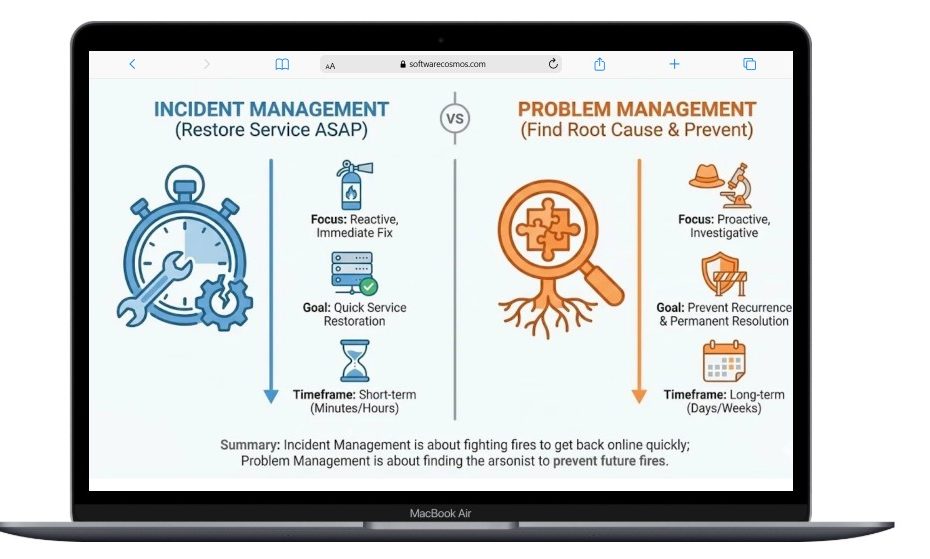
Think of it this way: incident management is like putting out fires, while problem management is like figuring out why fires keep starting in the first place. Both matter, but they require different approaches, tools, and mindsets. Let’s explore how these processes can transform your IT operations from reactive chaos to proactive stability.
What Is Incident Management?
Incident management is the process of restoring normal service operation as quickly as possible after a disruption occurs. When your users can’t access email, when your website crashes, or when your software throws errors, that’s when incident management kicks into action.
The primary goal here is speed. We’re not trying to understand why something broke. We’re trying to fix it fast so people can get back to work. Time matters more than anything else during an incident. Every minute of downtime costs money, frustrates customers, and damages your reputation.
How Incident Management Works in Practice
When someone reports an issue, it enters your incident management system. Your service desk team logs the incident, categorizes it, and assigns a priority based on how many people it affects and how badly it disrupts business operations. A company-wide email outage gets higher priority than one person’s printer problem.
The team then works to restore service using whatever method works fastest. Sometimes that means applying a workaround rather than a permanent fix. If resetting a server gets everyone back online in five minutes, you do that. You can figure out why it crashed later.
- Incident detection: Users report issues or monitoring systems automatically detect problems
- Incident logging: Every incident gets recorded with details about what went wrong and who reported it
- Categorization and prioritization: Teams classify incidents by type and urgency to ensure critical issues get immediate attention
- Diagnosis and investigation: Technical teams identify what’s causing the service disruption
- Resolution and recovery: Teams restore normal service operations through fixes or workarounds
- Incident closure: After verifying the fix works, teams close the incident and document what happened
Major incidents require special handling. When your entire e-commerce platform goes down during a holiday sale, you can’t follow normal procedures. You need emergency response protocols, immediate escalation to senior staff, and constant communication with affected stakeholders. Organizations dealing with online sales should review their incident management for ecommerce processes carefully.
Real-World Example of Incident Management
Remember the Cloudflare outage that broke X and ChatGPT? That’s a perfect example of incident management in action. When services went down, Cloudflare’s incident response teams jumped into action immediately. They didn’t spend hours analyzing root causes. They worked to restore service first, asking questions later.
The same thing happens with AWS cloud service outages. When Amazon’s cloud infrastructure experiences problems, their incident management teams focus on getting services back online. They communicate status updates to customers, implement failover procedures, and restore operations as quickly as possible.
Key Metrics for Incident Management
We measure incident management success through specific metrics. Mean Time to Detect (MTTD) tells us how quickly we notice problems. Mean Time to Respond (MTTR) shows how fast we start working on them. Mean Time to Resolve (MTTR – yes, same acronym, different meaning) indicates how long fixes take.
These numbers matter because they directly impact user experience and business operations. If your average resolution time is four hours but your service level agreement promises one-hour response, you’ve got a problem. Tracking these metrics helps teams improve their response capabilities over time.
Organizations should also consider implementing automated patch management processes to reduce incident frequency and maintain system health proactively.
What Is Problem Management?
Problem management is the process of identifying and addressing the root causes of incidents to prevent them from happening again. While incident management puts out fires, problem management asks why fires keep starting and fixes the underlying issues.
The goal here is prevention. We want to reduce the total number of incidents by eliminating their causes. One properly solved problem can prevent hundreds of future incidents. That’s where the real value comes from.
How Problem Management Works
Problem management typically starts after you’ve resolved an incident. Your team notices a pattern. The same type of incident keeps occurring. Maybe your database server crashes every time usage spikes. Maybe a specific software module throws errors under certain conditions.
This triggers a problem investigation. Unlike incident management’s rush to restore service, problem management takes a methodical approach. Teams conduct root cause analysis using techniques like the “5 Whys,” fishbone diagrams, or fault tree analysis. They dig deep to understand not just what failed, but why it failed.
- Problem detection: Teams identify recurring incidents or patterns that suggest underlying issues
- Problem logging: Each problem gets documented separately from individual incidents
- Investigation and diagnosis: Technical experts conduct thorough root cause analysis
- Known error database: Teams document problems and their workarounds before permanent fixes are available
- Resolution: Permanent fixes get developed, tested, and implemented through change management
- Problem closure: After verifying the solution works, teams close the problem record
Sometimes teams discover a problem but can’t fix it immediately. Maybe the fix requires expensive hardware upgrades. Maybe it needs software changes that take months to develop. In these cases, the problem gets documented in a “known error database” along with workarounds. This helps incident management teams resolve future occurrences faster while waiting for the permanent solution.
Proactive vs. Reactive Problem Management
Problem management comes in two flavors. Reactive problem management responds to incidents that have already happened. Your monitoring system crashed three times this month. That pattern triggers a problem investigation to prevent a fourth crash.
Proactive problem management looks for issues before they cause incidents. Teams analyze trends in monitoring data, review system logs, conduct security assessments, and identify weak points in infrastructure. Organizations should conduct regular network security audits and create comprehensive network security assessment checklists to catch problems early.
This proactive approach pays huge dividends. Finding and fixing a potential problem costs far less than dealing with the incidents it would cause. It’s like maintaining your car regularly instead of waiting for it to break down on the highway.
Real-World Example of Problem Management
Consider ransomware attacks. An organization might experience multiple ransomware incidents targeting different systems. Incident management handles each attack individually, restoring encrypted data from backups and removing malware.
But problem management asks bigger questions. Why do we keep getting hit? How are attackers getting in? The investigation might reveal that phishing emails are the entry point. The permanent solution involves implementing better email filtering, conducting security awareness training, deploying multi-factor authentication, and reviewing how companies can stop ransomware attacks.
Organizations should also understand how to protect backup data from ransomware attacks to ensure recovery options remain available. Implementing proper data encryption and understanding tokenization vs encryption differences also helps prevent security incidents.

What Are the Key Differences Between Incident and Problem Management?
The main difference is that incident management focuses on quick service restoration while problem management focuses on preventing future incidents by addressing root causes. But several other important distinctions separate these two processes.
Time Horizon and Urgency
Incident management operates on urgent timelines. Minutes and hours matter. Your team needs to restore service now. Users are waiting. Business operations are disrupted. The pressure is intense and immediate.
Problem management works on longer timelines. Days, weeks, or even months might pass during a thorough root cause investigation. There’s no immediate urgency because service has already been restored. The focus shifts from speed to thoroughness.
Goals and Success Criteria
We measure incident management success by how quickly we restore service. Did we meet our service level agreements? How long were users affected? How many people experienced disruptions? These metrics focus on minimizing impact.
Problem management success looks different. We count how many incidents we prevented. Did that server stop crashing after we implemented the fix? Are users reporting fewer login issues? The goal is reducing incident volume over time.
Team Composition and Skills
Incident management teams need excellent troubleshooting skills, good communication abilities, and the capacity to work under pressure. They’re often frontline support staff who excel at quick thinking and rapid response. Understanding what DDoS attacks are and what server unreachable means helps these teams diagnose issues faster.
Problem management teams require deeper technical expertise, analytical thinking, and patience for methodical investigation. These are often senior engineers or specialists who can conduct complex analysis and develop permanent solutions. They might use AI for penetration testing or leverage free penetration testing tools during investigations.
Documentation Requirements
Incident records capture what happened, when it happened, who was affected, and how it was fixed. The documentation focuses on immediate actions taken during the emergency. It’s often brief because speed matters more than detail during active incidents.
Problem records require extensive documentation. Teams document investigation steps, analysis results, root cause findings, solution options considered, and implementation details. This thorough documentation helps others understand complex issues and prevents knowledge loss when team members leave.
Process Triggers
Incidents get triggered by service disruptions. Someone reports a problem, or monitoring systems detect an issue. The trigger is external and reactive.
Problems get triggered by patterns, trends, or proactive analysis. Multiple related incidents might reveal an underlying problem. Trend analysis might predict a future issue. Security assessments might uncover vulnerabilities. The trigger can be either reactive (responding to incident patterns) or proactive (anticipating future issues).
Relationship to Other ITSM Processes
Incident management connects closely to service desk operations, monitoring and event management, and service level management. It’s often the first point of contact when things go wrong. Organizations should ensure their teams understand how important cybersecurity is for small businesses to properly assess incident severity.
Problem management integrates with change management, knowledge management, and availability management. Fixing root causes often requires changes to systems, which must go through proper change control processes. Understanding frameworks like the NIST Cybersecurity Framework helps organizations implement comprehensive problem management programs.
How Do Incident Management and Problem Management Work Together?
Incident management and problem management form a continuous improvement cycle where incidents reveal problems, and solving problems reduces future incidents. They’re two sides of the same coin, each making the other more effective.
The Feedback Loop
Here’s how it works in practice. Your incident management team resolves the same type of issue three times in one week. They recognize this pattern and create a problem record. This hands off the investigation to your problem management team.
Problem management investigates the root cause. They discover a configuration error that creates the issue under specific conditions. They develop a permanent fix and submit a change request to implement it. After the change is approved and deployed, those incidents stop occurring.
Meanwhile, incident management teams benefit from problem management’s work. The known error database provides documented workarounds that speed up incident resolution. When similar incidents occur before the permanent fix is ready, responders know exactly what to do.
Communication and Collaboration
These processes require constant communication between teams. Incident responders need to recognize when they’re seeing patterns that warrant problem investigation. Problem investigators need to understand operational constraints that affect when and how fixes can be deployed.
Regular meetings help maintain this connection. Many organizations hold problem review boards where teams discuss recurring incidents, evaluate problem investigations, and prioritize which root causes to tackle first. This collaboration ensures resources get allocated effectively.
Using Technology to Bridge the Gap
Modern ITSM tools help connect incident and problem management. They can automatically detect incident patterns and suggest problem records. They link related incidents to problems so everyone can see the big picture. They track metrics across both processes to show how problem resolution reduces incident volume.
- Automated pattern detection: Systems identify recurring incidents that might indicate underlying problems
- Linked records: Incidents connect to their parent problems for complete visibility
- Shared knowledge bases: Solutions from problem management help incident teams resolve issues faster
- Integrated metrics: Dashboards show how problem fixes reduce incident counts over time
- Workflow automation: Systems route information between teams without manual handoffs
Organizations implementing comprehensive security frameworks should also understand vulnerability management and attack surface management to reduce security-related incidents and problems.
Real-World Integration Example
Let’s say your organization experiences frequent AWS S3 bucket access issues. Incident management teams resolve each occurrence by adjusting permissions or restarting services. But the issues keep happening.
Problem management investigates and discovers that developers are misconfiguring bucket policies because the documentation is outdated. The permanent solution involves updating documentation, providing developer training, implementing automated policy validation, and possibly migrating to AWS S3 alternatives that better fit your use case.
Once implemented, these changes eliminate the configuration mistakes that caused incidents. Incident management benefits because they stop receiving those tickets. Problem management benefits because they can focus on other recurring issues. Everyone wins.
What Are Common Challenges in Managing Both Processes?
Organizations struggle to balance the urgent nature of incident management with the strategic importance of problem management. When fires are burning, it’s hard to think about fire prevention. But without prevention, you’ll never stop fighting fires.
Resource Allocation Conflicts
Most IT teams are already stretched thin. When an urgent incident occurs, everyone drops what they’re doing to help. This reactive mode becomes addictive. It feels productive because you’re constantly busy solving visible problems.
But this leaves no time for problem management. Root cause investigations get postponed. Permanent fixes never get implemented. The same incidents keep recurring because nobody has time to prevent them. It’s a vicious cycle that many organizations struggle to break.
The solution requires leadership commitment. Organizations must dedicate specific resources to problem management, even when incident queues are full. Some companies assign dedicated problem managers. Others rotate senior engineers through problem investigation duties. The key is protecting problem management time from incident management demands.
Cultural Resistance
Many IT professionals prefer incident management’s immediate gratification. You can see your impact right away. Users thank you for fixing their problems. Managers praise your quick response times. It feels good.
Problem management offers delayed gratification. You might work for weeks on an investigation that prevents future incidents. But those prevented incidents are invisible. Nobody thanks you for problems that never happened. It’s harder to demonstrate value, even though the long-term impact is much greater.
Changing this culture requires visibility into problem management’s benefits. Track and publicize metrics that show how problem fixes reduce incident volumes. Recognize team members who complete thorough root cause investigations. Celebrate when chronic issues finally stop occurring.
Measuring Success Appropriately
Many organizations measure IT team performance primarily through incident metrics. How many tickets did you close? What’s your average resolution time? These metrics inadvertently discourage problem management because time spent investigating root causes looks like reduced productivity.
Better measurement systems track both processes. Yes, monitor incident response metrics. But also track the number of problems resolved, the reduction in recurring incidents, and the overall trend in incident volume. Show how problem management investments pay off over time.
Organizations should also implement proper security testing in software development to catch issues before they reach production, reducing both incidents and problems.
Technology Integration Issues
Some organizations use separate tools for incident and problem management. This creates information silos where incident teams can’t easily see related problems, and problem teams struggle to identify incident patterns. Integration challenges make both processes less effective.
The solution involves either consolidating on integrated ITSM platforms or implementing proper integration between existing tools. Teams need visibility across both processes to work effectively. Understanding different types of storage management systems and data storage types helps organizations choose technologies that support both processes well.
Lack of Management Support
Perhaps the biggest challenge is securing management buy-in for problem management. Leaders under pressure to reduce costs often see problem management as a luxury. They ask why engineers are spending days investigating issues instead of closing tickets.
Educating management requires demonstrating problem management’s return on investment. Calculate the cost of recurring incidents. Show how much time incident teams waste repeatedly fixing the same issues. Estimate the business impact of chronic reliability problems. Present problem management as a cost-reduction strategy, not an optional extra.
How Can Organizations Improve Both Processes?
Organizations improve incident and problem management by implementing clear processes, investing in proper tools, training teams effectively, and fostering a culture of continuous improvement. Success requires commitment across the organization, not just within IT.
Start with Clear Process Documentation
Many organizations have informal incident and problem management processes that exist only in people’s heads. This creates inconsistency and makes it hard to improve. Start by documenting exactly how each process should work.
Your incident management process should define escalation paths, priority classifications, communication protocols, and resolution procedures. Your problem management process should outline when to create problem records, who conducts investigations, what analysis techniques to use, and how to track solutions.
These documents shouldn’t gather dust in a policy manual. They should be living guides that teams actually reference. Keep them updated as processes evolve. Make them easily accessible to everyone who needs them.
Invest in Training and Development
Both processes require specific skills. Incident management needs strong troubleshooting abilities, good communication skills, and grace under pressure. Problem management needs analytical thinking, root cause analysis expertise, and patience for thorough investigation.
Don’t assume people naturally have these skills. Provide training on incident response procedures, problem analysis techniques, and relevant tools. Send team members to external training programs. Encourage certifications like ITIL that cover these processes formally.
Cross-training also helps. Let incident responders shadow problem investigations to understand how their work feeds into long-term improvements. Let problem managers work some incident shifts to appreciate operational pressures. This builds empathy and improves collaboration.
Implement the Right Technology
Good tools make both processes easier. Look for ITSM platforms that integrate incident and problem management, automatically detect patterns, provide workflow automation, and offer comprehensive reporting. Understanding what open source software is versus proprietary software helps in tool selection.
Consider AI and machine learning for incident management improvements. Modern systems can predict incidents before they occur, suggest solutions based on past resolutions, and automatically categorize incoming tickets.
For security-related incidents and problems, implement proper monitoring and detection tools. Understanding vulnerability assessment vs vulnerability management differences helps organizations build comprehensive security programs.
Create Feedback Mechanisms
Regular reviews keep both processes improving. Hold weekly incident reviews where teams discuss major incidents and identify potential problems. Conduct monthly problem reviews where teams evaluate investigation progress and prioritize upcoming work.
Collect feedback from users about incident response quality. Survey technical teams about process effectiveness. Use this input to refine procedures, adjust priorities, and improve service delivery.
Build a Prevention-Focused Culture
The ultimate goal is shifting from reactive to proactive operations. This requires cultural change that values prevention as much as response. Celebrate when chronic problems get solved. Recognize teams that implement permanent fixes. Share success stories about how problem management improved service quality.
- Reward prevention: Recognize teams and individuals who solve root causes and prevent recurring issues
- Share success stories: Publicize examples of how problem management improved operations
- Measure prevention metrics: Track incident reduction rates and highlight improvements
- Allocate protected time: Ensure problem management work doesn’t get perpetually postponed for incident response
- Educate stakeholders: Help business leaders understand the value of addressing root causes
Organizations should also implement frameworks like the NIST Cybersecurity Framework to provide structure for both incident response and proactive problem prevention across security operations.
Frequently Asked Questions
Can we do problem management without proper incident management?
No, effective problem management requires good incident management data. Problem investigations start by analyzing incident patterns and trends. Without accurate incident records, you can’t identify which problems to investigate or measure whether your solutions work. Organizations need solid incident management as the foundation before building problem management capabilities. Start by getting incident management right, then expand into problem management.
How long should problem investigations take?
Problem investigation timeframes vary widely based on complexity. Simple problems might get resolved in a few days. Complex issues involving multiple systems, vendors, or organizational factors might take weeks or months. The key is maintaining regular progress rather than setting arbitrary deadlines. Teams should provide periodic updates on investigation status, share preliminary findings, and adjust timelines as they learn more about the issue.
Who should manage the problem management process?
Problem management typically falls to senior technical staff who have deep system knowledge and analytical skills. Some organizations designate a dedicated problem manager who coordinates investigations across different teams. Others distribute problem management responsibilities among senior engineers in various technical areas. The important factor is ensuring problem managers have sufficient authority, time, and resources to conduct thorough investigations and implement permanent solutions.
Should we create a problem record for every incident?
No, only recurring incidents or major one-time incidents warrant problem records. Creating problems for every incident would overwhelm your team with unnecessary work. Look for patterns where the same type of incident occurs multiple times. Also create problem records for significant one-time incidents where understanding the root cause could prevent future major disruptions. Focus problem management efforts where they’ll deliver the most value.
How do we balance incident response urgency with problem investigation thoroughness?
Organizations handle this by clearly separating the two processes. When an incident occurs, focus entirely on restoration first. Get service working again using whatever method is fastest, even if it’s just a temporary workaround. Only after service is restored should you shift to problem investigation mode. This separation ensures incidents get quick attention while problems receive the thorough analysis they require. Understanding differences between vulnerability management and vulnerability assessment helps teams apply appropriate urgency to different activities.
What metrics should we track for problem management?
Track the number of problems identified and resolved, the time to resolve problems, the number of incidents prevented by problem solutions, and the overall trend in incident volume. Also measure problem backlog size and age to ensure investigations don’t stall indefinitely. These metrics show whether problem management is delivering value through reduced incident frequency and improved service reliability.
Can small organizations implement both processes effectively?
Yes, but small organizations need to scale the processes appropriately. You don’t need separate teams for incident and problem management. The same people can handle both roles, just at different times. Small organizations should start with simple implementations focusing on the most impactful recurring issues. As the organization grows and processes mature, you can add more sophistication. The principles apply regardless of organization size, even though implementation details differ.
Conclusion
Incident management and problem management work together to create reliable IT operations. Incident management keeps your services running when things go wrong. Problem management ensures things go wrong less often. You need both to succeed.
We’ve seen how incident management focuses on speed and restoration while problem management emphasizes prevention and root cause elimination. We’ve explored how these processes connect through feedback loops where incidents reveal problems and solved problems reduce incidents. We’ve discussed common challenges like resource constraints and cultural resistance that make balancing both processes difficult.
The path forward starts with recognizing that you can’t choose between these processes. Organizations that only do incident management fight the same fires repeatedly. Those that ignore incident management while pursuing problem prevention frustrate users with slow response times. Success requires both, working together in balance.
Start by assessing your current state honestly. Are you stuck in reactive mode, constantly fighting incidents with no time for prevention? Or have you focused so much on analysis that your incident response suffers? Most organizations lean too heavily toward incident management because it feels more urgent.
Make problem management a priority, not an afterthought. Dedicate resources, even when incident queues are full. Track and publicize how problem solutions reduce incident volumes. Celebrate prevention as much as response. Build a culture that values both fixing things when they break and keeping them from breaking in the first place.
Your users will notice the difference. Fewer disruptions mean they can focus on their work instead of calling the help desk. Your team will feel less stressed as chronic issues finally get resolved. Your organization will save money by preventing expensive outages instead of constantly recovering from them.
Take action today. Review your incident data for recurring patterns. Pick one chronic problem and commit to solving it permanently. Document your problem management process. Train your team on root cause analysis techniques. Start building the capability to prevent tomorrow’s incidents instead of just fixing today’s.
The investment pays off quickly. Organizations with mature incident and problem management processes experience fewer outages, faster resolutions when issues do occur, and significantly lower IT operational costs. They also build more resilient systems that support business growth instead of holding it back. Understanding how to handle sensitive information and implementing proper data protection practices further reduces security incidents and problems.
Your journey toward better IT operations starts with understanding these two essential processes. Now that you know the differences, you can implement both effectively and watch your service reliability improve.
You May Also Like
 Web Development
What Is API Rate Limiting? (A Practical, Simple Guide for Safer, Faster APIs)
 Web Development
REST API vs SOAP API: Differences, Pros & Cons, and Use Cases
 Cybersecurity
What Is Zero Trust Network Access (ZTNA)? How It Works, How It Differs From a VPN, and When to Use It
 Cybersecurity
What Is Netskope? Cloud Security, SASE, and Zero Trust Explained
 Cybersecurity
Is Fanatical Legit and Safe? My Honest Take on Buying Game Keys
 Data Security & Privacy
Is Gameflip Legit and Safe for Gift Cards? What Buyers Should Know
 Data Security & Privacy
Is Eldorado.gg Legit and Safe in 2026? My Investigation and What Buyers Should Know
 Web Development
Supabase vs Firebase: Which Backend Platform is Right for Your Project?
 VPN & Proxy