

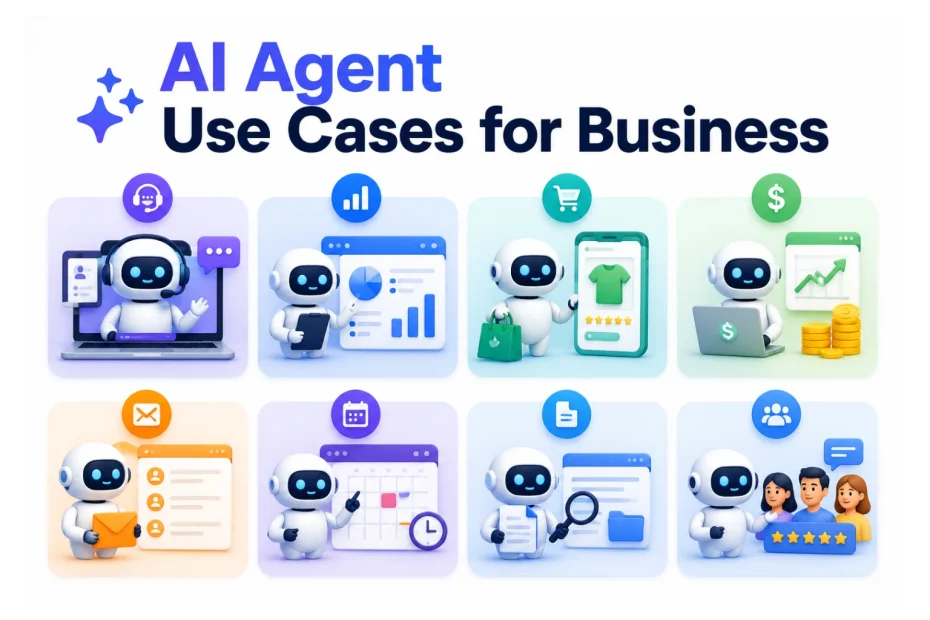
The conversation around AI agents has reached a strange point. Every software vendor claims to have one. Every consultant has a framework for deploying them. Every week brings another announcement that sounds revolutionary and turns out, on closer inspection, to be a chatbot with better marketing. Beneath all of that noise, though, something real is happening. Businesses that started taking agents seriously eighteen months ago are now reporting results that are difficult to dismiss, and the patterns of what works and what doesn’t are finally becoming clear.
This article is a grounded look at where AI agents are creating genuine value for businesses right now. Not the hype version. Not the dystopian version. The practical version, with concrete examples, honest assessment of limitations, and the kind of numbers that help you decide where to spend your time and budget.
What an AI Agent Actually Is
The word “agent” has been stretched so far it has almost lost meaning. Before going any further, it helps to be precise about what we’re talking about.
An AI agent is a system that can:
- Take a goal expressed in plain language
- Plan a sequence of steps to accomplish that goal
- Use tools, APIs, or software to actually execute those steps
- Observe whether each step worked
- Adjust and try again when something fails
That last point is the real test. A chatbot answers questions. An agent gets things done across multiple steps, including recovering from its own mistakes. If a system needs a human to step in every time something unexpected happens, it isn’t really an agent. It’s automation dressed up in better language.
This distinction matters because it shapes where agents create value. They thrive in workflows that used to require a human to connect a series of small judgments. Pulling data from one place, comparing it against something in another, deciding what to do next, and executing. That middle ground is exactly where most business work actually lives.
Customer Support: The Most Mature Use Case
If you only deploy one type of agent this year, make it a support agent. This is the area where the technology has matured fastest and where results are most consistent across industries.
Modern support agents are a different species from the rigid decision-tree bots that frustrated everyone five years ago. A properly configured agent can read a customer’s message, pull their order or account history, check inventory or service status, issue refunds or adjustments, update the CRM, and send a confirmation, all in seconds and all with appropriate brand voice.
The well-known example is Klarna, which publicly disclosed that its AI assistant was handling work equivalent to roughly 700 full-time agents, with comparable customer satisfaction and faster resolution times. Whether you trust the framing entirely or not, the underlying point is hard to argue with. A meaningful portion of support volume is repetitive enough that an agent with proper system access can close tickets end-to-end.
From what operators in the space are reporting consistently:
- Around 55% to 75% of total ticket volume can be deflected in the first year of a serious deployment
- First-response times drop from hours to seconds for the deflected tickets
- Labor cost per ticket often falls by 50% to 65%
- Customer satisfaction tends to hold steady or improve slightly, which surprises people who expect a tradeoff
That last finding is worth pausing on. Customers care more about getting their problem solved quickly and accurately than about whether a human solved it. The deployments that fail on satisfaction are almost always the ones where the agent was given a task without the system access to actually complete it, so it ends up promising things it can’t deliver. The deployments that succeed give the agent real authority to act, and a clean handoff path for anything emotional or complex.
The deeper effect on the support organization is the part most people miss. Companies that do this well don’t fire their support teams. They redeploy them onto higher-value work. Retention conversations. Complex escalations. Feedback loops with product. The agent handles the volume, the humans handle the moments that move the business forward. That redistribution is where the durable value lives, not in raw headcount reduction.
Sales Operations: The Hidden Hours Add Up Fast
Sales is the second area where agents are clearly earning their place, though the value shows up in less visible ways than in support.
Most studies of how sales reps actually spend their time land in the same range. Somewhere between 28% and 35% of the workday goes to selling. The rest disappears into CRM updates, follow-up drafting, calendar coordination, prospect research, and the relentless administrative drag of modern sales work. Agents are remarkably good at absorbing that overhead.
A useful way to think about it is in three layers:
- Research agents build pre-meeting briefs by pulling from LinkedIn, the prospect’s website, recent news, and prior conversation history. What used to be a 30-minute scramble before each call becomes a one-page brief waiting in the rep’s inbox.
- Follow-up agents listen to call recordings (using Gong, Chorus, or similar), extract commitments and action items, draft the follow-up email in the rep’s voice, and queue it for one-click approval.
- Pipeline hygiene agents flag stale deals, missing fields, and forecasting inconsistencies before every pipeline review, so the conversation focuses on strategy rather than data cleanup.
When I worked with a mid-market SaaS team to layer these three agents into their workflow, the change wasn’t that the reps got better at selling. It was that they finally had time to sell. Selling hours per rep rose meaningfully. CRM data quality improved because the agent maintained it rather than the rep. Deal velocity picked up because follow-ups went out within hours instead of days.
Companies running these setups successfully share a pattern. They didn’t try to automate selling itself. They automated the connective tissue around selling and let humans focus on the conversations that actually move deals.
Marketing Operations: Quality Over Volume
Marketing is the use case where I see the most damage being done with agents, and also the most potential when done right.
The temptation is to use agents to produce more, faster, cheaper. More blog posts. More social content. More emails. The internet is already drowning in this kind of generic AI output, audiences have developed a sixth sense for it, and search engines are starting to penalize it. The race to publish more is a race to the bottom.
The agencies and brands getting real value from marketing agents are using them differently. They use agents to remove operational drag, not to replace creative judgment. A few applications that work consistently:
- Content auditing. An agent crawls a site, identifies broken links, outdated statistics, thin pages, and missed conversion opportunities, and produces a prioritized list. A multi-day manual audit becomes a couple of hours of human review on agent-generated findings.
- Cross-channel reporting. Pulling numbers from Google Analytics, Meta Ads, LinkedIn, HubSpot, and Shopify into a coherent weekly view used to consume an analyst’s entire Monday. An agent now produces the draft in minutes, and the human focuses on interpretation and recommendations.
- Brief generation. An agent turns a strategic direction into a structured creative brief, pulling relevant brand guidelines, past campaign learnings, and competitor references. Briefs stop getting written at 11 pm by exhausted strategists, and the quality of the eventual creative work improves visibly.
- Repurposing. A single piece of pillar content becomes adaptations for newsletter, social, and video formats, with a human editor making sure the voice stays consistent across surfaces.
The agencies pulling ahead in this market aren’t the ones publishing 40 AI-written articles a month. They’re the ones using agents to give their creative people the time and headspace to think.
Internal Knowledge: The Productivity Tax Nobody Mentions
Every company of meaningful size has the same problem. Information is scattered across Notion, Slack, Google Drive, Confluence, email threads, project management tools, and the brains of three specific people who happen to be on vacation. Finding the right internal answer can take longer than doing the underlying work.
Knowledge agents address this directly. Connected to a company’s internal corpus with proper permissions and access controls, they let an employee ask plain-language questions and get answers with citations to the source documents. Where is the current parental leave policy. How did we handle a similar client situation last year. Which contract template applies to enterprise deals in Germany.
The productivity gain shows up in ways that are hard to put on a P&L but easy to feel:
- New hire ramp time compresses noticeably because the answer to “where do I find X” is always one question away
- Senior people stop being interrupted by questions they’ve already answered five times
- Decisions get made with better information because the relevant context is actually reachable
- Slack messages asking “does anyone know where the X doc is” decline sharply
For knowledge-heavy businesses, especially agencies, consultancies, and professional services firms, this single use case can justify the entire investment in agent infrastructure.
Finance and the Back Office: Quietly Valuable
The back office is where agents are doing some of their least glamorous and most economically meaningful work. Invoice processing, expense review, vendor onboarding, contract review, reconciliation. These workflows have resisted automation for decades because they involve too much judgment for rigid rule-based systems and too much structure for pure language models. Agents fit neatly into the middle ground.
A finance agent can ingest an invoice in any format, including the PDF scans from vendors still operating like it’s 2004. It can match the invoice against a purchase order and goods receipt, flag discrepancies with specific explanations, route for approval based on amount and department, and post directly to the ERP. The result is faster processing, lower error rates, and fewer late payment penalties because invoices stop getting lost.
A few things to keep in mind for businesses considering this:
- The ROI is unambiguous when the existing process is largely manual
- Implementation risk is lower than in customer-facing use cases because mistakes are caught internally before they reach a customer
- Lean finance teams running SaaS companies, agencies, and small operations often see the strongest relative gains, because they were stretched thin to begin with
I tested a finance-agent setup with a small operations team that had been spending an absurd portion of their week chasing invoice exceptions. After a few weeks of tuning, the exception rate dropped to roughly a fifth of what it had been, and the team redirected that time toward financial analysis they had been postponing for months. That kind of redirection is the real prize, not the headcount math.
Software Development: The Shift That’s Reshaping Engineering
I want to be careful with this section because the discourse around AI in software development has gone in two equally wrong directions. Either every developer is being replaced tomorrow, or none of it actually works. Reality sits between these poles.
What is clearly true, based on what engineering leaders across the SaaS world are reporting, is that a competent developer working with current-generation coding agents is producing meaningfully more output than the same developer was producing eighteen months ago. The gains are uneven though, and the pattern matters:
- Boilerplate, scaffolding, and CRUD work see massive acceleration
- Bug fixing in well-tested codebases roughly doubles in speed
- Greenfield feature development in clean code accelerates noticeably
- Complex architectural work, debugging mysterious production issues, or wading through legacy spaghetti shows minimal improvement, and occasionally goes slower
The teams getting the biggest gains have invested in the unglamorous foundations. Good test coverage. Clear documentation. Sensible code organization. Agents amplify whatever environment you put them in. Healthy environments accelerate. Messy ones generate more mess, faster.
For SaaS founders specifically, this is the most important shift to internalize. A small engineering team augmented with capable coding agents can credibly ship what a much larger team shipped two or three years ago. The unit economics of building software at small scale have genuinely changed, and that changes who can plausibly compete with whom.
Where AI Agents Still Fail
The honest assessment requires acknowledging the failures, because they tend to repeat across companies that rush into deployment.
Agents struggle with:
- Ambiguous goals. If you cannot articulate what success looks like, the agent will produce something plausible that misses the point.
- Workflows requiring deep cultural context. The unwritten rules about how things get done in a specific organization rarely live in any document the agent can read.
- High-stakes work where a small error rate is catastrophic. Certain medical, legal, and financial workflows fall here.
- Emotionally loaded situations. Layoffs, serious complaints, sensitive HR matters. These need humans.
The companies that fail with agents almost always make one of two mistakes. They deploy in places where the failure cost is too high, or they treat the agent as a substitute for thinking rather than a tool for executing decisions someone has already thought through.
How to Decide Where to Start
If you run a business and you’re trying to identify where to make your first serious agent investment, a few principles help.
Start with a workflow you understand deeply. Not the one that sounds most exciting at a leadership offsite, but the one where you can describe in detail what needs to happen, what good looks like, and what failure looks like. Customer support, sales operations, and internal knowledge tend to be the highest-confidence starting points for most businesses. Marketing and engineering offer higher ceilings but require more organizational sophistication to implement well.
Budget realistically. The software itself is rarely the expensive part. Integration work, data cleanup, change management, and iteration over the first few months are where the real cost lives. In most deployments, software costs run 15% to 25% of total first-year investment. The rest is implementation.
Accept that the first version will underperform expectations. Every serious deployment requires several rounds of refinement before it hits the numbers people projected at the start. The teams that succeed treat this as a capability they’re building rather than a quick efficiency play.
The companies that will look meaningfully different three years from now are not the ones using AI to do the same things slightly faster. They are the ones rebuilding how work gets done around what agents are genuinely good at, while preserving the human judgment that still matters more than any model. That balance, more than any specific tool or vendor, separates the businesses extracting real value from the ones still chasing demos.
You May Also Like
 SaaS
SaaSWhy Cloud CRM Has Quietly Become the Backbone of Modern Customer Support
 SaaS
SaaSWhat Is No-Code Automation? How It Works, Benefits, and Risks
 Cloud Computing
8 Best AWS S3 Alternatives Compared: Pricing, Egress, and S3 Compatibility
 SaaS
SaaSWhat is Confluence Used For In Project Management?
 Web Scraping
TinyFish.ai Review: Is It the Best AI Agent for Web Scraping
 AI Technology
ChatGPT API Alternatives: 13 AI APIs and Platforms for Developers
 SaaS
SaaSCognito Forms to Jira Software Cloud Integration: Setup, Automation, Field Mapping, and Best Practices
 Web Development
Building Apps with Lovable and Supabase: A Step-by-Step Guide
 Web Development