

The first time a prospect asks for your SOC 2 report, something shifts. What used to be a vague “we should probably look into that” suddenly becomes a deal-blocking question on a procurement checklist. I’ve watched founders go from blissfully ignoring compliance to frantically Slacking their CTO at 11 p.m. — all because a mid-market customer wouldn’t sign without seeing a Type 2 attestation.
That moment is happening earlier and earlier in a company’s lifecycle. Enterprise buyers, insurance underwriters, and even Series A investors now treat SOC 2 as table stakes. And the teams asked to deliver it are usually small, overworked, and not particularly excited about screenshotting AWS console pages for three months straight.
This is the gap SOC 2 compliance software has quietly filled over the last five years. Let’s get into what it actually does, where it helps, where it doesn’t, and how to pick the right one without falling for the marketing.
Why SOC 2 Is So Painful Without the Right Tooling
If you’ve never been through a SOC 2 audit, the difficulty isn’t really the standard itself — it’s the operational drag of proving compliance day after day.
A few realities most teams underestimate:
- Evidence gathering is relentless. Auditors don’t want a single screenshot. They want consistent, dated, repeatable proof that a control worked across a window of time — often 6 to 12 months.
- Spreadsheets collapse around month four. I’ve seen companies maintain a 47-tab Google Sheet tracking controls, owners, evidence links, and status. By the second audit, nobody can find anything.
- Re-audits never really end. SOC 2 isn’t a one-time certification. You’ll do it next year. And the year after.
- Monitoring needs to be continuous. A control that was working in February but broke in May is still a finding.
- Startups are resource-constrained. Most companies pursuing SOC 2 don’t have a dedicated GRC team. They have a CTO who already wears five hats.
The honest read: SOC 2 isn’t intellectually hard. It’s logistically brutal. And that’s exactly the problem compliance automation tools were built to solve.
What Is SOC 2 Compliance Software?
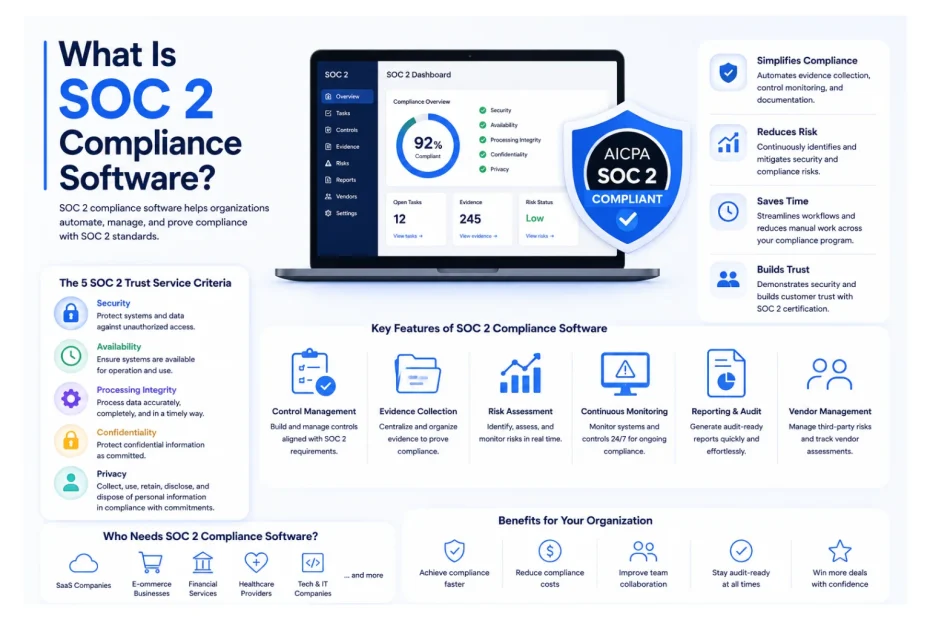
SOC 2 compliance software is a platform that automates the heavy lifting of preparing for and maintaining a SOC 2 audit — collecting evidence, monitoring controls, managing policies, tracking risks, and producing the documentation auditors need.
Think of it as the operating layer that sits between your cloud stack (AWS, Okta, GitHub, Jira, HRIS systems) and your auditor. Instead of manually exporting access logs every quarter, the software connects to your tools via API, pulls the evidence on a schedule, and flags anything that drifts out of compliance.
It’s sometimes called SOC 2 audit software, compliance automation software, or more broadly GRC software (Governance, Risk, and Compliance). The category overlaps with cybersecurity compliance software and security posture management, but SOC 2-focused platforms are usually optimized for the specific cadence of Trust Services Criteria audits.
What Is SOC 2, and Why Does It Actually Matter?
Quick refresher, in plain English.
SOC 2 — short for Service Organization Control 2 — is an auditing framework developed by the AICPA. It’s designed for service providers (especially SaaS companies) that store, process, or transmit customer data. Unlike ISO 27001, which is internationally recognized and certificate-based, SOC 2 produces an attestation report from a licensed CPA firm.
The Five Trust Services Criteria
Companies choose which criteria they want their report to cover. Security is mandatory. The rest are optional, depending on what your customers care about.
| Criterion | What It Covers |
|---|---|
| Security | Protection against unauthorized access, breaches, and misuse |
| Availability | System uptime, resilience, disaster recovery |
| Confidentiality | Protecting sensitive business data (contracts, IP, NDAs) |
| Processing Integrity | Whether your system does what it claims, accurately and on time |
| Privacy | Handling of personal information (PII) per stated commitments |
Most early-stage SaaS companies start with Security only and add Availability or Confidentiality when customers ask.
Type 1 vs Type 2 — The Difference That Trips Everyone Up
- SOC 2 Type 1 is a snapshot. It confirms your controls are designed correctly at a single point in time. Faster to get, less rigorous.
- SOC 2 Type 2 is a movie. It confirms your controls actually operated effectively over a period — typically 3 to 12 months.
Type 1 might unlock smaller deals. Type 2 is what enterprise procurement teams really want. Most companies go Type 1 first to show momentum, then roll into a Type 2 observation window.
How SOC 2 Compliance Software Actually Works
Strip away the marketing and there are essentially six things these platforms do:
1. Integrations with your stack. The software connects via API to AWS, GCP, Azure, Okta, Google Workspace, GitHub, Jira, HRIS tools like Rippling or BambooHR, endpoint managers, and dozens more. Every integration becomes a sensor.
2. Automated evidence collection. Instead of a human screenshotting MFA settings, the platform queries Okta’s API on a recurring schedule and stores the result with a timestamp. That timestamped record is the audit evidence.
3. Continuous control monitoring. Each Trust Services Criteria control maps to one or more technical or process checks. If an engineer disables MFA on a production account, the platform flags it within hours — not at year-end.
4. Policy management. Most platforms ship with starter templates for the ~20 policies SOC 2 expects (Information Security Policy, Incident Response, Access Control, etc.). Employees acknowledge them digitally; the system tracks who signed what and when.
5. Risk and vendor management. You’ll be asked to maintain a risk register and document third-party vendors. Good platforms turn this into structured workflows instead of another forgotten spreadsheet.
6. Audit readiness workflow. When the auditor arrives, they usually get read-only access to a clean dashboard showing every control, its evidence, and its current status. What used to be a 200-email back-and-forth becomes a guided review.
Key Features to Look For
Not all platforms are built equal. Here’s what genuinely matters when you’re evaluating:
- Depth of integrations — Count useful integrations for your stack, not the total number on the website.
- Continuous monitoring with sensible alerting — Alerts you can actually act on, not noise.
- Pre-built control library mapped to TSC — Saves weeks of interpretation work.
- Policy templates written by humans who’ve done audits — Generic templates create audit findings.
- Access reviews and user access monitoring — One of the most time-consuming controls to evidence manually.
- Vendor risk management module — Especially if you use a lot of subprocessors.
- Audit trail and change history — Auditors will ask “who changed this and when.”
- Dashboards your CFO and your auditor can both read.
- Multi-framework support — ISO 27001, HIPAA, GDPR, PCI DSS. If you’ll grow into those, single-framework tools age poorly.
- Auditor relationships — Some platforms have preferred CPA firms with experience reading their reports. This shortens audits meaningfully.
A nuance worth mentioning: I’d weight policy quality and auditor familiarity higher than most buyers do. The flashy dashboard matters less than whether your CPA has audited 100 companies on the same platform and knows exactly where to click.
The Real Benefits (and a Few You’ll Hear Oversold)
Where compliance software genuinely earns its keep:
- Audit timelines compress dramatically. Companies routinely cut prep time from 6+ months to 6–10 weeks.
- Manual work drops by an estimated 60–80% for evidence collection specifically.
- Security posture improves as a byproduct. Once you’re watching MFA, access reviews, and endpoint compliance daily, your actual security gets better — not just your paperwork.
- Continuous compliance becomes realistic. You stop “preparing for audits” and start being audit-ready by default.
- Sales cycles shorten. A live Trust Center page or shareable report unblocks security questionnaires faster.
- You scale without scaling headcount. A single GRC lead can manage what used to require a small team.
What’s oversold? The phrase “automatic compliance.” No tool gets you certified. They prepare you for certification. The auditor still has to review and write the opinion, and your people still have to operate the controls.
Limitations and Honest Trade-offs
Worth saying out loud:
- Pricing isn’t startup-trivial. Most platforms run $7,000 to $30,000+ annually, plus the auditor cost (often $10K–$40K).
- Setup takes real effort. Plan for 4–8 weeks of meaningful internal work even with great software. Anyone who tells you “two weeks to SOC 2” is selling.
- Integrations have edges. That obscure homegrown HR tool? It probably needs manual evidence.
- Tools don’t fix culture. If your engineers don’t do code reviews, no platform will create them.
- Lock-in is real. Migrating compliance platforms mid-audit cycle is genuinely painful, so choose carefully.
The Best SOC 2 Compliance Software Platforms in 2026
A balanced look at the major players. I’ve tried to keep this honest — every tool has trade-offs.
Drata
Overview: Polished automation platform, strong in startup-to-mid-market. Heavy investment in UX and continuous monitoring. Strengths: Best-in-class dashboard, fast integrations setup, strong auditor network. Weaknesses: Pricing has crept upward; some users find the policy templates generic. Ideal for: Series A–C SaaS companies that want a clean, modern experience.
Vanta
Overview: Often the category-defining brand. Broad multi-framework coverage (SOC 2, ISO 27001, HIPAA, GDPR, PCI). Strengths: Largest ecosystem, big auditor list, strong AI features, mature Trust Center. Weaknesses: Can feel sprawling for smaller teams; customer support quality varies by tier. Ideal for: Companies wanting one platform across multiple frameworks long-term.
Secureframe
Overview: Comparable to Drata and Vanta in scope; emphasizes managed services and white-glove onboarding. Strengths: Hands-on guidance, strong for first-time auditees. Weaknesses: Less self-serve than competitors; pricing can scale quickly. Ideal for: Teams that want a more guided path and don’t have an in-house GRC lead.
Sprinto
Overview: Built with startups in mind. Aggressive pricing and quick deployment. Strengths: Cost-effective, fast time-to-value, good support for early-stage companies. Weaknesses: Less mature than top-tier alternatives for complex enterprise needs. Ideal for: Early-stage SaaS teams getting SOC 2 for the first time.
Thoropass
Overview: Unique model — combines compliance software with in-house audit services. Strengths: Single vendor experience for software + audit, predictable pricing. Weaknesses: Vendor consolidation has trade-offs; less flexibility on auditor choice. Ideal for: Teams that want the simplest possible path from zero to report.
AuditBoard
Overview: Enterprise GRC platform. Not really a startup tool. Strengths: Deep functionality for risk, internal audit, ESG, and multi-framework programs. Weaknesses: Overkill — and overpriced — for small SaaS companies. Ideal for: Mid-market to enterprise organizations with mature compliance teams.
Hyperproof
Overview: Strong continuous compliance and risk management platform for growing companies. Strengths: Flexible framework mapping, solid evidence workflow, good for multi-framework programs. Weaknesses: UI less consumer-grade than Drata/Vanta; takes more configuration. Ideal for: Companies past the startup stage running 2–5 frameworks in parallel.
LogicGate
Overview: Risk Cloud platform — broader GRC orientation rather than SOC 2-first. Strengths: Highly configurable workflows, strong for risk management programs. Weaknesses: Steeper learning curve; not optimized for fastest-possible SOC 2 path. Ideal for: Enterprises building a long-term, customized GRC operating model.
Comparison Table
| Platform | Automation | Integrations | Ease of Use | Startup-Friendly | Enterprise-Ready |
|---|---|---|---|---|---|
| Drata | High | 170+ | Excellent | ✅ | ✅ |
| Vanta | High | 375+ | Strong | ✅ | ✅ |
| Secureframe | High | 200+ | Strong | ✅ | ✅ |
| Sprinto | High | 200+ | Strong | ✅✅ | ⚠️ Limited |
| Thoropass | Medium-High | 100+ | Good | ✅ | ⚠️ Limited |
| AuditBoard | High | Enterprise-grade | Moderate | ❌ | ✅✅ |
| Hyperproof | Medium-High | 70+ | Good | ⚠️ | ✅ |
| LogicGate | Configurable | Custom-built | Moderate | ❌ | ✅✅ |
Integration counts shift constantly; treat as directional.
Real-World Examples
The first-time founder. A 14-person fintech startup I followed had three enterprise deals stalled on SOC 2. They picked Sprinto, onboarded in nine days, and completed their Type 1 in about 10 weeks. The CTO told me the most valuable part wasn’t the automation — it was finally having a checklist that ended.
The scaling SaaS company. A 90-person dev tools company on Vanta added ISO 27001 and HIPAA in the same platform within a year of their first SOC 2. Their security engineer estimated they avoided two full-time hires by consolidating frameworks.
The compliance team in maintenance mode. A 400-person SaaS using AuditBoard cut audit preparation from “a quarter of pain” to ongoing background work. Their internal audit lead described it as “the difference between cramming and showing up rested.”
What these stories have in common: the tool was helpful, but the internal commitment to clean processes was what actually made things work.
Common Mistakes Teams Make
- Assuming the software guarantees certification. It doesn’t. The auditor does.
- Skipping policy customization. Default templates filled in with your company name produce findings.
- Ignoring access reviews. This is the #1 manual control teams underestimate.
- Choosing on price alone. A $5K platform that wastes 80 engineering hours costs more than a $20K platform that doesn’t.
- Treating it like a project, not a program. SOC 2 is recurring. Buy with year three in mind, not just year one.
- Forgetting subprocessor management. Every vendor with your customer data is in scope.
Expert Tips for Evaluating Compliance Software
A few things I’d push hard on during demos:
- Ask to see a real customer’s auditor dashboard (anonymized). The polish in the sales demo isn’t always what auditors see.
- Talk to two reference customers in your stage. Not the platform’s biggest logos.
- Get pricing in writing for years 1, 2, and 3. Renewal jumps are the dirty secret of the category.
- Confirm auditor compatibility. If you already have a CPA firm in mind, ask if they’ve audited through this tool before.
- Test the integration with your weirdest internal tool first. That’s where reality lives.
- Watch how they handle a control that genuinely doesn’t apply to you. “We don’t have on-prem servers” should result in a clean exclusion, not an awkward workaround.
- Plan for the human. Even the best platform expects a human owner inside your company. Decide who that is before you buy.
FAQ
Is SOC 2 compliance software worth the cost for an early-stage startup? If you have even one enterprise deal blocked by a missing report, yes. If you’re pre-revenue and 18 months from enterprise sales, you can wait — but start documenting good security practices now so the eventual lift is smaller.
How long does a SOC 2 audit actually take with compliance software? For a Type 1: typically 6–10 weeks from kickoff to report. For Type 2: add the observation window (often 3–6 months) plus 4–8 weeks of audit fieldwork.
Can I do SOC 2 without compliance software? Yes. People did it for years using spreadsheets and consultants. It’s just expensive in human time and prone to errors. Above ~15 employees, software almost always pays back.
SOC 2 vs ISO 27001 — which should I get first? SOC 2 if your buyers are in North America. ISO 27001 if they’re primarily European or global enterprises. Many companies eventually get both.
Does SOC 2 compliance software replace my security team? No. It replaces manual evidence work. Your security decisions, architecture, and culture still come from humans.
What’s the difference between SOC 2 Type 1 and Type 2 reports in terms of effort? Type 1 is roughly half the work. Type 2 requires you to actually operate controls consistently over time, which is the harder part.
Can compliance software help with multiple frameworks at once? Yes — most modern platforms map controls across SOC 2, ISO 27001, HIPAA, GDPR, and PCI DSS so you don’t duplicate evidence.
Does my company need all five Trust Services Criteria? No. Security is mandatory; the others are optional based on customer demand. Start narrow.
Final Thoughts
SOC 2 compliance software won’t make your company secure. But the right platform — implemented with intent — turns a brutal, distracting, sales-blocking project into background infrastructure that quietly works. That shift is worth a lot, both in engineering hours saved and in deals unblocked.
The honest decision framework looks something like this: if you’re a SaaS company with paying customers and any enterprise pipeline, you’ll need SOC 2 eventually. If you have fewer than ~15 employees and a simple stack, you can probably get by with a leaner tool like Sprinto. If you’re scaling fast and want one platform for the next five frameworks, look hard at Vanta or Drata. If you have a real GRC function, AuditBoard, Hyperproof, or LogicGate become serious contenders.
Whatever you pick, remember the part no vendor will say in a demo: the software is the easy half. The discipline to actually run your controls every day — that’s the half that earns the report.
You May Also Like
 SaaS
SaaSWhy Cloud CRM Has Quietly Become the Backbone of Modern Customer Support
 SaaS
SaaSWhat Is No-Code Automation? How It Works, Benefits, and Risks
 Cloud Computing
8 Best AWS S3 Alternatives Compared: Pricing, Egress, and S3 Compatibility
 SaaS
SaaSWhat is Confluence Used For In Project Management?
 SaaS
SaaSCognito Forms to Jira Software Cloud Integration: Setup, Automation, Field Mapping, and Best Practices
 Web Development
Building Apps with Lovable and Supabase: A Step-by-Step Guide
 Web Development
Heroku vs. Netlify (2026): Pricing, Features, and Best Uses
 Software
When Fixing Bugs Is No Longer Enough: How to Rescue a Failing Software Project
 SaaS
SaaS