

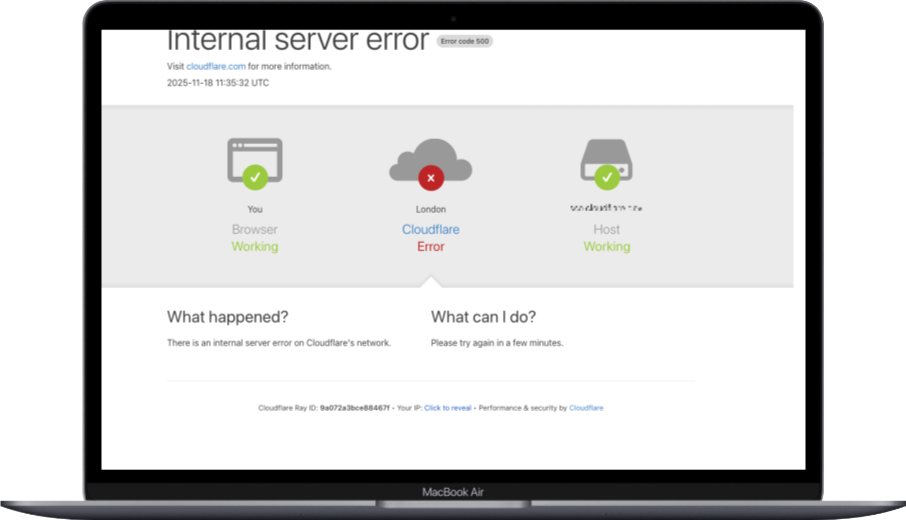
Tuesday, November 18, 2025, started like any other morning for millions of internet users. But at 11:20 UTC, something went terribly wrong.
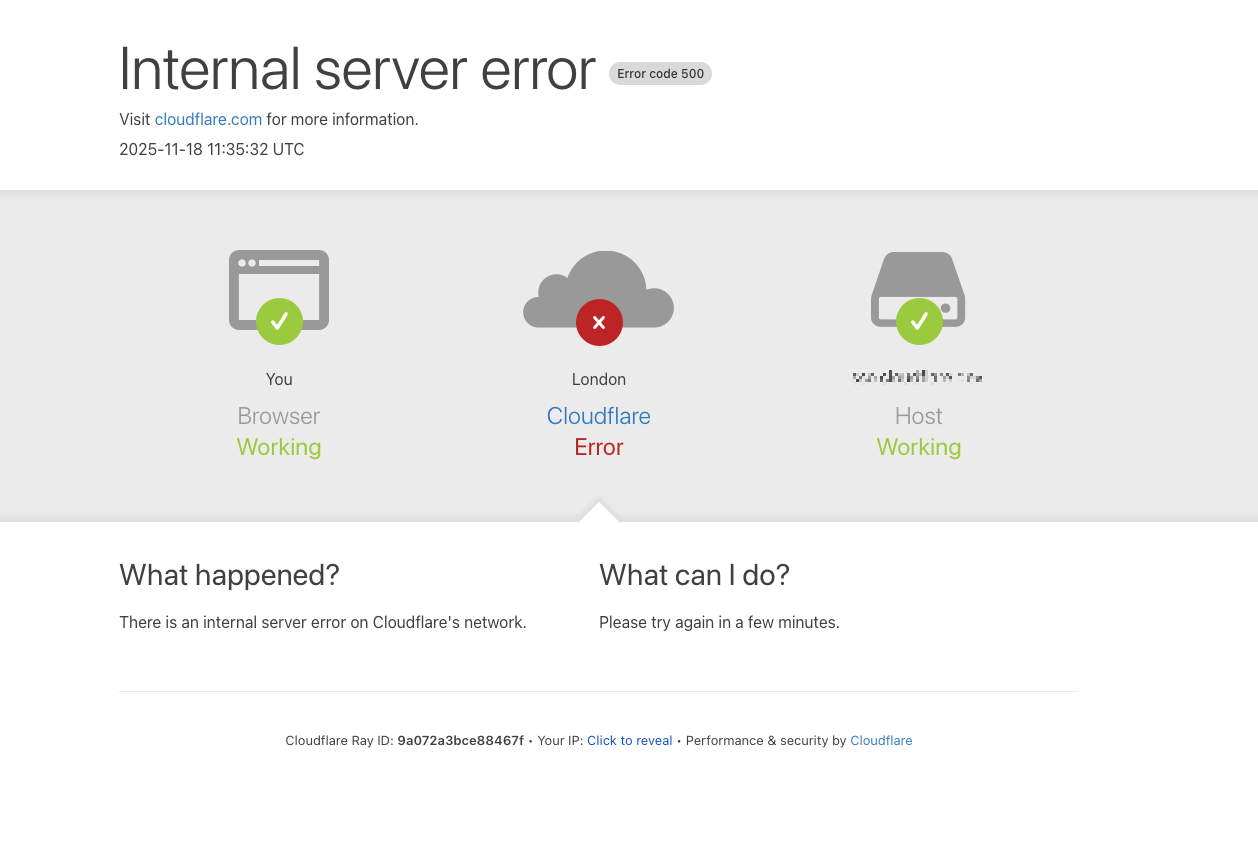
I was sitting at my desk, coffee in hand, ready to catch up on social media when my screen greeted me with an error message I’d seen before but never thought much about: “Error 500: Internal Server Error.” I refreshed. Nothing. Tried another site. Same thing. My first thought? “Great, my internet’s acting up again.” Little did I know, I was experiencing something much bigger—half the internet had just gone dark.
What Actually Happened?
The culprit wasn’t a cyberattack or some shadowy hacker collective. It was something far more mundane yet equally devastating: a configuration file gone wrong. Cloudflare, the company that helps protect and speed up millions of websites, had accidentally created a digital traffic jam that brought down some of the internet’s biggest names.
For those wondering what Cloudflare does, think of it as the internet’s traffic cop and bodyguard rolled into one. When you visit a website, Cloudflare often sits between you and that site, making things faster and safer. The problem? When Cloudflare stumbles, millions of websites stumble with it.
According to Cloudflare’s official incident report, the disaster started with a seemingly innocent database permission change at 11:05 UTC. This change caused their Bot Management system—which helps filter out malicious automated traffic—to generate a configuration file twice its normal size. When this oversized file hit their network, it crashed the system that handles website traffic.
The result? Websites started spitting out 500 errors like confetti at a parade.
The Domino Effect: Who Got Hit?
The outage didn’t discriminate. Major platforms went down one after another:
- X (formerly Twitter) – Social media users found themselves locked out, unable to tweet their frustrations
- ChatGPT – OpenAI’s popular AI chatbot became unreachable just when people needed it most
- Spotify – Music lovers were left in silence
- Shopify – Online stores couldn’t process orders
- Canva – Designers couldn’t access their projects
- Coinbase – Crypto traders watched helplessly as they couldn’t access their accounts
- League of Legends – Gamers couldn’t log in for their matches
- Archive of Our Own – Fan fiction readers were left hanging mid-story
- Zoom – Video meetings hit snags
- Dropbox – Cloud storage became temporarily unreachable
According to DownDetector reports, peak outage complaints hit over 11,000 reports before services started recovering.
Real People, Real Frustration
The Reddit tech community exploded with reactions. One user perfectly captured the absurdity: “You don’t realize how many websites use Cloudflare until Cloudflare stops working. Then you try to look up how many websites use Cloudflare and can’t because all the Google results that would answer your question also use Cloudflare.”
Another website owner shared their panic: “I own a tech news blog where I use Cloudflare. When my website went down, I checked the server status and everything was fine. Until I saw the news, I was trying to figure out issues with my server.” This was a common story—countless website owners spent precious hours troubleshooting problems that weren’t actually on their end.
One particularly frustrated user tried to check DownDetector to see if Cloudflare was down, only to discover that DownDetector itself uses Cloudflare. “You can’t even check the status on DownDetector since it relies on Cloudflare,” they wrote with a facepalm emoji.
The timing couldn’t have been worse for some. A data center technician posted: “I was literally in my data center working on my rack when it hit. Went crazy as it’s always whoever is working on the rack’s fault, until it isn’t… Perfect timing. Now I can yank on all the wires and nobody will know…”
My Own Experience: Hours of Digital Darkness
Like many others, I spent several frustrating hours trying to access our company website. Every attempt was met with that dreaded 500 error. I checked our hosting. Fine. Checked our domain registration. Fine. Ran network diagnostics. Everything looked normal on our end.
The helplessness was real. Our website wasn’t actually broken—it was just unreachable. Our content, our data, everything sat there perfectly intact on our servers, but Cloudflare’s traffic cop had taken an unexpected coffee break, leaving visitors stranded at the digital intersection.
What made it worse was the cascading effect. I couldn’t check status updates on social media because X was down. I couldn’t ask ChatGPT for troubleshooting ideas. I couldn’t even properly Google the issue because half the search results led to sites also protected by Cloudflare. It felt like being trapped in a digital echo chamber where everyone was shouting questions but nobody had answers.
The Technical Details: What Cloudflare Actually Broke
For those interested in the technical side, Cloudflare’s detailed post-mortem reveals just how a small change can trigger catastrophic failure.
The problem started when Cloudflare updated database permissions in their ClickHouse system. This caused a query that generates bot detection features to return duplicate data—essentially doubling the size of a critical configuration file from about 60 features to over 200.
Their system had a safety limit of 200 features. When the bloated file exceeded this limit, the software panicked and crashed. Because this file gets automatically distributed across Cloudflare’s entire global network every five minutes, the crash propagated worldwide almost instantly.
Initially, Cloudflare’s team suspected a massive DDoS attack. The symptoms looked similar—sudden traffic spikes and system failures. Making matters worse, their own status page briefly went down (ironically, not because of Cloudflare, but due to unrelated issues with their status page provider).
The Road to Recovery
The outage lasted approximately three hours at its peak:
- 11:20 UTC – First errors appeared
- 13:05 UTC – Cloudflare implemented workarounds for some services
- 14:30 UTC – Main fix deployed globally
- 17:06 UTC – All services fully restored
According to reports from Reuters, DownDetector complaints dropped from over 11,000 at peak to around 2,800 once recovery began.
The Bigger Picture: Why This Matters
This incident highlights a growing concern about internet infrastructure. As reported by CNN, we’ve consolidated so much of the internet under a handful of companies—Cloudflare, AWS, Microsoft Azure, Google Cloud—that when one stumbles, millions feel the impact.
Reddit users didn’t hold back on this point. One wrote: “2025 internet in a nutshell. But trust me bro just one more merger, if it ain’t a monopoly then it’s fine bro.” Another added: “We’ve made things so much easier by offloading everything to the public cloud. That always comes at a cost and it feels this year that’s starting to catch up.”
The numbers tell the story: according to BBC’s coverage, similar major outages have become increasingly frequent. Where we once saw three or four major internet disruptions per decade, we’re now seeing them quarterly.
What Cloudflare Is Doing About It
To Cloudflare’s credit, they’ve been remarkably transparent. Their post-mortem report was published the same day, detailing exactly what went wrong and what they’re doing to prevent future incidents:
- Strengthening validation of configuration files before deployment
- Creating more “kill switches” to quickly disable problematic features
- Preventing error reporting systems from overwhelming resources during failures
- Reviewing how all their core systems handle errors
Cloudflare CEO Matthew Prince acknowledged this was their worst outage since 2019, stating: “An outage like today is unacceptable. We’ve architected our systems to be highly resilient to failure to ensure traffic will always continue to flow. On behalf of the entire team at Cloudflare, I would like to apologize for the pain we caused the Internet today.”
Lessons Learned
This outage serves as a wake-up call about our internet infrastructure’s fragility. As Forbes reported, the internet was designed to be decentralized and resilient, able to route around damage. But in practice, we’ve created massive choke points where a single company’s mistake can break countless websites.
For website owners, the lesson is clear: diversification matters. Don’t put all your eggs in one basket, even if that basket is as big and reliable as Cloudflare generally is.
For users, it’s a reminder of how interconnected our digital world has become. When half the internet goes down, we suddenly realize just how dependent we’ve become on services we barely understand.
Moving Forward
The outage is now resolved, and Cloudflare has committed to implementing fixes. But the conversation it sparked continues. Are we too dependent on too few companies? Is convenience worth the risk of these massive single points of failure?
As one Reddit user eloquently put it: “The internet is very resilient, as evidenced by the fact that large chunks of the internet are offline but Reddit is still humming along as if nothing is wrong. Yeah, every individual service on the internet is quite fragile. But the internet itself is incredibly resilient.”
Maybe that’s the silver lining here. Despite everything, the internet survived. We all survived. And hopefully, the tech giants learned something too.
Sources & Further Reading:
- Cloudflare Official Post-Mortem Report
- CNN: Why your favorite websites keep going down
- CNBC: Cloudflare outage impacts X, ChatGPT
- Reuters: Cloudflare restores services after outage
- BBC: Cloudflare apologizes for outage
- The Guardian: Cloudflare outage causes error messages
- The New York Times: Cloudflare Outage Disrupts X, ChatGPT
- AP News: Cloudflare resolves outage
You May Also Like
 Web Development
What Is API Rate Limiting? (A Practical, Simple Guide for Safer, Faster APIs)
 Web Development
REST API vs SOAP API: Differences, Pros & Cons, and Use Cases
 Cybersecurity
What Is Zero Trust Network Access (ZTNA)? How It Works, How It Differs From a VPN, and When to Use It
 Cybersecurity
What Is Netskope? Cloud Security, SASE, and Zero Trust Explained
 Cybersecurity
Is Fanatical Legit and Safe? My Honest Take on Buying Game Keys
 Data Security & Privacy
Is Gameflip Legit and Safe for Gift Cards? What Buyers Should Know
 Data Security & Privacy
Is Eldorado.gg Legit and Safe in 2026? My Investigation and What Buyers Should Know
 Web Development
Supabase vs Firebase: Which Backend Platform is Right for Your Project?
 Cloud Computing