

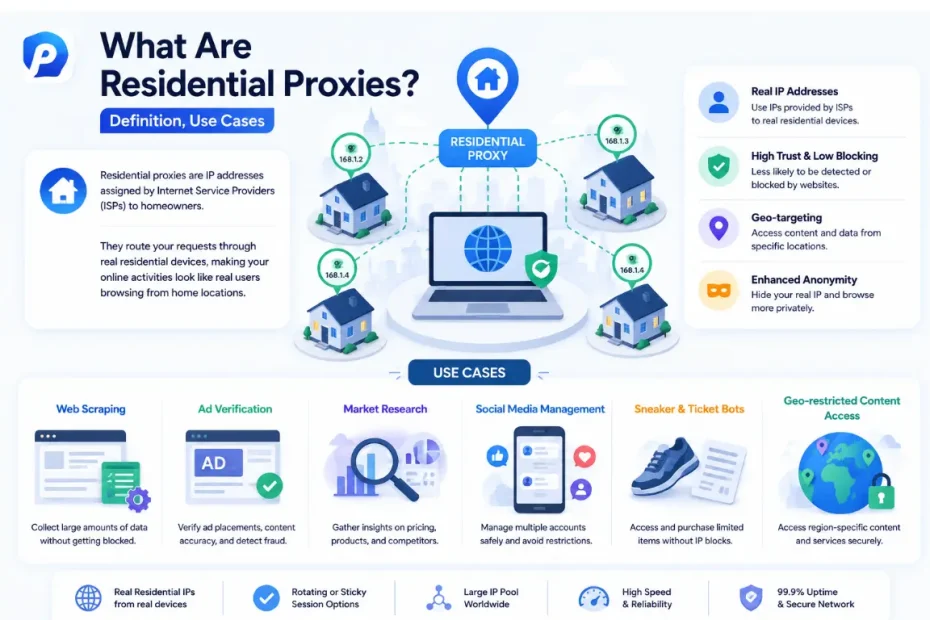
Residential proxies are often presented as a simple upgrade from datacenter proxies. In practice, they are a different category of infrastructure with different costs, reliability characteristics, sourcing considerations, and compliance risks.
Our team spent 90 days testing residential proxy services from IPRoyal, Proxy-Seller, and RoundProxies. Across 2.4 million requests, we measured valid-response rates, latency, retry behavior, geo-targeting reliability, and effective cost per successful result.
For one controlled price-monitoring workflow, moving from datacenter proxies to residential proxies increased our successful extraction rate from 71.4% to 97.8%. That is an improvement of 26.4 percentage points, or 36.9% relative to the datacenter baseline.
The practical outcome was less time spent rerunning failed jobs and more complete data for analysts and clients.
Disclosure: We purchased the test plans used for this benchmark. This page may contain affiliate links, including links to providers mentioned below. Affiliate relationships do not determine inclusion, methodology, or ranking.
Testing period: 90 days in 2026
Test volume: 2.4 million requests across e-commerce, SERP, and ad-verification workflows
Important: Results reflect our traffic patterns, target categories, locations, request volumes, session settings, and success criteria. They should not be treated as a universal benchmark for every site, country, or workload.Compliance note: Residential proxies are legitimate infrastructure tools, but they should only be used for authorized, lawful, and privacy-conscious purposes. Do not use them to access private data, evade access controls, bypass purchase restrictions, create deceptive accounts, or violate applicable laws or contractual terms.
Quick Verdict
| Provider | Best for | What stood out in our testing | Main limitation |
|---|---|---|---|
| IPRoyal | Intermittent or bursty workloads | Non-expiring residential bandwidth; straightforward geo-targeting | You need to manage your own data-collection reliability and compliance controls |
| Proxy-Seller | Teams that need multiple proxy product types | Broad product mix and competitive public pricing | Results varied more by target and location than with our top e-commerce configuration |
| RoundProxies | Cost-sensitive static ISP and datacenter use cases | Aggressive advertised static/ISP pricing | Shorter track record and smaller public-review footprint |
What Are Residential Proxies?
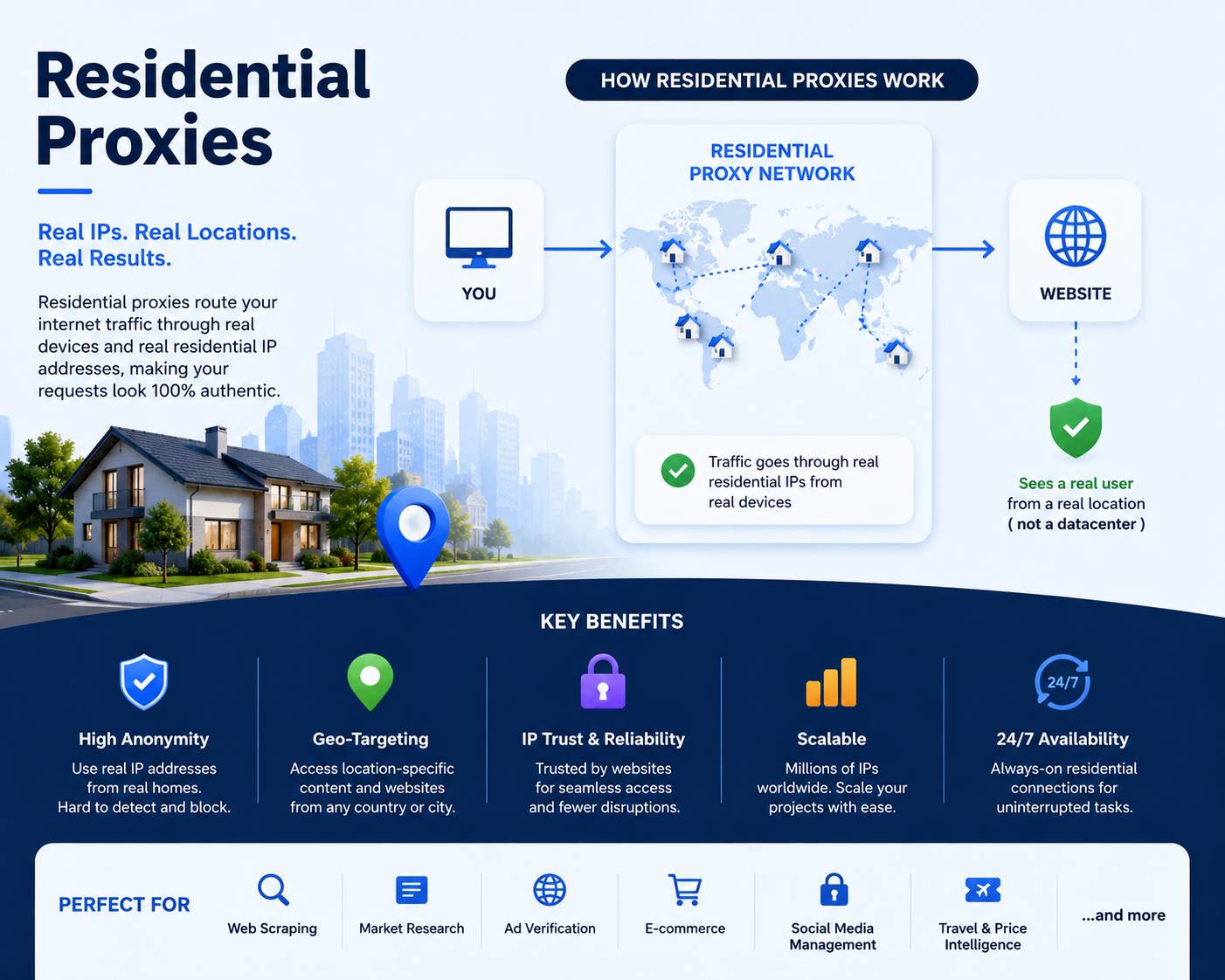
Residential proxies route requests through IP addresses assigned by internet service providers to consumer internet connections.
When a site receives a request through a residential proxy, it sees the assigned residential IP address rather than the IP address of your application server or office network.
That does not make the traffic undetectable. Websites can still assess many signals beyond IP type, including:
- request rate and consistency;
- browser and device characteristics;
- authentication behavior;
- IP reputation;
- session behavior;
- unusual geographic changes;
- known proxy or hosting classifications;
- target-site policies and anti-abuse controls.
The correct way to think about residential proxies is not “undetectable traffic.” It is:
Residential proxies can provide more geographically representative, consumer-network IP addresses than typical datacenter proxies, which may improve reliability for legitimate, authorized workflows where IP reputation and location matter.
For a broader comparison, see: Datacenter Proxies vs Residential Proxies.
How Residential Proxies Work

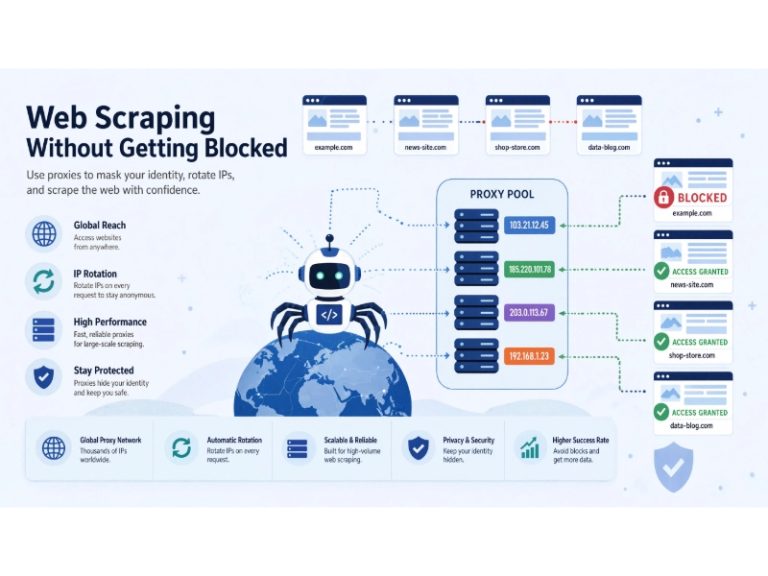
A typical request flow looks like this:
- Your application sends a request to the proxy provider’s gateway.
- The provider applies the session, geographic, and authentication settings you selected.
- The provider routes the traffic through an assigned exit IP.
- The target website responds through the same proxy path.
The exact implementation differs by provider and product. Some networks use peer-based residential endpoints; others provide ISP-registered static IPs hosted in data-center environments. You should not assume every “residential” product has the same sourcing model, routing architecture, or performance profile.
Where Residential IPs Come From
Legitimate providers may source residential IP capacity through:
- opt-in software development kit integrations;
- compensated peer-to-peer bandwidth networks;
- consumer applications with clear consent;
- VPN or connectivity products that disclose bandwidth-sharing arrangements;
- direct ISP relationships for certain static or ISP proxy products.
However, provider statements should be treated as vendor representations unless independently audited.
Before buying, ask each provider for:
- an explanation of its IP sourcing model;
- proof of user consent procedures;
- abuse-reporting and remediation processes;
- privacy documentation;
- prohibited-use policies;
- country-specific compliance information;
- details about whether static “residential” IPs are physically residential or ISP-registered server-hosted addresses.
The FBI has warned that compromised consumer devices can also be used in residential proxy networks. That makes ethical sourcing and vendor due diligence especially important. Read the FBI public service announcement.
Types of Residential Proxies
Rotating Residential Proxies
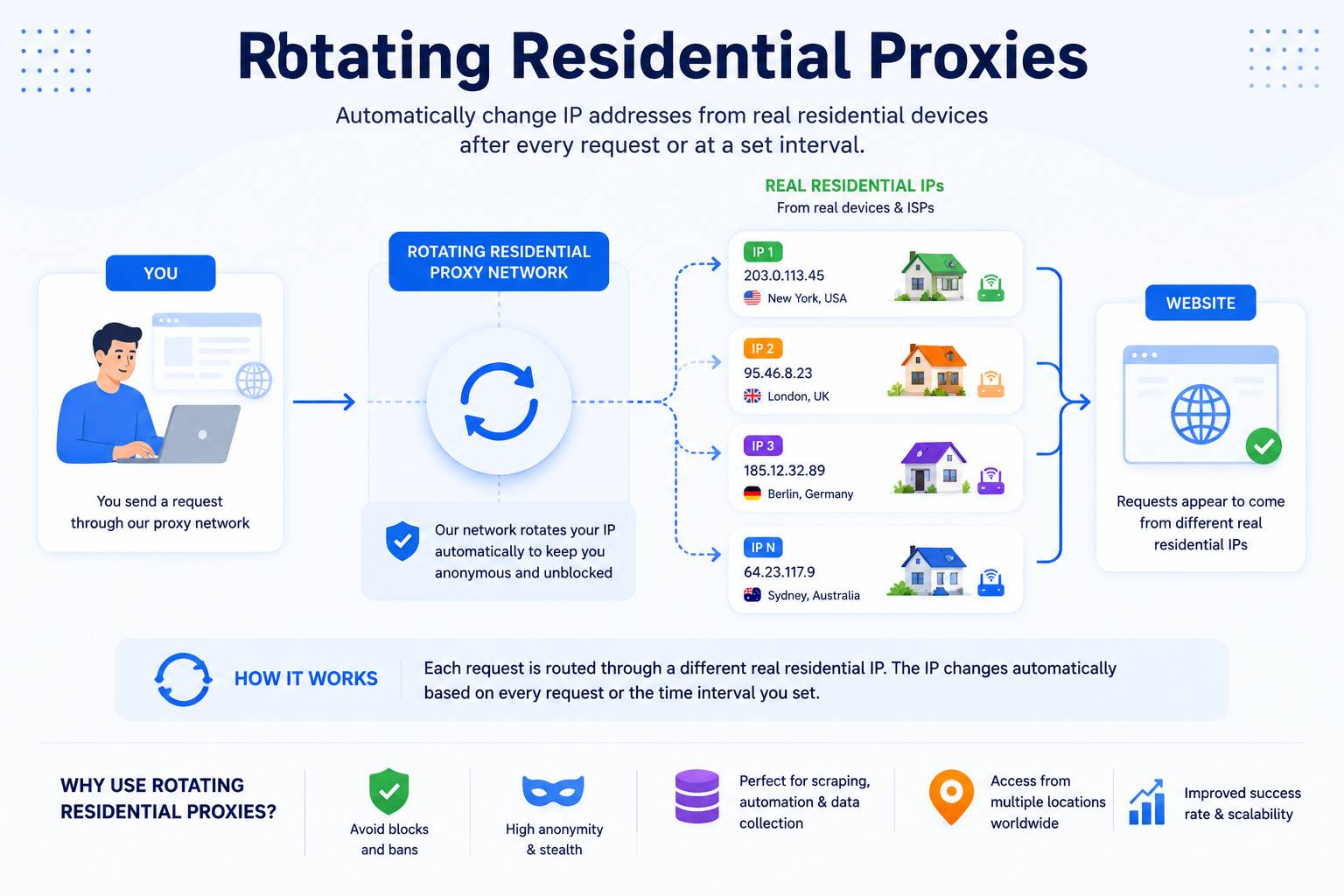
Rotating residential proxies assign a different IP address per request or after a configurable sticky-session period.
They are commonly used for authorized high-volume data collection, localized QA, public-price monitoring, search-result observation, and ad-delivery verification.
In our testing, rotating residential proxies handled most of our volume-oriented workloads. Their main benefit was flexibility: they reduced dependence on a small set of IP addresses.
Best suited for:
- public-web price monitoring;
- localized content QA;
- approved SERP monitoring;
- public review and catalog monitoring;
- ad verification for campaigns you operate or are authorized to audit.
Main trade-offs:
- billed by bandwidth in many plans;
- higher latency than datacenter infrastructure;
- quality varies by country and ISP;
- session continuity can be limited;
- a large advertised pool does not guarantee the same effective IP diversity in every geography.
Static Residential or ISP Proxies
Static residential proxies, often marketed as ISP proxies—provide a persistent IP address for a defined period.
Many are hosted in data centers but use IP ranges associated with internet service providers. They can offer more stable sessions and lower latency than rotating peer-based residential networks.
Best suited for:
- long-running authorized sessions;
- regional website QA;
- persistent e-commerce testing environments;
- applications requiring a stable outbound IP;
- approved access to internal or partner systems through allowlisted IPs.
Important distinction: “Static residential,” “ISP proxy,” and “residential proxy” are often used interchangeably in provider marketing, but they do not always describe identical underlying infrastructure. Ask the provider for clarification.
Mobile Proxies
Mobile proxies route traffic through cellular network IPs.
They can be useful for legitimate mobile-app QA, mobile ad verification, and localization testing. They also tend to cost more than standard rotating residential services.
Mobile proxies should not be described as impossible to block. Platforms can still apply challenges, rate limits, account restrictions, device checks, or behavioral controls.

Rotating vs Static Residential Proxies
| Metric | Rotating Residential | Static Residential / ISP |
|---|---|---|
| IP behavior | Changes per request or session | Remains stable for a defined period |
| Typical pricing | Usually per GB | Usually per IP, per day, week, or month |
| Session persistence | Limited or configurable | Stronger |
| Typical use | Authorized high-volume public-data workflows | Stable, long-running authorized sessions |
| Latency | Often higher and more variable | Often lower and more predictable |
| Geographic flexibility | Usually broad | Depends on available inventory |
| Main risk | Variable IP quality and bandwidth cost | Limited inventory and persistent-IP reputation risk |
Our Operational Conclusion
For our workloads:
- Rotating residential proxies were more useful for large-scale public-data tasks where session persistence was not necessary.
- Static ISP proxies were more useful for stable, authorized sessions where location consistency mattered.
The choice should depend on your actual workload—not on the assumption that one proxy type is universally “better.”
Our Testing Methodology
A provider comparison is only useful if readers understand what was measured.
Scope
We tested three providers over 90 days:
- IPRoyal
- Proxy-Seller
- RoundProxies
Our benchmark included approximately 2.4 million requests across selected e-commerce, SEO-monitoring, and ad-verification workflows.
What We Measured
We tracked:
- valid-response rate;
- block or challenge rate;
- median response time;
- 95th-percentile response time;
- error categories;
- retry recovery rate;
- geo-targeting reliability;
- bandwidth consumption;
- effective cost per valid result.
Definition of a Successful Request
A request counted as successful only when it produced a response that was both:
- technically accessible; and
- usable by the downstream workflow.
For example, an HTTP 200 response that returned an interstitial page, empty content, or invalid product data was not treated as a successful extraction.
Limitations
These results should not be generalized to:
- every target website;
- login-based workflows;
- account creation or account-management activity;
- every country-level IP pool;
- all request volumes or concurrency settings;
- all browser, API, or mobile traffic patterns.
Provider performance can change materially over time as inventory, routing, pricing, and target-site defenses change.
Benchmark Results
Summary Table
| Provider | Tested success rate* | Median response time | Best fit in our test |
|---|---|---|---|
| IPRoyal | 95.3% | 612 ms | Bursty residential data workloads |
| Proxy-Seller | 92.3% | 277–311 ms on selected tests | Mixed proxy portfolio requirements |
| RoundProxies | 96.1% | 487 ms | Cost-conscious e-commerce workload testing |
*Success rate refers to our internal test definition and test conditions. It is not a provider-wide performance guarantee.
1. IPRoyal: Best for Bursty Workloads and Non-Expiring Bandwidth
Our Test Results
- Success rate: 95.3% across 380,000 selected requests
- Median response time: 612 ms
- 95th-percentile response time: 891 ms
- Primary advantage: non-expiring bandwidth
- Observed use case: intermittent data collection with irregular traffic patterns
IPRoyal’s most useful feature for our team was its non-expiring traffic model. For workloads that do not consume the same bandwidth every month, this can reduce pressure to use credits before a monthly expiration date.
At the time of testing, we purchased a 50 GB allocation and did not need to consume all of it immediately. The unused balance remained available, which made budgeting easier for variable workloads.
Current Vendor-Reported Product Information
IPRoyal currently advertises:
- residential proxy traffic that does not expire;
- country, state, city, and ISP targeting;
- rotating and sticky session options;
- public pricing that varies by package size and purchase model.
Always verify current prices directly before purchasing: IPRoyal Residential Proxies and IPRoyal Residential Proxy Pricing.
Where It Fell Short
IPRoyal worked well in our general benchmark, but results declined on our most restrictive targets and at higher concurrency levels. This does not mean the provider is uniquely weak; it reflects a broader reality of proxy-based collection: target-site policies, traffic volume, geography, and session behavior all affect outcomes.
Verdict
Choose IPRoyal if: you have unpredictable bandwidth demand and value non-expiring traffic.
Do not choose it solely because of advertised IP-pool size. Test the locations and target categories that matter to your business.
2. Proxy-Seller: Best for Teams That Need Multiple Proxy Products
Our Test Results
- Success rate: 92.3% in a selected Google SERP workflow
- Latency: 277–311 ms in selected network measurements
- Google response time: 982 ms in our measured workflow
- Best fit: teams needing residential, static ISP, mobile, and datacenter options in one account
Proxy-Seller’s main advantage is product breadth. Teams that use more than one proxy type may prefer the operational simplicity of buying through one vendor.
Current Vendor-Reported Product Information
Proxy-Seller currently advertises:
- residential IPs across 220+ geographic locations;
- city and ISP targeting;
- rotating and sticky sessions;
- residential proxy pricing that changes by traffic tier;
- static ISP and mobile proxy products.
Verify pricing and availability directly: Proxy-Seller Residential Proxies.
Important Pricing Note
Do not compare proxy vendors using only the headline “per GB” price.
Your real comparison should include:
- usable response rate;
- average bytes consumed per valid result;
- retry volume;
- geographic availability;
- support quality;
- whether unused traffic expires;
- minimum commitments;
- cost of engineering time spent handling failures.
Verdict
Choose Proxy-Seller if: you need several proxy types and want a single-provider procurement workflow.
3. RoundProxies: Best for Aggressive Static ISP and Datacenter Pricing
Our Test Results
- Success rate: 96.1% across our selected e-commerce target set
- Median response time: 487 ms
- Best fit: cost-sensitive tests involving static ISP and datacenter products
RoundProxies delivered competitive results in our e-commerce test set, particularly for workloads where we wanted to compare lower-cost ISP and datacenter options alongside residential traffic.
Current Vendor-Reported Product Information
RoundProxies advertises:
- static residential / ISP proxy products;
- unlimited-bandwidth plans for certain products;
- multiple ISP providers;
- HTTP, HTTPS, and SOCKS5 support;
- pricing that varies by package size and duration.
Verify the exact package terms, quantity requirements, and billing period before purchasing: RoundProxies ISP Proxy Pricing.
Where to Be Careful
A low entry price is not enough to establish value. Before committing, test:
- the exact countries you need;
- stability over several days;
- replacement policy;
- support response time;
- IP reputation for your approved use case;
- renewal pricing;
- refund conditions.
Verdict
Choose RoundProxies if: you want to test competitively priced static ISP or datacenter inventory and are prepared to validate it against your own workload.
Provider Comparison
| Feature | IPRoyal | Proxy-Seller | RoundProxies |
|---|---|---|---|
| Best for | Bursty residential usage | Mixed proxy requirements | Budget-conscious ISP/static testing |
| Residential bandwidth expiry | Vendor advertises non-expiring traffic | Depends on plan | Depends on plan |
| Geographic targeting | Country, state, city, ISP options | Country, city, ISP options | Depends on product and inventory |
| Proxy types | Residential, ISP, mobile, datacenter | Residential, ISP, mobile, datacenter | Residential, ISP, mobile, datacenter |
| Our tested success rate | 95.3% | 92.3% | 96.1% |
| Our observed median latency | 612 ms | 277–311 ms in selected tests | 487 ms |
| Test period | 90-day benchmark | 90-day benchmark | 90-day benchmark |
Reminder: Vendor-reported pool sizes, country counts, and pricing are subject to change. Check the provider’s live product and pricing pages before making a decision.
How Much Do Residential Proxies Cost?
Residential proxy prices are typically billed per GB. Static ISP proxies are often billed per IP and per billing period.
Pricing depends on:
- traffic volume;
- target country;
- city or ISP filtering;
- session type;
- residential vs ISP vs mobile product;
- commitment term;
- whether traffic expires;
- support and enterprise features.
Cost Per Valid Result Matters More Than Cost Per GB
A cheaper $/GB rate is not automatically cheaper operationally.
Use this formula:
Effective cost per valid result =
(total proxy spend + operational overhead) / valid completed results
For example, a provider with a higher $/GB price may still be more cost-effective if it produces fewer failures, fewer retries, lower engineering overhead, and better data completeness.
A Note on Our Cost Figures
Some internal costs in our original operational reporting covered different scopes: individual projects, specific provider tests, and broader traffic categories. They should not be treated as a single universal monthly operating-cost figure.
If you publish internal cost data, separate:
- total proxy traffic;
- residential-only traffic;
- datacenter traffic;
- client-specific spend;
- test spend;
- production spend;
- bandwidth cost;
- operational labor cost.
That level of detail prevents misleading comparisons.
How to Choose a Residential Proxy Provider
1. Start With the Use Case
Ask:
- Do you need rotating or persistent IPs?
- Which countries, cities, or ISPs matter?
- Are you collecting public data with authorization and a documented lawful basis?
- Do you need predictable latency or maximum geographic coverage?
- Is your workflow bandwidth-heavy?
- Do you need support for API, browser, or server-side traffic?
- Can you use an official API, data license, or partner feed instead?
2. Test Your Real Workload
Do not choose a provider based only on a marketing page.
Run a limited test with:
- your permitted target categories;
- your actual countries;
- your expected request volume;
- realistic response-validation rules;
- consistent retry policy;
- a fixed budget;
- documented success criteria.
3. Measure More Than Access Rate
Track:
- valid data completeness;
- response latency;
- error type;
- retry recovery;
- bandwidth per valid result;
- country-level variation;
- support response time;
- cost per valid result.
4. Evaluate Ethical Sourcing and Governance
Ask whether the provider can explain:
- how end users consent;
- how users opt out;
- how abuse is reported;
- how the network handles compromised devices;
- whether privacy and data-processing documentation is available;
- what prohibited uses are actively enforced.
Residential Proxies vs Other Proxy Types
Residential vs Datacenter Proxies
| Aspect | Residential | Datacenter |
|---|---|---|
| Typical IP source | Consumer ISP-assigned address space | Hosting/cloud/data-center address space |
| Latency | Often higher and more variable | Often lower and more predictable |
| Cost model | Usually per GB | Often per IP or lower-cost bandwidth |
| Geographic realism | Often stronger | Depends on provider and location |
| Best fit | Approved location-sensitive public-web workflows | Internal testing, permitted APIs, lower-risk and lower-cost tasks |
| Detection risk | Can be lower in some contexts, not zero | Often easier to classify as hosting infrastructure |
For more detail, read: Datacenter Proxies vs Residential Proxies.
Residential vs Mobile Proxies
Mobile proxies may be useful for authorized mobile ad QA and mobile-app testing. They are usually more expensive and should not be treated as a guarantee against challenge or restriction.
Residential vs ISP Proxies
Static ISP proxies can provide a stable IP identity and predictable performance. Rotating residential proxies can provide broader IP variation. The right choice depends on whether your approved workflow needs continuity or rotation.
Residential Proxies vs VPNs
A VPN and a proxy are different tools:
- a VPN typically encrypts device-wide traffic through a selected endpoint;
- a proxy routes selected application traffic through a configured intermediary;
- neither tool creates permission to collect data, access restricted systems, or circumvent site controls.
For region-specific QA or authorized public-data operations, a proxy platform may offer more granular session and geographic controls than a consumer VPN.
Legal and Compliance Considerations

Residential proxies are lawful tools in many jurisdictions, but whether a specific use is lawful depends on the facts.
Relevant factors include:
- applicable national and local law;
- website terms and contractual restrictions;
- technical access controls;
- whether personal data is involved;
- copyright and database rights;
- request volume and burden on the target;
- purpose of collection;
- data retention and onward use;
- cross-border transfers;
- your authority to access, collect, or test the target.
Public availability of a webpage does not automatically resolve all legal, privacy, contract, or intellectual-property questions.
For web-scraped personal data, UK regulator ICO guidance emphasizes that scraping can create significant privacy risks and requires a defensible lawful basis and transparency analysis. ICO guidance on web-scraped data
Appropriate Uses May Include
Subject to law, authorization, and target-site policies:
- regional QA for your own site or application;
- ad verification for campaigns you operate or are authorized to audit;
- market research using permitted public information;
- price monitoring where legally and contractually appropriate;
- brand and review monitoring;
- fraud and threat-intelligence work performed with appropriate authority;
- testing localized experiences for your own products.
High-Risk or Prohibited Uses
Do not use proxies for:
- fraud or identity theft;
- credential theft;
- unauthorized access;
- evading access controls;
- account takeover;
- deceptive account creation;
- bypassing purchase limits or resale restrictions;
- collecting protected personal information;
- excessive activity that degrades a target’s service;
- violating applicable privacy, copyright, or computer-misuse laws.
This article is not legal advice. For high-volume, regulated, cross-border, personal-data, or commercially sensitive collection, obtain advice from qualified counsel.
Operational Best Practices for Authorized Workflows
Use the Least Intrusive Data Source First
Before using proxies, evaluate whether you can use:
- an official API;
- a licensed data provider;
- a partner feed;
- an export function;
- a sitemap;
- direct permission from the site owner.
Keep Collection Proportionate
For authorized public-data workflows:
- collect only the data you need;
- cache reusable responses;
- reduce unnecessary repeat requests;
- maintain clear user-agent and contact information when appropriate;
- monitor rate and error patterns;
- honor contractual obligations and legal restrictions;
- document purpose, retention period, and access controls.
Monitor Quality, Not Just Volume
A useful dashboard should include:
- valid-result rate;
- error rate by target category;
- response latency;
- bandwidth per valid result;
- country-level performance;
- retry rate;
- cost per valid result;
- changes in provider performance over time.
Frequently Asked Questions
Are residential proxies legal?
Residential proxies are legitimate infrastructure products, but specific uses may carry legal, contractual, privacy, copyright, or regulatory risk. Legality depends on what you access, how you access it, the data involved, your jurisdiction, and whether you have authorization.
Can websites detect residential proxies?
Yes. Residential proxies can reduce reliance on easily classified data-center IP ranges, but websites can still evaluate IP reputation, browser signals, behavior, session patterns, location consistency, and other indicators.
How much do residential proxies cost?
Residential proxies are commonly billed per GB, while static ISP products are often billed per IP. Public pricing varies significantly by provider, volume, target geography, and contract term. Compare providers by cost per valid result, not only by sticker price.
What is the difference between rotating and static residential proxies?
Rotating residential proxies change the exit IP per request or session window. Static residential or ISP proxies keep the same IP for a longer period. Rotating products are generally better for approved volume-based workflows; static products are better for persistent, authorized sessions.
Which provider is best?
There is no universal winner. In our benchmark:
- IPRoyal was strongest for intermittent workloads because of its non-expiring bandwidth model;
- Proxy-Seller was useful for teams that wanted several proxy types from one vendor;
- RoundProxies was competitive for cost-sensitive static ISP and datacenter testing.
Always run a controlled test against your own approved workload.
Are free residential proxies safe?
Usually not. Free proxy lists may contain unreliable endpoints, compromised devices, unclear sourcing, data interception risk, or malware-related infrastructure. Use providers that can explain their sourcing, privacy practices, support model, and abuse controls.
For more context, see: Why You Should Avoid Free Proxies for Web Scraping.
Final Takeaway
Residential proxies can improve the reliability of location-sensitive, authorized web-data and QA workflows—but they are not a universal solution, and they are not inherently undetectable.
The strongest provider choice depends on:
- your lawful and approved use case;
- required countries and cities;
- session persistence needs;
- data-quality requirements;
- bandwidth profile;
- acceptable latency;
- budget;
- sourcing and compliance requirements.
Our recommendation is simple:
- Choose two or three providers.
- Run a limited, documented test using your actual permitted workload.
- Measure valid-result rate, latency, bandwidth, support, and cost per valid result.
- Verify IP sourcing and contractual terms.
- Scale only after the test produces consistent results.
For related comparisons, see:
- Datacenter Proxies vs Residential Proxies
- Mobile Proxies vs Residential Proxies
- How to Prevent IP Bans During Web Scraping
- Why Free Proxies Are Risky for Web Scraping
You May Also Like
 VPN & Proxy
Why Do CAPTCHAs Appear When You Use a VPN?
 VPN & Proxy
Why Does Google Say Our Systems Have Detected Unusual Traffic From Your Computer Network?
 VPN & Proxy
How to Block Ads on Pinterest: A Simple Guide
 Web Scraping
TinyFish.ai Review: Is It the Best AI Agent for Web Scraping
 VPN & Proxy
10 Best VPNs for California in 2026: Privacy, Speed, and Security
 VPN & Proxy
Mobile Proxies vs. Residential Proxies: Differences, Costs, and Use Cases
 VPN & Proxy
Datacenter vs. Residential Proxies: Differences, Costs, and Use Cases
 Web Scraping
Reasons Why You Should Avoid Using Free Proxies For Web Scraping
 Web Scraping