

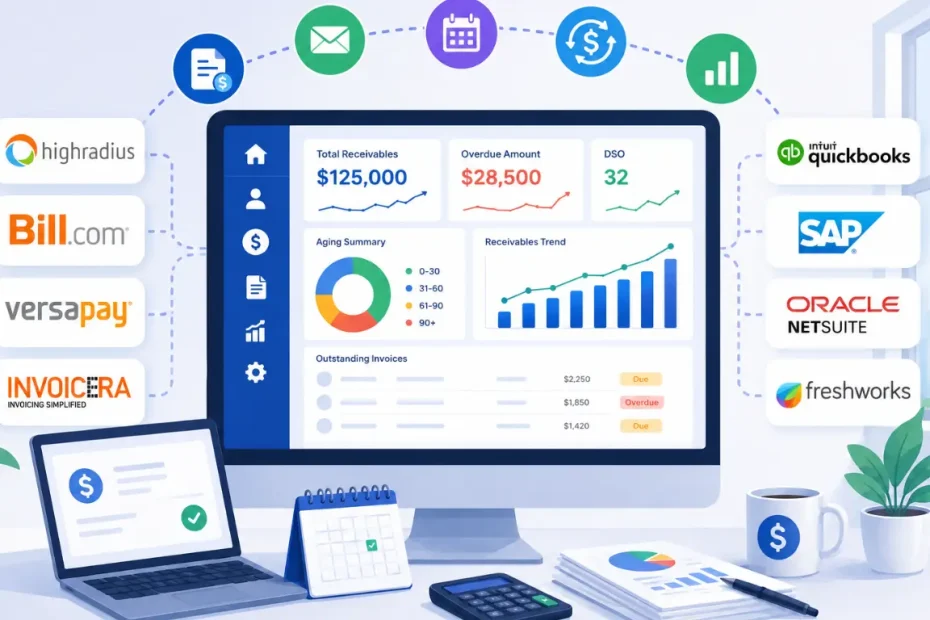
The best accounts receivable software platforms in 2026 include HighRadius, Billtrust, Versapay, Quadient AR by YayPay, NetSuite, Sage, Upflow, Kolleno, Gaviti, and BILL, each offering a mix of automation, payment processing, collections management, cash flow forecasting, and ERP integrations designed to help businesses streamline receivables and improve cash flow in 2026.
Here’s the thing: most “best accounts receivable software” lists are too shallow. They mix simple invoicing tools with full AR automation platforms, then call it a day. That’s not helpful if you’re trying to reduce DSO, automate collections, improve cash application, or give customers a better payment experience.
This guide is different. It focuses on real accounts receivable software for finance teams, not just generic invoicing apps. I looked at each platform through the lens that actually matters in day-to-day AR work: collections automation, cash flow visibility, ERP integration, payment options, analytics, customer experience, and fit by company size.
If your AR team is still bouncing between ERP screens, Excel, inboxes, and customer calls, this list will help you find software that fits how your receivables process actually works.
Featured snippet: The best accounts receivable software for 2026 includes HighRadius, Billtrust, Versapay, Quadient AR, NetSuite, Sage, Upflow, Kolleno, Gaviti, and BILL because they offer strong automation, visibility, payments, integrations, and collections workflows.
How I Ranked the Best Accounts Receivable Software
I ranked these accounts receivable software platforms based on AR depth, collections automation, cash application, payment tools, reporting, integrations, and business fit. AR automation software should reduce manual work, improve visibility, and help finance teams get paid faster while keeping customer communication clear and consistent.
I used five practical filters:
- Collections strength — reminder workflows, dunning, prioritization, promise-to-pay, and dispute support
- Cash visibility — dashboards, aging, DSO tracking, forecasting, and reporting
- Payments and reconciliation — portal, ACH/card options, matching, and cash application
- Integration quality — ERP, accounting system, banking, or CRM connectivity
- Fit by business size — SMB, mid-market, enterprise, and B2B complexity
In real life, the “best” AR platform is not the one with the longest feature list. It’s the one that fits your invoice volume, customer mix, team size, and ERP setup.
Quick Comparison Table: 10 Best Accounts Receivable Software
| Software | Best for | Standout strengths | Likely fit |
|---|---|---|---|
| HighRadius | Large enterprises | Deep AI across credit, invoicing, collections, cash app, deductions | Enterprise and global B2B teams |
| Billtrust | End-to-end invoice-to-cash | Strong AR platform with embedded payments and AI insights | Mid-market to enterprise B2B |
| Versapay | Customer portal + collaborative AR | Digital invoicing, portal, AI cash app, ERP payments | Mid-market B2B finance teams |
| Quadient AR | Mid-market collections automation | Strong workflows, dashboards, forecasting, payment experience | B2B teams wanting structured AR |
| NetSuite | ERP-first AR management | Native AR inside ERP with dashboards, invoicing, dunning, payment link | Companies already in NetSuite |
| Sage | Sage-centered finance operations | Recurring invoices, CRM visibility, online payments, reporting | SMB to mid-market on Sage |
| Upflow | Modern AR collaboration | Personalized reminders, portal, live dashboards, cross-team visibility | SaaS and modern B2B finance teams |
| Kolleno | All-in-one AR + reconciliation | Portal, payments, analytics, credit risk, AI search | Mid-market teams replacing manual tools |
| Gaviti | Focused collections automation | Smart workflows, payment forecasting, AR drill-down visibility | In-house AR and collections teams |
| BILL | Fast setup for SMBs | Easy invoicing, reminders, ACH/cards, two-way sync | Small businesses and lean finance teams |
Best A/R Automation Software by Use Case
The best A/R automation software depends on the problem you need to solve first. Some businesses need deep enterprise automation. Others need better payment workflows, faster collections follow-up, or a cleaner customer portal.
| Use case | Best software | Why it fits |
|---|---|---|
| Best for enterprise AR automation | HighRadius | Deep AI coverage across collections, cash application, credit, deductions, and payments |
| Best for integrated invoice-to-cash | Billtrust | Strong AR platform plus embedded payments and analytics |
| Best for customer portal and self-service payments | Versapay | Strong customer portal, payment access, and dispute-friendly workflow |
| Best for structured mid-market B2B collections | Quadient AR | Strong workflow automation, forecasting, and dashboard visibility |
| Best for ERP-native AR management | NetSuite | AR lives inside the ERP |
| Best for Sage ecosystem users | Sage | Good AR fit for Sage-based accounting and finance teams |
| Best for modern B2B collaboration | Upflow | Strong personalized collections and cross-team workflows |
| Best all-in-one AR, payments, and reconciliation tool | Kolleno | Combines collections, portal, analytics, and payments in one place |
| Best for focused in-house collections | Gaviti | Dedicated collections visibility, reminders, and forecasting |
| Best for quick SMB setup | BILL | Fast invoice automation and simple payment collection |
Best A/R Automation Platforms for Every Business Size
The right A/R automation platform should match your business size and operational complexity. From experience, this is where many buying decisions go wrong. Teams either buy too much software or not enough.
| Business size | Best options | Why they work |
|---|---|---|
| Small business | BILL, Sage | Easier setup, lighter workflows, practical payment tools |
| Lower mid-market | Upflow, Quadient AR, Kolleno | Better collections structure without full enterprise complexity |
| Mid-market B2B | Versapay, Quadient AR, Upflow | Strong mix of automation, payments, and visibility |
| Upper mid-market to enterprise | Billtrust, Versapay, NetSuite | Better fit for deeper invoice-to-cash operations |
| Enterprise and global B2B | HighRadius, Billtrust | Best fit for large-scale automation and complex finance environments |
Smart Criteria for A/R Automation Selection
The smartest way to choose A/R automation software is to compare tools against your real AR workflow, not just vendor marketing.
| Selection criteria | What to review | Why it matters |
|---|---|---|
| Invoice volume | Monthly invoices and complexity | Higher volume needs stronger automation |
| Collections workflow | Reminder rules, disputes, prioritization, promises to pay | This is where many tools are too shallow |
| Payment options | ACH, card, wire, autopay, customer portal | Easier payment usually improves collections speed |
| Cash application | Matching, remittance handling, reconciliation | Weak cash app creates manual work |
| Reporting | Aging, DSO, CEI, forecasting, collector metrics | Finance leaders need current visibility |
| ERP integration | Native connectors, APIs, sync quality | Bad integration weakens the whole process |
| Customer experience | Portal, invoice access, payment flow, dispute tools | Better experience reduces back-and-forth |
| Pricing model | Per user, per invoice, subscription, payment fees | Total cost can change fast |
| Implementation effort | Go-live time, onboarding, training | Great software still fails if rollout is poor |
| Scalability | Multi-entity, multi-region, permissions, controls | You do not want to replace the tool too soon |
In real life, the right platform should answer three simple questions: Will it reduce manual work? Will it improve visibility? Will it make it easier for customers to pay?
1) HighRadius: Best for Enterprise-Scale AR Automation
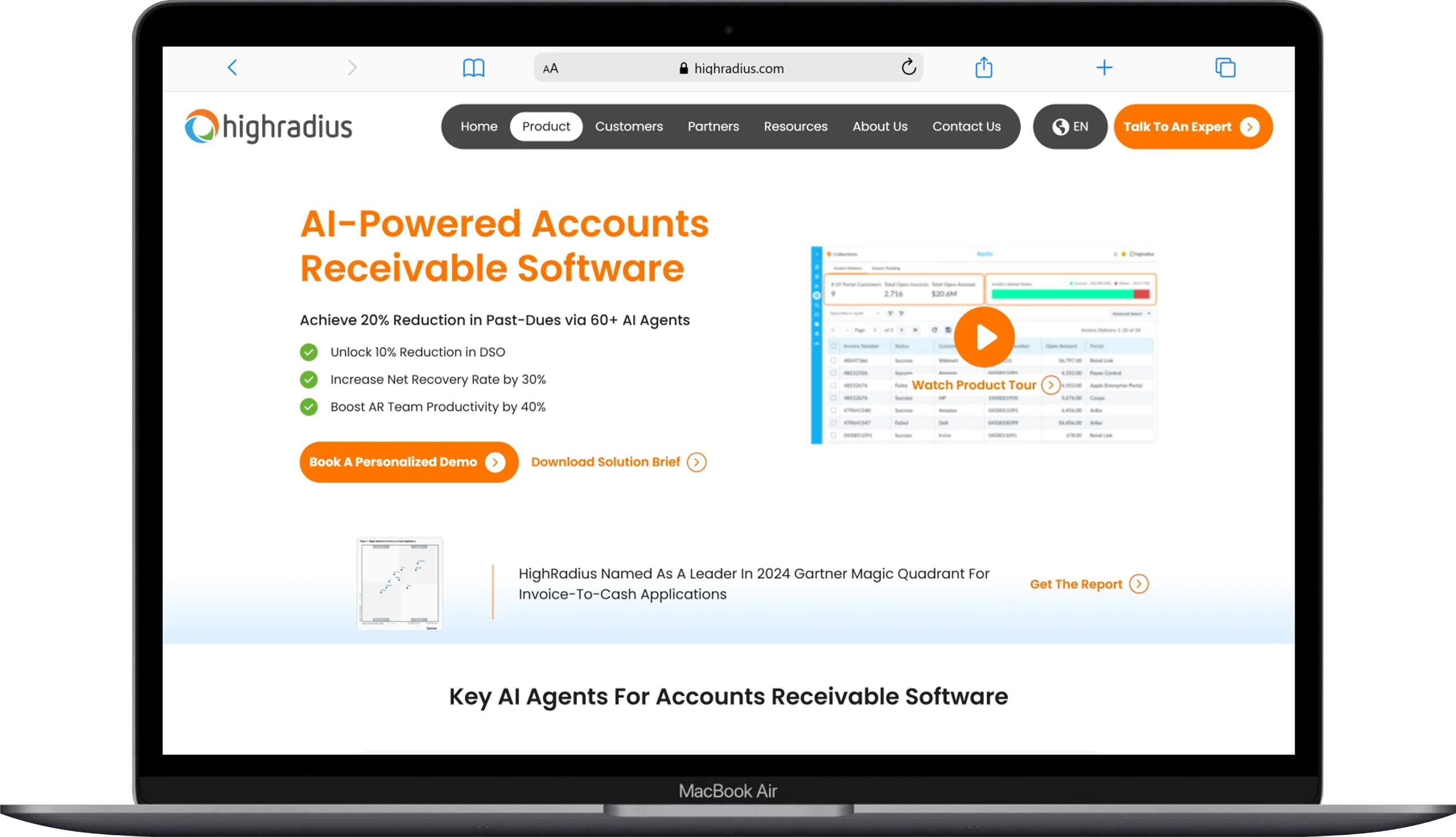
HighRadius is the best accounts receivable software for large companies that need deep automation across the full invoice-to-cash cycle.
HighRadius goes beyond reminder emails. Its product positioning covers credit risk, invoicing, collections, cash application, deductions, AR visibility, and B2B payments. The platform highlights AI agents across each layer of AR, including payment matching, AP portal uploads, collection workflows, remittance capture, and deduction validation. It also supports broad payment coverage with 200+ payment methods and 135+ currencies, which matters for complex enterprise environments.
What makes HighRadius stand out is scale. If you’re running high invoice volume, complex customer terms, multiple regions, or a large shared services model, this is the kind of platform built for that pressure. The vendor claims 20% lower past-dues, 10% lower DSO, 30% higher net recovery rate, and 40% higher AR team productivity, though those are vendor-reported outcomes and should be treated as directional, not guaranteed.
Key features
- AI-driven credit risk management
- Automated invoicing and AP portal uploads
- Collections workflows with reminders and prioritization
- Cash application and remittance capture
- Deduction validation and resolution support
- Real-time AR dashboards and performance visibility
- Multi-currency and multi-payment-method support
Pricing
Custom quote. HighRadius says pricing depends on selected modules, integration requirements, and the complexity of your AR operations.
Pros
- One of the deepest AR automation platforms on the market
- Strong enterprise and global B2B fit
- Broad AI coverage across multiple AR functions
- Good for complex invoice-to-cash environments
Cons
- No public flat pricing
- Likely heavier implementation than smaller tools
- May be too complex for teams that only need basic reminders and payments
Why it’s on this list: it has one of the deepest AR feature sets in the market.
Best for: enterprise finance organizations, global B2B operations, and teams with complex order-to-cash processes.
Watch-out: if you only need simple invoicing and reminders, this will likely feel much heavier than necessary.
2) Billtrust: Best for Integrated Invoice-to-Cash and Embedded Payments
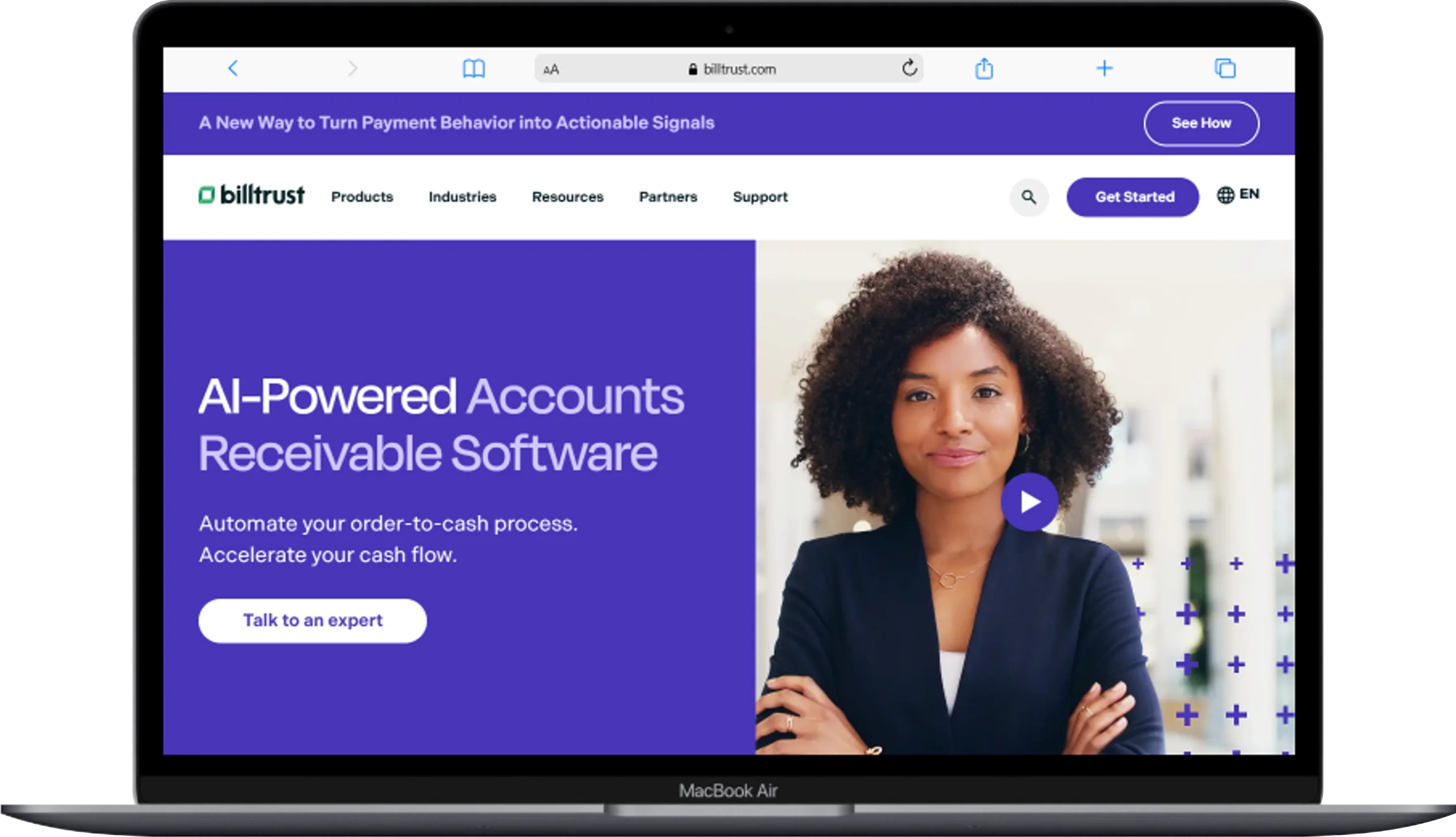
Billtrust is one of the best accounts receivable software platforms for companies that want billing, payments, and AR automation in one connected system.
Billtrust positions itself as an AI-powered AR platform built to automate the order-to-cash process. Its homepage emphasizes integrated invoice-to-cash applications, embedded payments, real-time AI-driven analytics, predictive insights, and customizable AR rules. That makes it especially attractive for B2B teams that want more than collections alone. It is trying to unify billing, collections, payment capture, and visibility into one platform.
From a buyer’s view, Billtrust looks strongest when a business needs a platform approach, not a point tool. If your team wants to reduce manual AR work while also improving customer payment options and building more intelligent workflows, Billtrust deserves a serious look. In real life, this matters most for finance teams that are tired of separate systems for invoicing, payment acceptance, and collections.
Key features
- Integrated invoice-to-cash workflow
- Embedded payments
- AI-driven analytics and predictive insights
- Customizable AR rules
- Automated invoice presentment
- Collections workflow support
- Cash application support
- Real-time AR visibility
Pricing
Contact sales. Billtrust does not show public flat pricing on the official pages reviewed here. Its buyer’s guide focuses on evaluation factors such as integration, automation scope, support, security, and scalability rather than published pricing tiers.
Pros
- Strong invoice-to-cash platform positioning
- Embedded payments are a major advantage
- Good fit for mid-market and enterprise B2B teams
- Strong analytics and automation story
Cons
- No public pricing
- Budget comparison requires a sales conversation
- May be too broad for teams that only need simple invoicing and reminders
Why it’s on this list: strong invoice-to-cash orientation with payments built in.
Best for: mid-market and enterprise B2B teams that want platform-level AR modernization.
Watch-out: teams looking for a very lightweight SMB tool may prefer something simpler.
3) Versapay: Best for Customer Portal and Collaborative AR
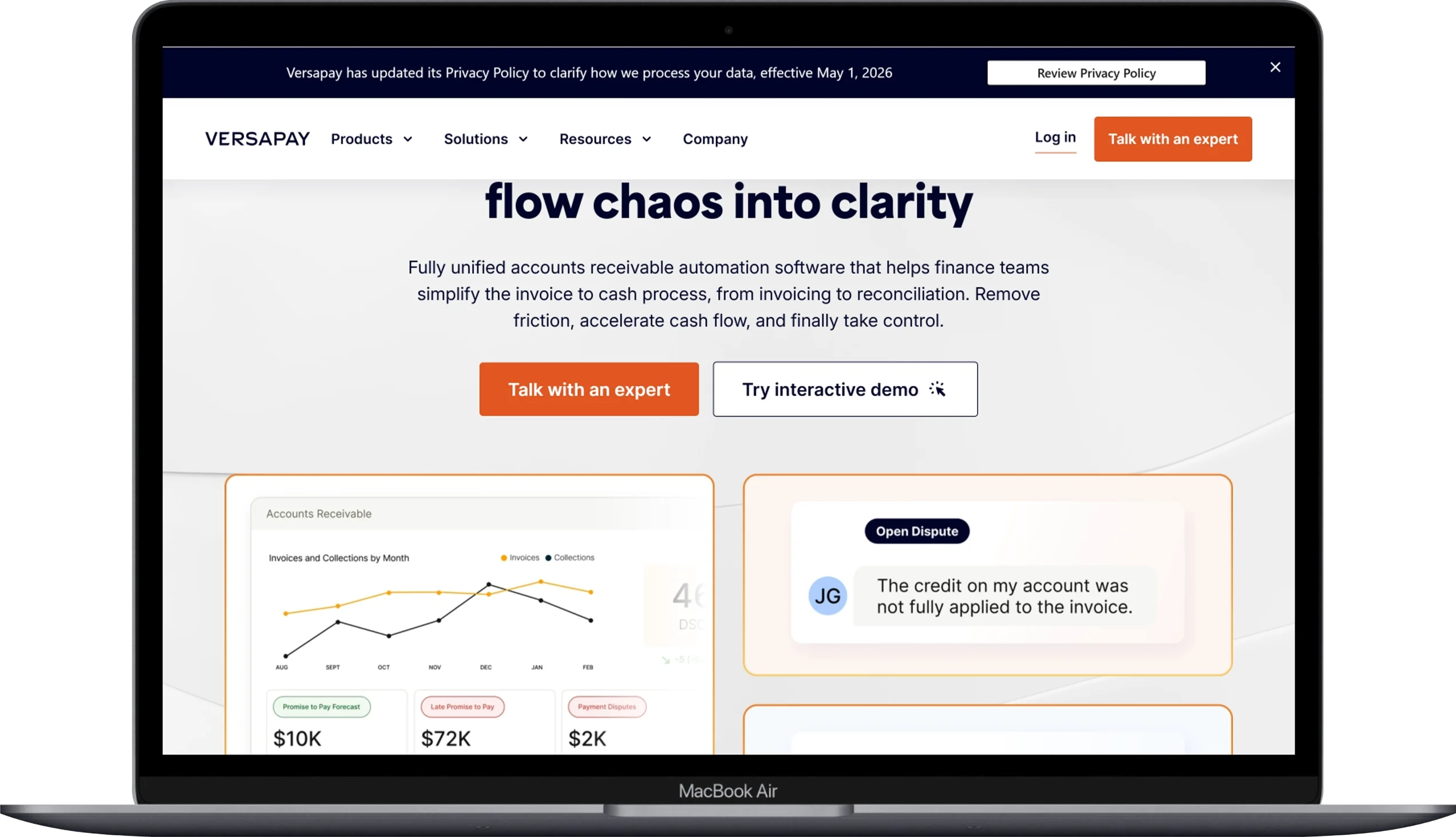
Versapay is the best accounts receivable software for companies seeking customer-friendly AR, digital payments, and strong collaboration on collections.
Versapay’s AR platform covers digital invoicing, customer portal access, collections management, AI-powered cash application, B2B payment services, reporting, and ERP integrations. One of its biggest strengths is the customer experience layer. Customers can view invoices, pay online, review account history, and resolve disputes through a portal, reducing back-and-forth and lowering payment friction.
The company says users see 50% less time managing receivables, 25% faster payments, and 30% fewer past-due invoices. Again, those are vendor claims, but they show how the platform is positioned: less admin work, faster cash, and cleaner AR operations. Versapay also highlights native integrations for Oracle NetSuite, Sage Intacct, and Microsoft Dynamics 365, which is useful for finance teams that want AR and payments to stay close to ERP workflows.
Key features
- Digital invoicing
- Customer self-service portal
- Collections management
- AI-powered cash application
- B2B payment services
- Real-time reporting
- ERP integrations
- Dispute-friendly payment workflow
Pricing
Custom quote. Versapay says pricing depends on invoice volume, customer count, user count, implementation support, payment processing, and integration requirements.
Pros
- Excellent customer portal and payment experience
- Strong balance between AR automation and collaboration
- Good ERP integration story
- Useful for B2B teams with customer-facing collections processes
Cons
- No public dollar pricing
- Final cost can vary by usage and implementation scope
- Some enterprise buyers may still compare it against heavier suites
Why it’s on this list: excellent balance between AR automation and customer payment experience.
Best for: mid-market B2B teams that care about self-service payment, portal visibility, and dispute-friendly collections.
Watch-out: if your main need is very deep enterprise-grade credit and deduction automation, some buyers may still compare it against heavier enterprise suites.
4) Quadient AR by YayPay: Best for Mid-Market B2B Collections Workflows
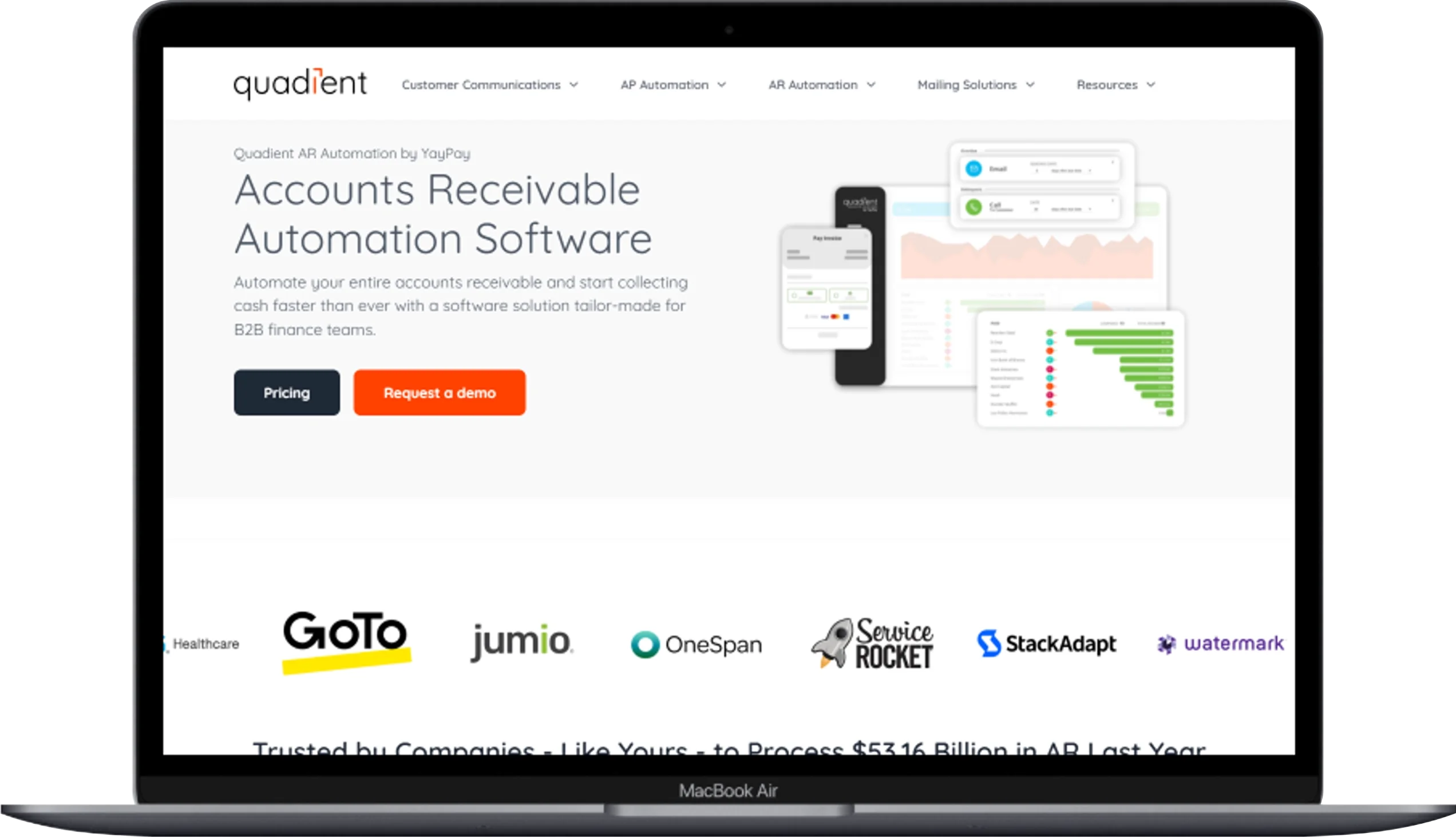
Quadient AR is one of the best accounts receivable software options for mid-market B2B teams that want stronger collections workflows and better forecasting without overcomplicating the stack.
Quadient AR by YayPay focuses on the full order-to-cash journey, including credit management, payment portal access, collections, cash application, dashboards, and forecasting. The product page emphasizes tailored collection workflows, real-time dashboards, external credit data, and a secure integrated payment portal. It also supports integrations with NetSuite, Acumatica, Sage, Microsoft Dynamics, QuickBooks, and SAP.
The metrics on its page are strong: 34% average reduction in DSO, 16 minutes saved per invoice, 94% forecasting accuracy, and 403% ROI over three years. Those numbers are again vendor-reported, but they show where Quadient wants to win: cash acceleration, workflow efficiency, and planning visibility.
From a practical angle, Quadient AR tends to make sense for B2B companies that have outgrown spreadsheets and basic accounting reminders but do not necessarily need the full weight of an enterprise order-to-cash suite.
Key features
- Tailored collections workflows
- Credit management
- Secure payment portal
- Cash application support
- Real-time dashboards
- Forecasting tools
- External credit data support
- Broad ERP integrations
Pricing
Custom quote. Quadient’s official pricing page directs buyers to book a demo and request business-specific pricing rather than using public flat plans.
Pros
- Strong collections engine
- Strong dashboards and forecasting
- Good fit for mid-market B2B AR teams
- Good integration coverage across common ERP systems
Cons
- No public pricing
- Still requires vendor conversations to estimate full cost
- May not be the best fit for businesses seeking broader finance transformation beyond AR
Why it’s on this list: strong collections engine, strong dashboards, and solid mid-market positioning.
Best for: B2B finance teams that want to automate collections and get cleaner AR reporting.
Watch-out: companies wanting very broad finance transformation across multiple adjacent functions may still compare it against larger suite vendors.
5) NetSuite: Best for Businesses That Want AR Inside the ERP
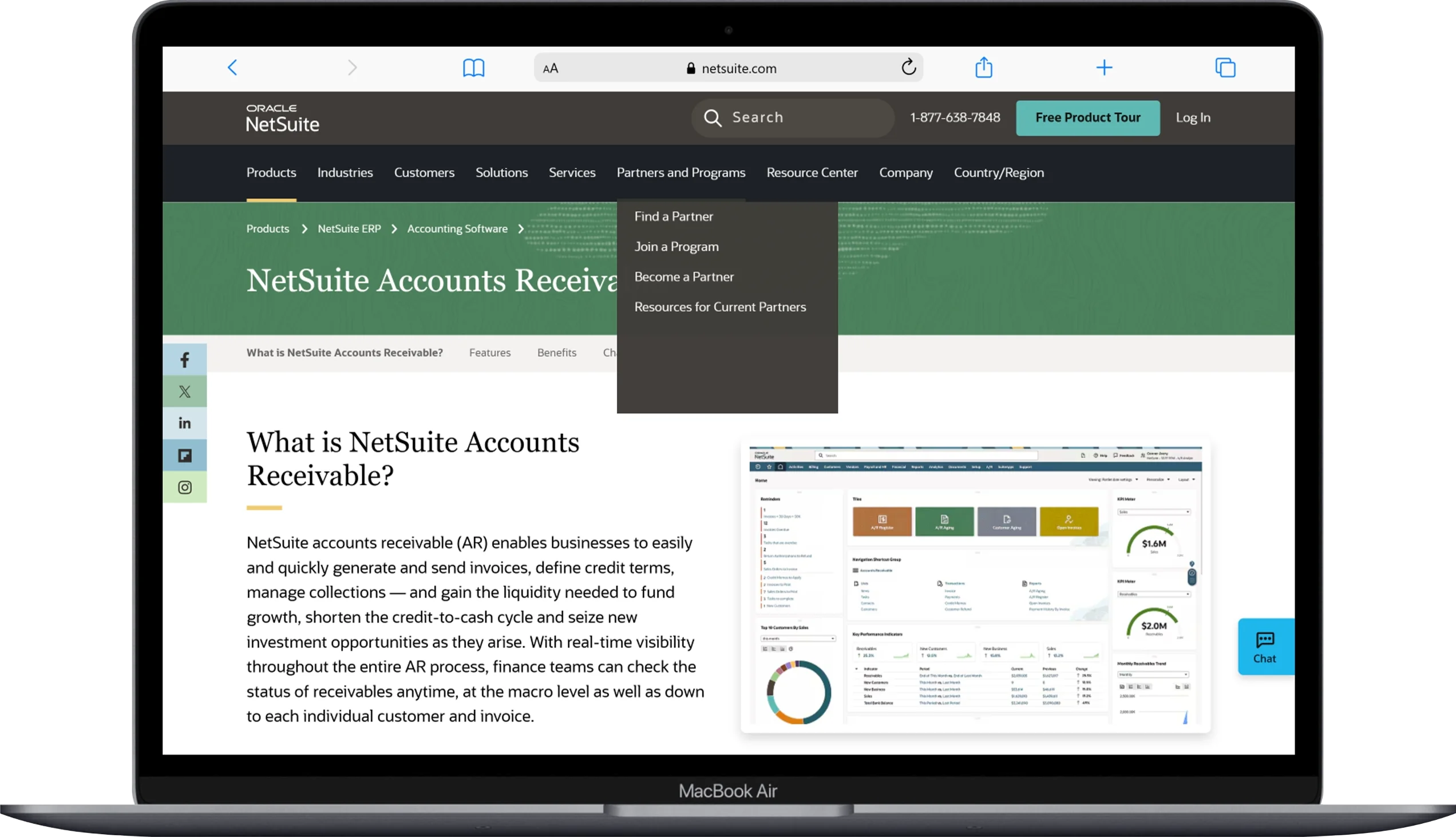
NetSuite is the best accounts receivable software choice for businesses that want AR managed inside their core ERP instead of through a separate overlay platform.
NetSuite AR includes automated invoicing, customer records, invoice grouping, payment management, dunning and collections, dashboards, and reporting. It also includes NetSuite Payment Link, which adds a “pay now” option to invoices. The big advantage is visibility. Finance teams can move from customer record to invoice record to receivable status without leaving the ERP.
This matters more than many vendor comparisons admit. In real life, a lot of AR friction comes from data split across too many systems. NetSuite solves that by making AR part of the main financial system. The product page also highlights multiple payment methods, automated tax handling, automated reminder notices, and configurable reporting. AR capabilities are included in the NetSuite platform, with an annual license structure plus one-time implementation costs.
Key features
- Automated invoicing
- Customer records
- Invoice grouping
- Payment management
- Dunning and collections
- AR dashboards
- Configurable reporting
- NetSuite Payment Link
Pricing
Annual license plus implementation. NetSuite says pricing includes the core platform, optional modules, number of users, and a one-time implementation fee. AR capabilities are included with the NetSuite platform license.
Pros
- Native ERP visibility
- Strong core AR controls
- Good fit for businesses already using NetSuite
- Reduces data fragmentation across tools
Cons
- Pricing is not simple or flat
- Implementation can be significant
- Specialized AR tools may offer more workflow nuance in collections
Why it’s on this list: native ERP visibility and strong core AR operations.
Best for: companies already using NetSuite or planning to standardize around it.
Watch-out: if you want a highly specialized collections layer with more advanced workflow nuance, you may still compare NetSuite with AR-first tools.
6) Sage: Best for Sage-Centered Finance Teams
Sage is one of the best accounts receivable software options for teams that already live in the Sage ecosystem and want AR automation tied closely to accounting and CRM data.
Sage’s AR page emphasizes collections management, recurring invoice generation, online payment processing, reminders, real-time reporting, credit management, and integrations with CRM and banking systems. It also highlights visibility into quotes, sales orders, invoices, outstanding balances, and aging. That combination can be attractive for finance teams that want AR automation but also want it to stay close to sales and accounting workflows.
Sage points users toward Sage Intacct for cloud accounting and ERP functionality and also mentions Sage 50 for smaller businesses. The product page cites customer outcomes around ROI and productivity at the broader product level, and it notes that AR automation can help reduce DSO and improve cash flow visibility.
Key features
- Collections management
- Recurring invoice generation
- Online payment processing
- Reminder automation
- Real-time reporting
- Credit management
- CRM integration
- Aging and cash flow visibility
Pricing
Contact sales. The official Sage pages reviewed here do not list public AR pricing and direct buyers to talk with product specialists.
Pros
- Strong fit for Sage-centered finance teams
- Good recurring invoice and reporting functionality
- Useful CRM and accounting visibility
- Good option for SMBs and mid-market companies already on Sage
Cons
- No public pricing on the official pages reviewed
- Best value often depends on broader Sage stack adoption
- Buyers outside Sage may prefer AR-first platforms
Why it’s on this list: strong fit for organizations already invested in Sage tools.
Best for: SMBs and mid-market teams using Sage Intacct or related Sage products.
Watch-out: buyers outside the Sage ecosystem may get more out of a platform with broader AR-first positioning.
7) Upflow: Best for Modern Finance Teams That Want Better AR Collaboration
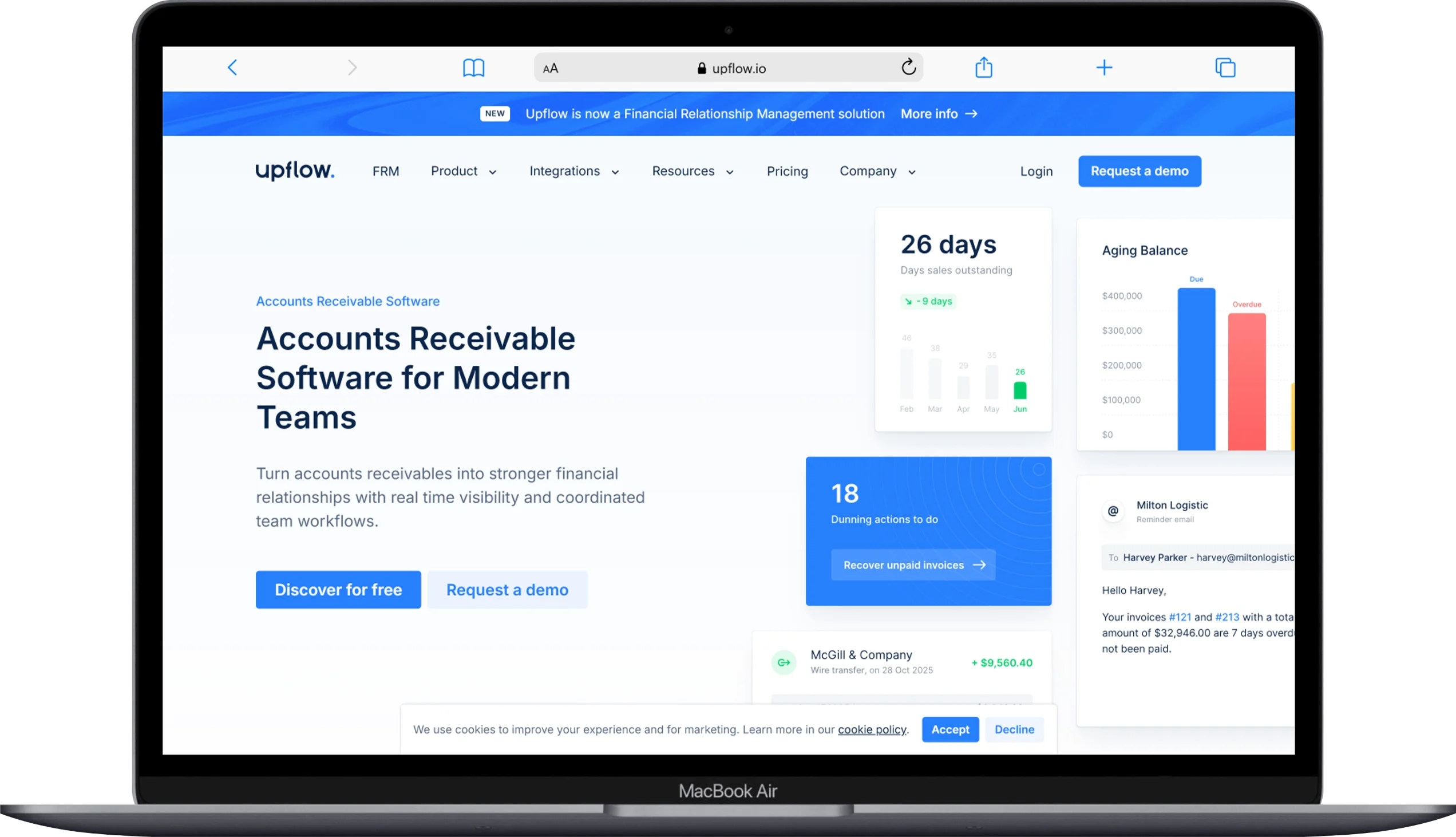
Upflow is the best accounts receivable software for modern B2B teams that want collections automation with a cleaner user experience and stronger internal collaboration.
Upflow frames AR as financial relationship management, not just invoice chasing. Its product page highlights automated personalized collections, real-time AR analytics, branded payment experience, Autopay, promise-to-pay, smart cash application, and cross-team collaboration between finance, sales, and customer success. That last part is a real differentiator. Many overdue issues are not purely finance issues. They often involve account ownership, service issues, or customer context.
Upflow also emphasizes real-time dashboards for DSO, CEI, aging, and forecasted cash inflows, plus integrations with NetSuite, QuickBooks, Sage, Xero, Stripe, Salesforce, Slack, and Zapier. It says businesses can reduce overdue payments by 50%, which is a vendor claim but does show its focus: getting teams out of manual follow-up and into a more coordinated workflow.
Key features
- Automated personalized collections
- Real-time AR analytics
- Branded payment experience
- Autopay
- Promise-to-pay tools
- Smart cash application
- Cross-team collaboration
- Integrations with ERP, accounting, CRM, and payment tools
Pricing
Free plus quote-based paid tiers. Upflow publicly lists a free Discover plan and names paid tiers such as Grow, Scale, and Strategic, but it does not show public paid prices on the pricing page.
Pros
- Modern UX
- Strong collaboration model
- Good for SaaS and fast-growing B2B teams
- Personalized collections approach feels more customer-friendly
Cons
- Paid tier pricing is not public
- May not be ideal for highly traditional enterprise environments
- Very complex multinational teams may want broader suite depth
Why it’s on this list: modern UX, strong collaboration model, and customer-friendly collections approach.
Best for: SaaS, subscription, and fast-moving B2B finance teams that want visibility and teamwork around receivables.
Watch-out: very complex multinational enterprises may still want deeper suite breadth.
8) Kolleno: Best All-in-One AR, Payments, and Reconciliation Platform
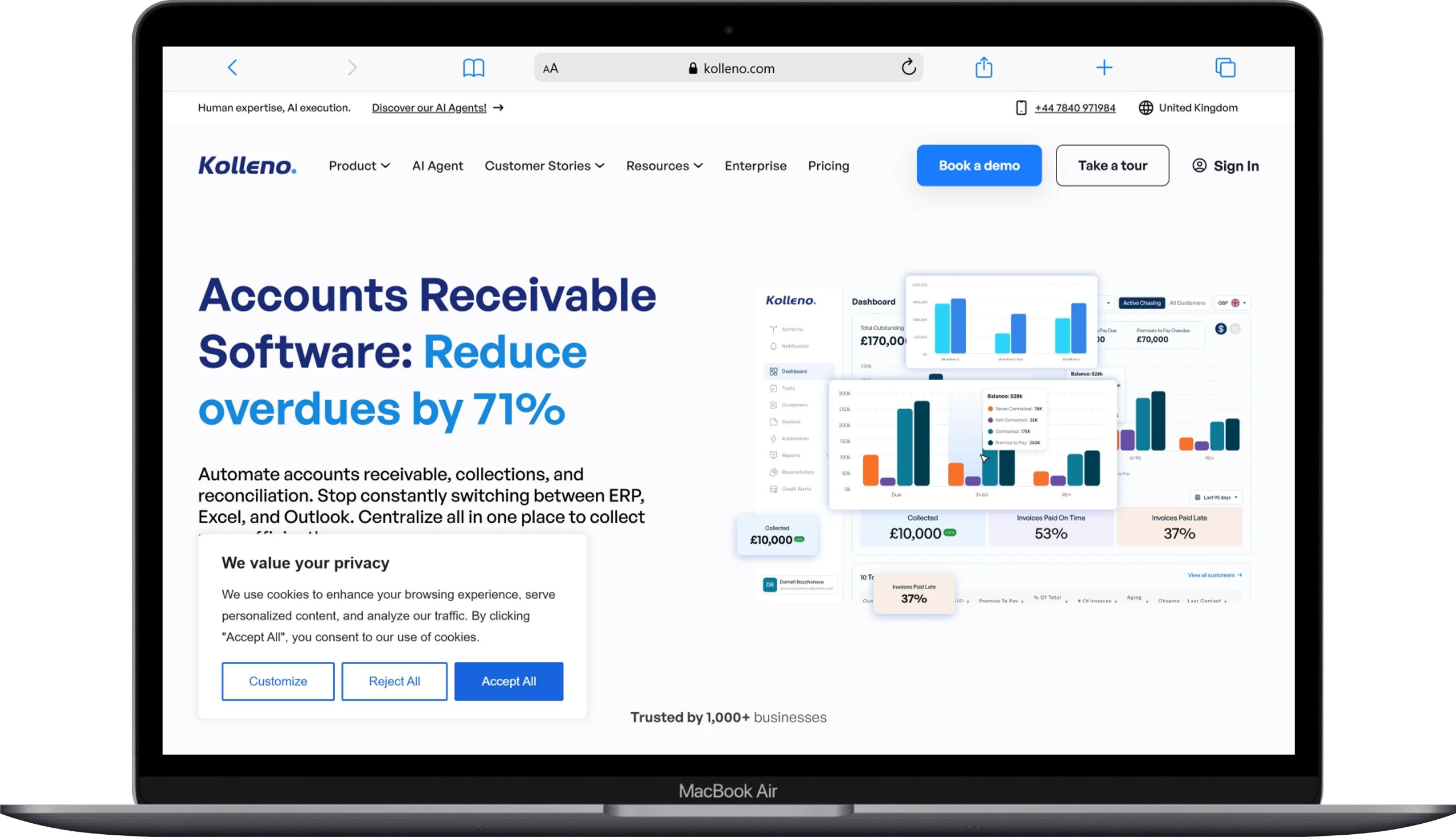
Kolleno is one of the best accounts receivable software platforms for teams that want AR automation, customer payments, reconciliation, and analytics in one place.
Kolleno’s positioning is practical. It is built to stop finance teams from switching between ERP, Excel, and Outlook. Its feature set includes collections automation, customer portal access, payment options, cash application, live dashboards, scheduled reports, AI-assisted search, credit risk monitoring, and partner integrations. It also says synchronization with ERP data happens every few minutes, with go-live as fast as 10 to 14 days.
The platform posts clear vendor-reported outcomes: 71% reduction in overdue balances, 10+ hours saved each week, and 30% reduction in DSO in the first six months. Those numbers won’t apply equally to every company, but they help explain why Kolleno is gaining attention in mid-market finance teams.
Key features
- Collections automation
- Customer portal access
- Payment options
- Cash application
- Live dashboards and reports
- Scheduled reporting
- AI-assisted search
- Credit risk monitoring
- ERP synchronization
Pricing
Contact sales. Kolleno does not show public flat pricing on the official product page reviewed here.
Pros
- Strong all-in-one proposition
- Good fit for teams replacing manual fragmented workflows
- Combines payments, analytics, and reconciliation in one platform
- Fast go-live message may appeal to mid-market teams
Cons
- No public pricing
- Brand awareness is lower than some larger incumbents
- Buyers need a demo to assess fit and real cost
Why it’s on this list: strong all-in-one proposition for teams replacing fragmented manual workflows.
Best for: mid-market businesses that want AR automation, payments, and analytics without juggling multiple tools.
Watch-out: if you need a deeply embedded ERP-native workflow above all else, you may compare this against ERP-centered options.
9) Gaviti: Best for Focused Collections Automation
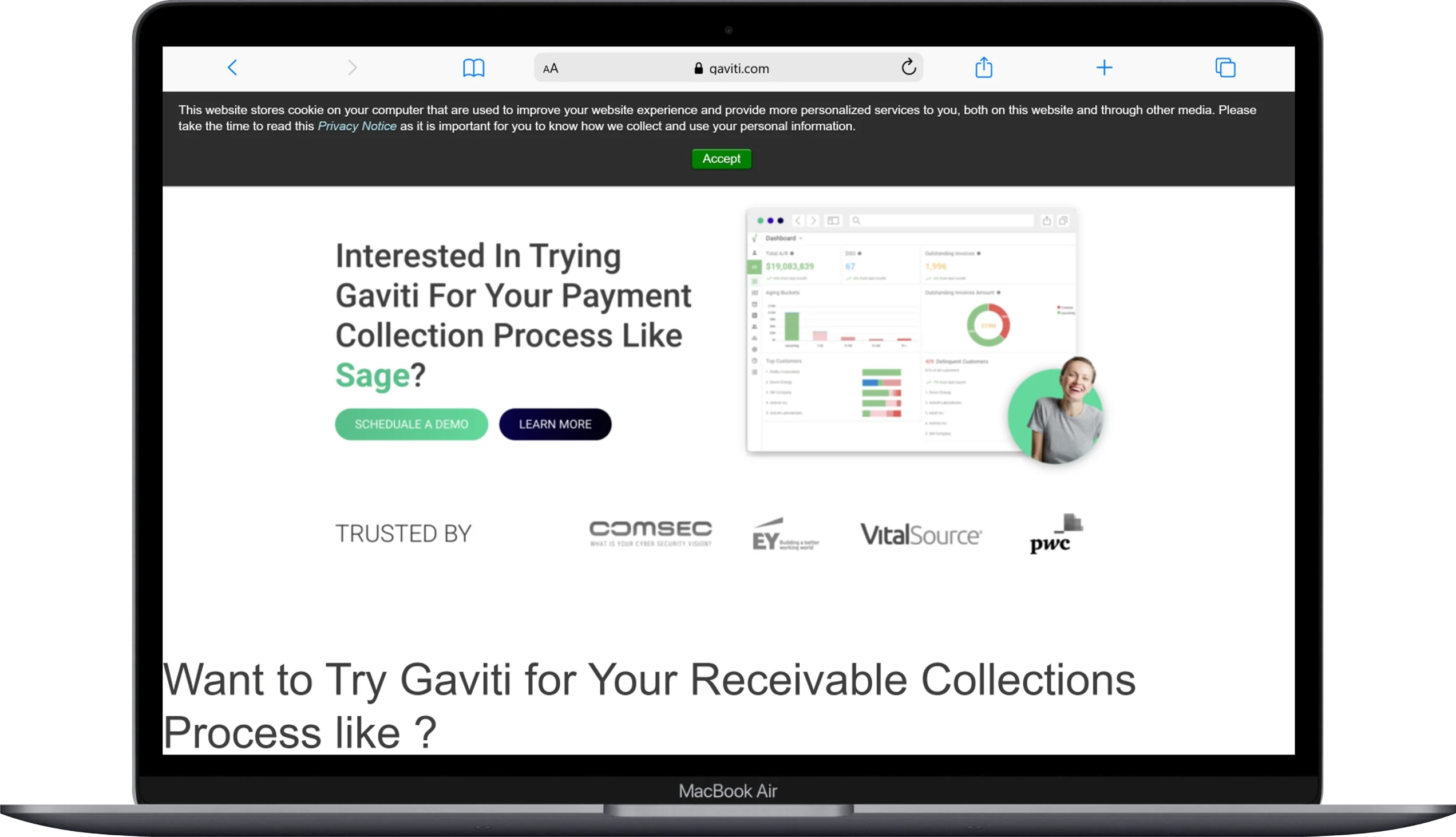
Gaviti is the best accounts receivable software on this list for teams that want a focused collections platform instead of a huge finance suite.
Gaviti emphasizes payment forecasting, real-time performance metrics, smart workflows, risk identification, team collaboration, and dashboard visibility. Its customer testimonials on the collections page add useful context. One finance director says the platform improved DSO by six days, helped the team drill into customers and invoices by aging bucket, and automated invoice distribution and reminder timing. Another customer points to the value of automatic emails and high-level AR visibility with drill-down detail.
That kind of feedback matters because it reflects the daily reality of collections work. Many teams don’t need an oversized suite. They need a platform that makes outreach consistent, keeps dashboards current, and helps collectors act faster.
Key features
- Payment forecasting
- Real-time performance metrics
- Smart workflows
- Risk identification
- Team collaboration support
- Dashboard visibility
- Customer-facing payment portal
- Dispute tracking
- AI-generated emails and AI assistant
Pricing
Custom quote. Gaviti says pricing is tailored to company needs and is based on usage rather than per-user pricing. It also says core features like unlimited workflows and unlimited users are included.
Pros
- Focused and practical collections automation
- Good dashboard visibility and drill-down view
- Usage-based pricing model may fit some finance teams well
- Helpful for in-house AR departments that want dedicated collections control
Cons
- No public dollar pricing
- Narrower platform scope than broader invoice-to-cash tools
- Requires a quote to compare true cost
Why it’s on this list: focused, practical collections automation with clear visibility.
Best for: in-house collections teams, controllers, and AR departments that want a dedicated receivables workflow tool.
Watch-out: if you want a broader invoice-to-cash platform with embedded payment stack and deeper ERP breadth, compare it carefully against platform vendors.
10) BILL: Best for Small Businesses That Need Fast AR Automation
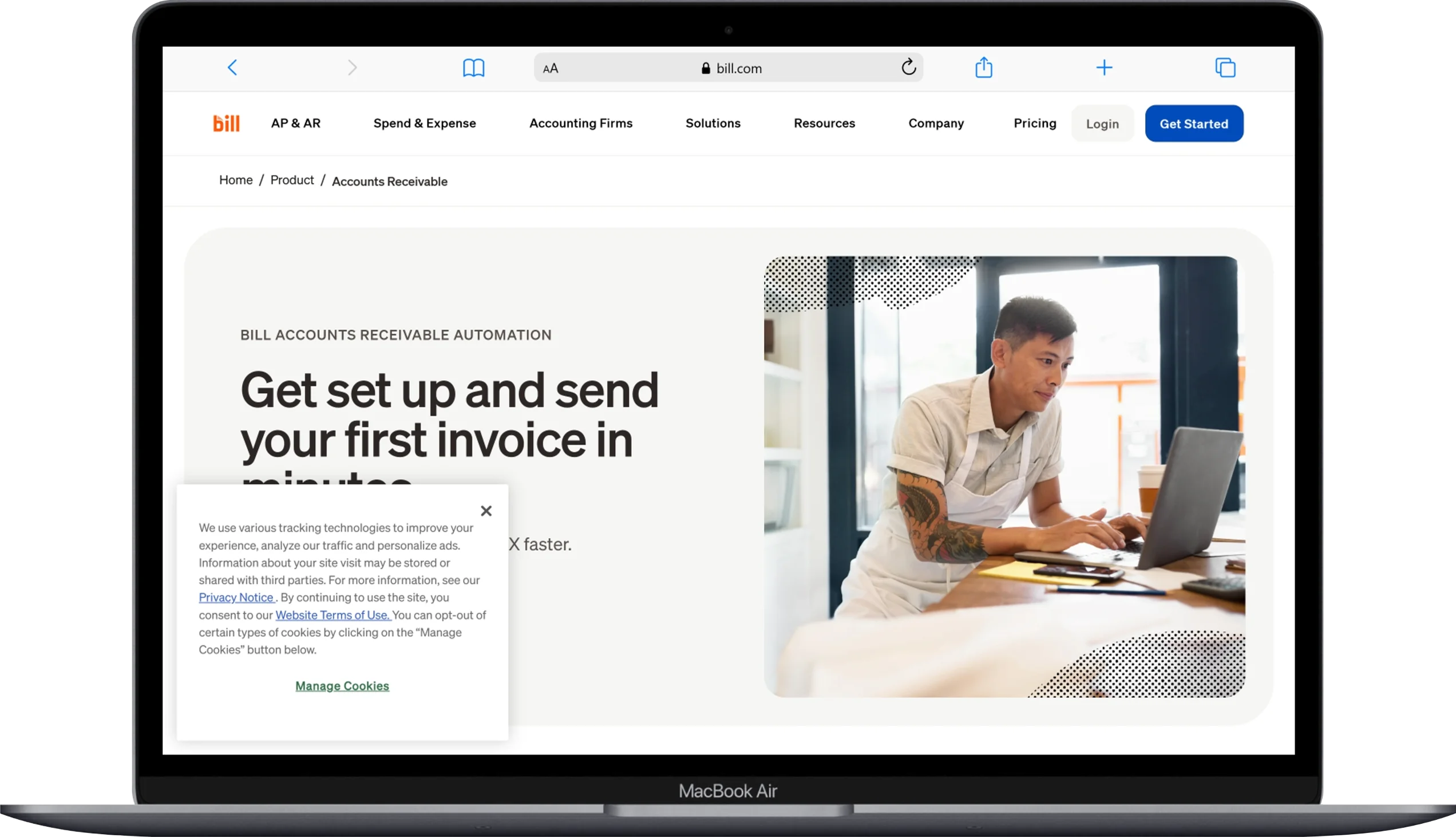
BILL is the best accounts receivable software for small businesses and lean finance teams that want to get invoices out fast and get paid faster without a long implementation cycle.
BILL keeps the workflow simple: create, send, track, and get paid. Its AR product supports invoice templates, recurring invoices, automated reminders, ACH and credit card payments, auto-charge and auto-pay, and two-way synchronization with accounting systems. It integrates with QuickBooks, NetSuite, Xero, Sage Intacct, and Microsoft Dynamics, which makes it a strong fit for growing companies that want easy AR automation without moving to an enterprise AR platform right away.
The product page says businesses can get paid 2x faster and get their first invoice out in minutes. That positioning tells you exactly where BILL wins: speed, ease of use, and lower setup friction.
Key features
- Invoice templates
- Recurring invoices
- Automated reminders
- ACH and credit card payments
- Auto-charge and auto-pay
- Invoice tracking
- Two-way accounting sync
- Fast setup workflow
Pricing
Public pricing available. BILL lists Essentials at $49/user/month, Team at $65/user/month, Corporate at $89/user/month, and Enterprise custom pricing.
Pros
- Very accessible AR automation for SMBs
- Public pricing is a strong advantage
- Fast setup and easy onboarding story
- Good integrations with common accounting tools
Cons
- Advanced teams may outgrow it
- Less depth than enterprise AR suites
- Per-user pricing can rise as teams expand
Why it’s on this list: very accessible AR automation for SMBs.
Best for: small businesses, startups, professional services firms, and lean finance teams.
Watch-out: if you need advanced collections segmentation, enterprise forecasting, or deep deduction workflows, you’ll likely outgrow it.
Which Accounts Receivable Software Is Best for Your Business?
The best accounts receivable software depends on your invoice volume, ERP environment, team size, and how complex your collections process is.
If you want the short version:
- Choose HighRadius if you need enterprise-scale automation across credit, invoicing, collections, cash app, and deductions.
- Choose Billtrust if you want a broad invoice-to-cash platform with embedded payments.
- Choose Versapay if customer portal experience and collaborative AR matter most.
- Choose Quadient AR if you want strong mid-market collections workflows and forecasting.
- Choose NetSuite if you want AR inside your ERP.
- Choose Sage if you already run on the Sage stack.
- Choose Upflow if you want a modern, collaborative AR experience.
- Choose Kolleno if you want all-in-one AR, payments, reconciliation, and analytics.
- Choose Gaviti if you want a focused collections platform.
- Choose BILL if you want quick AR automation for a smaller business.
Common Mistakes When Choosing Accounts Receivable Software
The biggest mistake is choosing accounts receivable software based on a feature demo instead of your real collections process.
Here are the mistakes I see most often in this category:
1. Buying based on price alone
Cheap software is expensive if it creates manual work later.
A lower-cost tool may still force your team to handle reminders, payment matching, notes, and reporting manually. That slows collections and limits ROI.
2. Ignoring ERP and accounting integration
AR software only works well when invoice and payment data stay current.
ERP integration matters because disconnected systems can lead to wrong reminders, poor forecasting, and slower operations.
3. Overbuying for your current stage
A small team does not always need an enterprise AR suite.
If you send 200 invoices a month and mostly need fast online payments and reminders, a large enterprise platform may be too much. The reverse is also true. If you run complex B2B collections across regions, a lightweight SMB tool will hit a wall.
4. Underestimating customer experience
Customers pay faster when the process is clear and easy.
Portals, payment links, invoice access, and professional communication matter more than many buyers expect.
Practical Tips for Picking the Right Accounts Receivable Software
The best way to choose AR software is to map your current receivables process before you compare vendors.
Start with these questions:
What is breaking today?
- Late payments
- Manual reminders
- Slow cash application
- Weak reporting
- Poor customer communication
- Too many tools
What systems must the software connect to?
- ERP
- Accounting system
- CRM
- Bank
- Payment gateway
- Customer portal
What does success look like in 6 months?
- Lower DSO
- Fewer overdue invoices
- Better cash visibility
- Less manual work
- Better collector productivity
- Improved customer satisfaction
From experience, the cleanest buying decisions happen when finance teams define the operational problem first. Then the software shortlist becomes much easier.
Product Demos Worth Watching
If you want quick visual references before booking demos, these are useful:
- NetSuite Accounts Receivable Software: Reports & Dashboards
- HighRadius AI-Powered Accounts Receivable Automation Software
- Sage Intacct Accounts Receivable Demo
These won’t replace a live demo, but they can help you quickly see whether a product feels ERP-first, portal-first, or collections-first.
FAQ About the Best Accounts Receivable Software
Is there one best accounts receivable software for every business?
No, because the best platform depends on your invoice volume, ERP stack, customer payment behavior, and how advanced your collections process needs to be.
Is enterprise AR software always better than SMB AR software?
No, because enterprise software can be too complex and too expensive if your team mainly needs fast invoicing, reminders, and online payment collection.
Can accounts receivable software improve cash flow?
Yes, because AR automation can speed invoicing, improve follow-up timing, reduce manual errors, and help businesses collect payments faster.
Should I choose ERP-native AR or a specialized AR platform?
It depends, because ERP-native AR gives you tighter system control, while specialized AR platforms often give you stronger collections workflows, portals, analytics, and payment experience.
Is a customer portal really important in AR software?
Yes, because portal access can reduce payment friction by giving customers one place to view invoices, make payments, and resolve disputes.
Can small businesses benefit from accounts receivable software?
Yes, because even a small finance team can save time and improve collections with recurring invoices, automated reminders, and easier payment options.
Final Verdict on the 10 Best Accounts Receivable Software
If you want the strongest enterprise platform, start with HighRadius. If you want a broad invoice-to-cash platform, look closely at Billtrust and Versapay. If you want ERP-native control, NetSuite is hard to ignore. If you want faster, simpler wins for a smaller business, BILL is a strong starting point.
Let’s be honest: the best accounts receivable software is the one your finance team will actually use every day. That means it needs to fit your workflow, your data, your customers, and your team’s capacity. A polished demo is nice. A platform that actually reduces overdue invoices, gives you cleaner aging visibility, and makes payment easier is what matters.
You May Also Like
 Cloud Computing
8 Best AWS S3 Alternatives Compared: Pricing, Egress, and S3 Compatibility
 SaaS
SaaSWhat is Confluence Used For In Project Management?
 SaaS
SaaSCognito Forms to Jira Software Cloud Integration: Setup, Automation, Field Mapping, and Best Practices
 Web Development
Building Apps with Lovable and Supabase: A Step-by-Step Guide
 Web Development
Heroku vs. Netlify (2026): Pricing, Features, and Best Uses
 Software
When Fixing Bugs Is No Longer Enough: How to Rescue a Failing Software Project
 SaaS
SaaS25 Best Pipedrive Integrations to Automate Sales and Grow Your Business
 SaaS
SaaS10 Best Virtual Phone Number Services for 2026: A Practical Buying Guide
 SaaS
SaaS