


A Distributed Denial of Service (DDoS) attack is a deliberate, coordinated assault designed to disrupt the normal operations of a targeted server, service, or network by flooding it with an overwhelming volume of internet traffic. This traffic, originating from thousands or even millions of compromised devices known as a botnet, consumes critical resources, rendering the target slow, unstable, or completely inaccessible to legitimate users. For businesses and organizations, the consequences extend far beyond temporary inconvenience; they include significant financial loss, reputational damage, and erosion of customer trust. Understanding DDoS attacks is a non-negotiable aspect of modern digital risk management.
These attacks are not about data theft; their primary objective is pure disruption. They exploit the fundamental architecture of the internet to create digital gridlock. While large enterprises frequently make headlines, small and medium-sized businesses are equally, if not more, vulnerable due to often limited defensive resources. The path forward is not one of fear, but of preparedness. This guide delivers a clear, actionable framework for identifying, preventing, and responding to DDoS threats, empowering organizations to safeguard their digital infrastructure and ensure uninterrupted business operations.
How DDoS Attacks Operate?
A DDoS attack functions by orchestrating a massive, synchronized traffic flood from a global network of compromised devices, known as a botnet, to exhaust a target’s resources. Unlike a simple, single-source Denial of Service (DoS) attempt, the distributed nature of a DDoS attack makes it exponentially more powerful and difficult to mitigate. Blocking one malicious IP address is futile when thousands more are waiting to take its place.
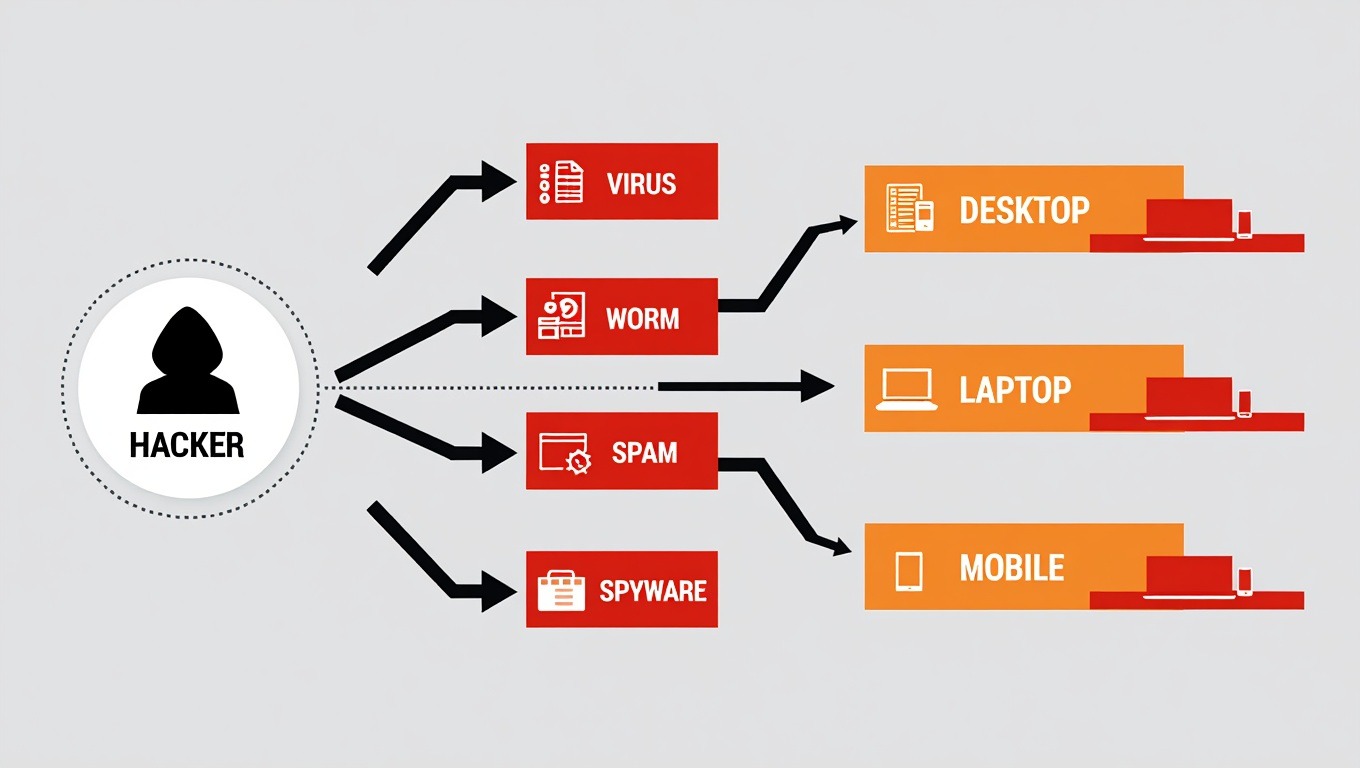
The process begins with attackers infecting computers, servers, and Internet of Things (IoT) devices like security cameras or routers with malware. These infected machines, called “bots” or “zombies,” are silently controlled through a central command-and-control server. When activated, the entire botnet directs its traffic towards a specific target. The goal is to consume one or more critical resources: available network bandwidth, server processing power (CPU), memory (RAM), or application capacity. The result is akin to a major highway being blocked by thousands of abandoned vehicles; legitimate traffic simply cannot get through. This coordinated assault can bring even the most robust online services to a standstill.
The Three Primary Types of DDoS Attacks Targeting Modern Infrastructure
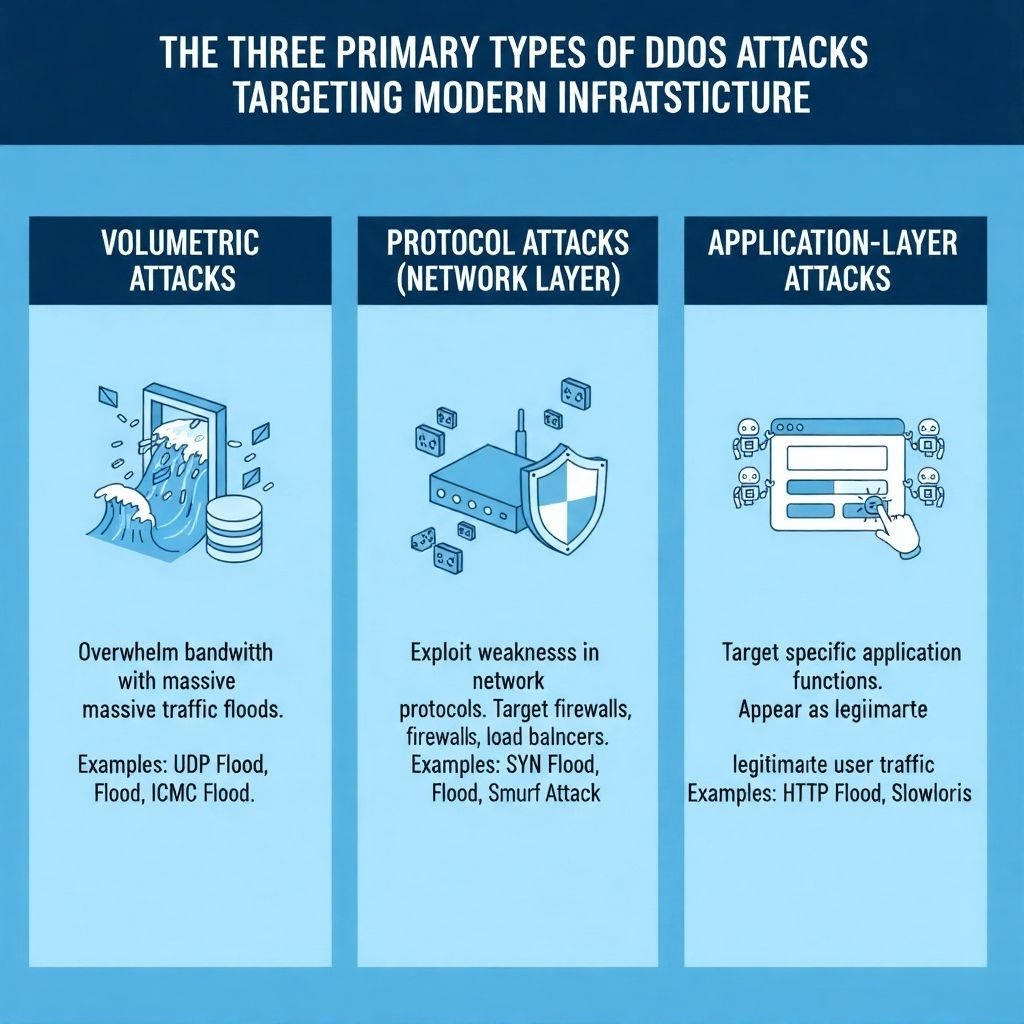
DDoS attacks are strategically categorized into three distinct types—volumetric, protocol, and application-layer—each designed to exploit different vulnerabilities in a target’s infrastructure. Understanding these categories is essential for deploying effective, layered defenses.
- Volumetric Attacks: These are the most common and aim to saturate the target’s internet bandwidth. Attackers generate enormous amounts of data, often using techniques like UDP or ICMP floods, effectively clogging the “pipes” that connect the target to the rest of the internet. The primary metric here is bits per second (bps). If an organization’s connection is 1 Gbps, an attacker might launch a 500 Gbps flood to ensure complete saturation.
- Protocol Attacks (Network Layer Attacks): These attacks target the network infrastructure itself, such as firewalls, load balancers, and servers, by exploiting weaknesses in communication protocols like TCP. A classic example is the SYN flood, where the attacker initiates a vast number of TCP connection requests but never completes them. This forces the target server to allocate resources to these half-open connections, eventually exhausting its capacity to handle legitimate requests.
- Application-Layer Attacks: Often considered the most insidious, these attacks target the top layer of the OSI model, where web pages and applications are delivered. Instead of brute force, they mimic legitimate user behavior, making them harder to detect. An attacker might repeatedly request a resource-intensive database query or reload a complex webpage thousands of times per second. This slowly drains the server’s CPU and memory, degrading performance for all users until the service fails. These attacks are measured in requests per second (RPS).
How Can You Tell If Your Website Is Under a DDoS Attack?
The most definitive sign of a DDoS attack is a sudden, unexplained degradation or complete outage of your online service, often accompanied by a massive spike in inbound traffic and critically high server CPU or memory usage. While legitimate traffic surges can cause slowdowns, DDoS attacks typically present a cluster of specific, anomalous symptoms that warrant immediate investigation.
Organizations should monitor for these critical warning signs:
- Severe Performance Degradation or Outage: Websites or applications become extremely slow or return errors like “503 Service Unavailable” for all users, not just a few.
- Unexplained Traffic Spikes: Network monitoring tools show a dramatic, sustained increase in traffic volume that cannot be attributed to a marketing campaign, product launch, or other known event.
- Skyrocketing Server Resource Utilization: System monitoring dashboards will show CPU usage spiking to 90-100% and memory being fully consumed, even if the number of legitimate user sessions hasn’t changed. This is a crucial indicator, especially for application-layer attacks.
- Unusual Traffic Patterns: Traffic originates from a single IP range, a geographic region where you have no users, or occurs at odd hours. You might also see an abnormal number of requests to a single page or endpoint.
- Internal Network Issues: For attacks targeting internal infrastructure, widespread network slowness or disconnections across the corporate network can be a symptom.
Recognizing these signs quickly is paramount. The faster an organization can confirm an attack, the sooner it can activate its mitigation plan and minimize business impact.
How Can You Protect Websites from DDoS Attacks?

Protecting against DDoS attacks requires a proactive, multi-layered security posture that combines robust technology, vigilant monitoring, and strategic partnerships. Relying on a single solution is insufficient; resilience is built through defense in depth.
Here are the essential strategies organizations should implement:
- Leverage a Reputable DDoS Mitigation Service: This is the cornerstone of modern DDoS defense. Services like Cloudflare, Akamai, or AWS Shield act as a protective shield in front of your infrastructure. They absorb and filter malicious traffic before it ever reaches your servers. Cloudflare, for instance, offers a global network that can mitigate attacks of virtually any size. Organizations can also explore dedicated strategies for protecting customer data, as the infrastructure for DDoS defense often overlaps with broader data security measures.
- Implement Multi-Layered Security: Combine network-level protections (like firewalls and intrusion prevention systems) with application-level security (like a Web Application Firewall – WAF). This ensures that different types of attacks are caught at different stages. If you’re using WordPress, you can install a security plugin like WordFence, Sucuri, iThemes Security, MalCare, and CleanTalk Security.
- Deploy Continuous Traffic Analysis: Establish a baseline of normal traffic patterns and implement real-time monitoring. Tools that use machine learning can detect subtle anomalies indicative of an emerging attack, allowing for a faster response.
- Increase Network Resilience: Design your network with redundancy. If one server or connection path fails, others should seamlessly take over. Consider scaling your bandwidth capacity to handle larger surges, although this alone cannot stop a determined, large-scale attack.
- Maintain Rigorous Cyber Hygiene: Keep all systems, software, and firmware patched and updated. Unpatched vulnerabilities are how attackers build their botnets. Enforce strong, unique passwords and implement multi-factor authentication (MFA) for all critical systems.
A truly resilient defense is built on three pillars: reducing your attack surface, continuously monitoring for threats, and having scalable, on-demand mitigation tools ready to deploy.
How to Choose a Hosting Provider or Server Infrastructure to Minimize DDoS Risk
Selecting the right hosting provider or server infrastructure is a critical first step in building inherent DDoS resilience, as the provider’s capabilities directly impact your ability to withstand an attack. Not all hosting environments are created equal when it comes to DDoS protection.
Organizations should evaluate potential providers based on these key criteria:
- Built-in DDoS Mitigation: Does the provider offer DDoS protection as a standard feature or as an affordable add-on? Look for providers that explicitly state their mitigation capacity (e.g., “mitigates attacks up to 2 Tbps”). Managed cloud providers like AWS, Google Cloud, and Azure typically offer robust, scalable protection.
- Network Size and Redundancy: A larger, globally distributed network has more capacity to absorb and disperse attack traffic. Providers with multiple data centers and redundant network paths can reroute traffic around an attack.
- Scalability: Can the provider quickly scale your bandwidth or computing resources on-demand during an attack? Elastic cloud infrastructure is inherently more resilient than fixed, on-premise servers.
- Security Expertise and Support: Does the provider have a dedicated security team and a clear, documented incident response process for DDoS attacks? 24/7 support is crucial.
- Transparency and Reporting: Will the provider give you detailed reports on attack traffic and mitigation efforts? Transparency is key for post-attack analysis and improving your defenses.
For small to medium businesses, a managed cloud hosting solution with integrated DDoS protection is often the most cost-effective and secure choice. For larger enterprises with complex needs, a hybrid approach combining on-premise infrastructure with a cloud-based DDoS mitigation service may be optimal. Understanding the underlying differences between a host and a server can also inform this decision.
What Should You Do If You’re Currently Under a DDoS Attack?
If an organization suspects it is under a DDoS attack, it must immediately activate its predefined incident response plan, notify its internet service provider (ISP) or DDoS mitigation partner, and prioritize maintaining critical business functions. Hesitation can turn a manageable incident into a full-blown crisis. The primary goal of the response plan is to define the resources, tools, and procedures required to minimize the cost and duration of the attack.
Here is a critical instruction list for an active attack:
- Confirm and Assess: Quickly use monitoring tools to verify the attack and determine its type (volumetric, protocol, or application-layer) and scale. Check server CPU, memory, and network graphs.
- Activate Your DDoS Response Plan: Mobilize your incident response team. Follow the predefined steps, which should include communication protocols and technical mitigation procedures.
- Engage Your Mitigation Provider: Contact your DDoS mitigation service (e.g., Cloudflare) or ISP immediately. They can often reroute traffic through their scrubbing centers to filter out the malicious packets upstream.
- Implement On-Premise Mitigation (If Applicable): If you have on-premise defenses, activate rate limiting, block suspicious IP ranges (if feasible and not too broad), or divert traffic.
- Communicate Transparently: Inform internal stakeholders and, if necessary, external customers about the situation. Provide regular updates on the status and expected resolution time. Transparency helps maintain trust.
- Post-Attack Analysis: Once the attack subsides, conduct a thorough analysis. Review logs, understand the attack vector, and update your defenses and response plan to prevent a recurrence.
The response plan should be designed so that critical services can continue to operate, even in a degraded state. Prioritization is key; not every service needs to be restored at the same time.
How Can You Prepare a Comprehensive DDoS Response Plan for Your Organization?
Preparing a DDoS response plan involves meticulously documenting roles, responsibilities, communication channels, and technical procedures well before an attack occurs, ensuring a swift and coordinated defense. Preparation is universally recognized as the most critical phase. A well-structured plan transforms chaos into a controlled, effective response.
Essential components of a robust DDoS response plan include:
- Define the Response Team: Clearly identify who is responsible for detection, technical mitigation, internal and external communications, and executive decision-making. Ensure these individuals are trained and know their roles.
- Create a Critical Systems Inventory: Document all essential systems, their dependencies, and contact information for key vendors, including ISPs and DDoS mitigation providers.
- Establish Detection and Escalation Procedures: Define the specific metrics and thresholds that will trigger an alert and outline the exact steps for escalating the incident to the response team.
- Outline Mitigation Strategies: Detail the specific technical actions to be taken, such as which mitigation service to contact, which firewall rules to implement, or which servers to failover to.
- Develop Communication Templates: Prepare pre-approved communication templates for internal staff, customers, partners, and the media. This ensures consistent, timely messaging during a high-stress event.
- Integrate Threat Intelligence: Regularly review threat intelligence reports to understand evolving DDoS tactics and update your plan accordingly.
- Test and Refine: Conduct regular tabletop exercises to simulate an attack and test the plan. Use the findings to refine and improve the plan. An untested plan is an unreliable plan.
Organizations should use cyber threat intelligence to understand the latest attack methods and develop their response plan accordingly. Regular testing ensures the plan remains effective as the threat landscape evolves.
What Are the Legal Consequences for Individuals or Groups Who Launch DDoS Attacks?
Launching a DDoS attack is a serious federal crime in most jurisdictions, carrying severe penalties that include substantial fines and lengthy prison sentences, reflecting the significant harm these attacks cause. These attacks are explicitly illegal under laws such as the U.S. Computer Fraud and Abuse Act.
Legal repercussions for perpetrators can be severe:
- In the United States, an unauthorized DDoS attack can result in up to 10 years in federal prison and fines of up to $500,000.
- Courts have handed down significant sentences; for example, in 2021, an individual received the maximum five-year sentence for his role in DDoS attacks.
- Using, supplying, or obtaining “stresser” or “booter” services—tools marketed for testing but often used for illegal attacks—can also lead to criminal charges, including imprisonment and fines.
- Beyond criminal penalties, attackers can face civil lawsuits from their victims, seeking damages for financial losses incurred during the attack.
These stringent legal consequences underscore the gravity with which authorities treat DDoS attacks, recognizing them as destructive acts that can cripple businesses and disrupt essential online services.
Frequently Asked Questions (FAQ) About DDoS Attacks
Is a DDoS attack the same as a data breach?
No. DDoS attacks aim to disrupt service availability by overwhelming a target with traffic. They do not involve unauthorized access to steal or alter sensitive data, which is the hallmark of a data breach.
Can DDoS attacks target small businesses?
Yes. While large corporations are frequent targets, small businesses are often seen as “low-hanging fruit” due to potentially weaker defenses. Competitors, disgruntled individuals, or even automated botnets can target them.
Are all DDoS attacks massive and obvious?
No. While some are enormous floods, others, like sophisticated application-layer attacks, can be “low and slow,” quietly degrading performance over hours or days, making them harder to detect without proper monitoring.
Is it advisable to pay a ransom demanded during a DDoS attack?
No. Paying a ransom does not guarantee the attack will stop and may identify the organization as a willing payer, making it a target for future attacks. Focus on technical mitigation and involve law enforcement.
Can standard antivirus software stop a DDoS attack?
No. Antivirus software protects individual endpoints from malware. DDoS attacks target network and application services and require specialized infrastructure-level defenses like traffic filtering and mitigation services.
Do DDoS attacks only target websites?
No. Any internet-facing service is a potential target, including email servers, DNS services, APIs, gaming servers, and even entire corporate networks.
Conclusion: Building Resilience Against the Inevitable
DDoS attacks are a persistent and evolving threat in the digital ecosystem. They represent a deliberate attempt to disrupt business continuity by exploiting the internet’s openness. Understanding that a DDoS attack is a malicious flood from many sources designed to overwhelm a target is fundamental. Recognizing the different attack types—volumetric, protocol, and application-layer—is crucial for selecting the appropriate defensive measures.
Detection hinges on vigilance: unexplained slowdowns, traffic spikes, and critically high server CPU usage are key indicators. Protection is not about achieving absolute immunity—it’s about building resilience. This requires a multi-layered strategy: partnering with a robust DDoS mitigation provider like Cloudflare, implementing continuous traffic monitoring, practicing good cyber hygiene, and, most importantly, having a well-documented and regularly tested incident response plan.
Real-world incidents, from the Dyn attack to recent events in 2024, demonstrate the widespread and severe impact these attacks can have. The legal consequences for attackers are severe, reflecting the seriousness of the offense. By taking these proactive steps, organizations can significantly reduce their vulnerability, ensure they are prepared to respond effectively, and maintain operational continuity even in the face of a digital siege. In today’s interconnected world, DDoS preparedness is not optional; it is a core component of responsible business management.
You May Also Like
 Web Development
What Is API Rate Limiting? (A Practical, Simple Guide for Safer, Faster APIs)
 Web Development
REST API vs SOAP API: Differences, Pros & Cons, and Use Cases
 Cybersecurity
What Is Zero Trust Network Access (ZTNA)? How It Works, How It Differs From a VPN, and When to Use It
 Cybersecurity
What Is Netskope? Cloud Security, SASE, and Zero Trust Explained
 Web Development
How Long Does It Take to Code an App?
 Cybersecurity
Is Fanatical Legit and Safe? My Honest Take on Buying Game Keys
 Data Security & Privacy
Is Gameflip Legit and Safe for Gift Cards? What Buyers Should Know
 Data Security & Privacy
Is Eldorado.gg Legit and Safe in 2026? My Investigation and What Buyers Should Know
 Web Development