

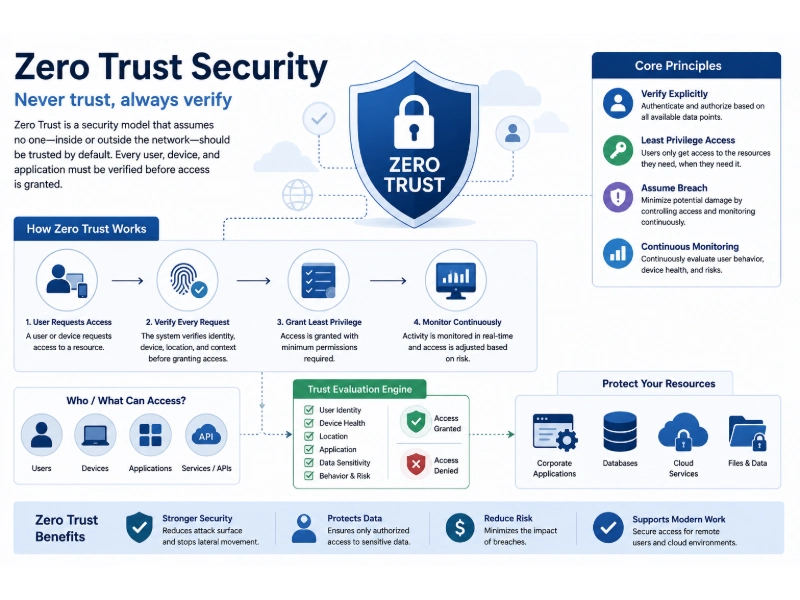
Most breaches over the past decade share a common thread: an attacker got hold of a single set of valid credentials, or landed on one machine inside the network, and then moved around freely because everything past the firewall was assumed safe. Zero Trust exists to close that gap. It isn’t a product you buy — it’s an architectural stance that treats every request the same way regardless of where it originates: verify it, grant the minimum access it needs, and keep watching after access is granted.
If you’ve read a network security audit checklist or worked through a small business network security checklist, you’ve already brushed up against Zero Trust thinking even if nobody called it that. This article goes deeper than the usual surface-level explainer: where the model came from, exactly what NIST and CISA say it requires, how the pieces work together technically, where it actually gets used, what a realistic rollout looks like, and where organizations commonly get it wrong.
Where the Term Actually Comes From
The phrase “Zero Trust” dates to 2010, when Forrester analyst John Kindervag coined it around the idea of “never trust, always verify” — a direct challenge to the assumption that anything inside a corporate network perimeter could be trusted by default.
Google gave the concept its first large-scale real-world test. In 2009, the company was hit by a sophisticated, nation-state-linked intrusion known as Operation Aurora, which also targeted Adobe, Yahoo, Symantec, and roughly thirty other firms. The attackers used spear-phishing and a browser zero-day to get a foothold and then moved laterally inside trusted networks to reach source code repositories. Google’s response was to start building what it later called BeyondCorp beginning in 2011, publicly documenting the architecture in a 2014 research paper. BeyondCorp removed the idea of a privileged internal network entirely — every request, from any location, went through the same identity and device verification. You can read Google’s own account of the project on the Google Cloud BeyondCorp page.
NIST formalized the broader approach in August 2020 with Special Publication 800-207, Zero Trust Architecture, which remains the closest thing to an official reference framework. In May 2021, Executive Order 14028, “Improving the Nation’s Cybersecurity,” required U.S. federal agencies to adopt Zero Trust Architecture, and the Office of Management and Budget followed with implementation deadlines in Memorandum M-22-09. CISA subsequently published its own Zero Trust Maturity Model, now on version 2.0, to give agencies — and by extension, any organization — a structured way to measure progress. That combination of events is what pulled Zero Trust out of niche security circles and into mainstream enterprise IT budgets.
Why the Perimeter Model Stopped Working
Traditional network security assumed a hard outer shell — firewalls, VPNs, a trusted internal LAN — with soft, high-trust space inside. That assumption made sense when employees sat in one building and applications lived in one data center. It stopped making sense once companies adopted SaaS tools, remote work, bring-your-own-device policies, and multi-cloud infrastructure. There is no longer a single perimeter to defend, so a model that depends on one no longer holds up. Employees now connect to sensitive systems from home routers, coffee shop Wi-Fi, and personal phones — and understanding wireless network security standards like WPA2 and WPA3 only covers one layer of that exposure, not the whole picture.
This is also why every honest conversation about how important cybersecurity is for small businesses eventually arrives at identity and access, not just firewalls. A smaller company with a flat network and one shared admin account is, in effect, running the exact perimeter model that large enterprises are actively abandoning.
The Seven NIST Tenets
NIST 800-207 doesn’t describe Zero Trust as a single checklist so much as a set of tenets a mature architecture should satisfy. Distilled down:
- All data sources and computing services are treated as resources. Every asset — a database, an IoT sensor, a laptop — needs protection regardless of where it sits or how mundane it seems.
- All communication is secured regardless of network location. Being on the “internal” network confers no special trust; a request from the office and a request from a hotel Wi-Fi network are evaluated identically.
- Access to individual resources is granted per session. Authentication at 9 a.m. doesn’t imply authorization at 5 p.m. for something unrelated; trust is evaluated at the point of each request.
- Access is determined by dynamic policy, including the identity of the requesting user or service, the requesting device’s posture, and other behavioral or environmental attributes.
- The enterprise monitors and measures the integrity and security posture of all owned and associated assets. No device is trusted just because it was compliant last week.
- All resource authentication and authorization is dynamic and strictly enforced before access is allowed. This is a continuous cycle of scan, assess, adapt, not a one-time gate.
- The enterprise collects as much information as possible about the current state of assets, network infrastructure, and communications, and uses it to improve its security posture over time.
Those tenets are why Zero Trust so often gets summarized as “never trust, always verify” — but the actual publication is considerably more specific about what “verify” needs to include at each layer.
CISA’s Five Pillars
Where NIST describes principles, CISA’s Zero Trust Maturity Model breaks the work into five practical pillars that map more directly onto how IT teams actually organize their tooling: Identity, Devices, Networks, Applications & Workloads, and Data, plus three cross-cutting capabilities — visibility and analytics, automation and orchestration, and governance — that tie the five pillars together. Each pillar is scored across four maturity stages: Traditional, Initial, Advanced, and Optimal. It’s a useful lens because it turns “adopt Zero Trust” from an abstract goal into five separate workstreams that different teams can own and measure independently, which lines up well with how a network security assessment checklist is usually structured in practice.
How the Pieces Fit Together Technically
Identity and access management (IAM) is the foundation. Multi-factor authentication, single sign-on, and strong identity providers confirm that a user is who they claim to be before anything else happens. This is also where the difference between ABAC and RBAC access control models actually matters in a Zero Trust build: role-based access control (RBAC) grants permissions by job title, while attribute-based access control (ABAC) evaluates dynamic attributes — device health, location, time of day, data sensitivity — at the moment of the request. Zero Trust architectures lean heavily toward ABAC-style policy because static roles don’t capture the “verify every time” requirement well. Administrative and service accounts deserve extra scrutiny here; that’s the specific problem privileged access management solutions are built to solve, since a compromised admin credential is worth far more to an attacker than a standard user account.
Device posture matters just as much as user identity. A valid login from an unpatched, jailbroken phone is a fundamentally different risk than the same login from a managed, encrypted corporate laptop. This is where endpoint management tools, the distinction between endpoint security and traditional antivirus, and a disciplined automated patch management process all become part of the access decision rather than separate IT hygiene tasks running on their own schedule.
Microsegmentation breaks the network into small zones with independent access policies, often down to the level of individual workloads. If an attacker compromises one segment, the architecture is built so they can’t simply pivot laterally to the next one — a technique that mattered directly in incidents like the 2020 SolarWinds compromise, where lateral movement inside trusted networks was central to the damage. It’s also the practical answer to threats like a DDoS attack aimed at a specific service: a well-segmented environment contains the blast radius instead of letting pressure on one system cascade into others.
Policy enforcement points sit between users and resources, checking every request against current policy rather than a one-time credential. NIST’s model names three specific logical components doing this work: a policy engine that makes the trust decision, a policy administrator that carries it out, and a policy enforcement point that sits directly in the path of the request.
Continuous monitoring feeds all of the above. Security teams track behavior in real time so anomalies — a user suddenly pulling large volumes of data, a login from an unusual location — get flagged and can trigger re-authentication or access revocation immediately, not after a quarterly audit. This is also where regular vulnerability scanning earns its keep, and it’s worth being precise about terminology here: vulnerability scanning and penetration testing solve different problems, and so do vulnerability scanning and ongoing vulnerability management as a program. A scanner finds known weaknesses; a penetration test tries to actually exploit them the way a real attacker would, and increasingly that testing itself is being reshaped by AI-assisted tooling. Feeding results from all three into your Zero Trust policy engine is what keeps access decisions grounded in your actual current risk rather than a snapshot from six months ago — which is also why prioritizing vulnerability remediation and staying ahead of zero-day vulnerabilities belong in the same conversation as access policy, not in a separate silo.
Data protection wraps around the rest. Data encryption at rest and in transit — and understanding how encryption actually works under the hood — means that even if access controls are bypassed somewhere, the data itself is harder to use. Pair that with data loss prevention practices so that sensitive information can’t simply walk out the door through email or a USB drive once someone does get access to it. This layer is also where a real answer to how companies can protect customer data lives, and it’s a large part of what auditors are checking for when a client asks about SOC 2 compliance.
Zero Trust and Cloud Environments
Cloud adoption is arguably the single biggest reason Zero Trust moved from theory to necessity. In a hybrid cloud environment, workloads span on-premises infrastructure, public cloud providers, and SaaS applications simultaneously, and there is no single network edge left to defend. Misconfigured storage buckets and overly permissive sharing settings are a routine cause of public cloud data leakage, and identity-based controls at the resource level are often the only consistent enforcement point available across that many environments at once. Platforms like Microsoft 365 have built substantial native Zero Trust tooling — conditional access policies, device compliance checks, sensitivity labels — precisely because so much enterprise data now lives there rather than on a controlled internal server.
Where Organizations Actually Use This
Remote and hybrid workforces. Since employees connect from home networks and personal devices, Zero Trust replaces the old VPN-plus-implicit-trust model with per-request verification, which is why it’s become the default security posture for distributed teams rather than an edge case.
Cloud and multi-cloud environments. With infrastructure spread across providers, identity-based access control at the resource level becomes the practical substitute for a network perimeter that no longer exists in any meaningful sense.
Healthcare. Protecting patient records under HIPAA benefits directly from Zero Trust’s insistence that every access to protected health information be individually authenticated and logged, which also produces the audit trail regulators expect. Many healthcare organizations pair this with a move toward private cloud infrastructure specifically because it gives them tighter control over exactly where patient data physically resides.
Financial services and banking. High-value targets for credential theft and insider risk get real benefit from continuous verification and tight segmentation between systems handling payments, customer data, and trading infrastructure — the kind of environment where a single over-privileged account can translate directly into fraud losses.
Legal services. Law firms hold enormous volumes of privileged, client-confidential material and are frequent targets precisely because of it; law firm data breach prevention programs increasingly build around Zero Trust principles for exactly this reason — least-privilege access to case files, strict identity verification for anyone touching privileged documents, and audit logging that can withstand scrutiny if a breach does happen.
Mergers and acquisitions. Combining two companies’ networks used to mean either a slow, careful integration or risky over-trusting of an unfamiliar network. Zero Trust lets both sides authenticate independently while systems are combined, without extending blanket trust before it’s earned.
Getting Started: A Realistic Sequence
1. Assess before you architect. You can’t segment or apply least privilege to assets you haven’t mapped. Start with a real inventory of users, devices, applications, and data flows, guided by something like a formal network security assessment checklist. This is where most Zero Trust initiatives lose momentum if it’s skipped, because every later decision depends on having an accurate picture here — it’s also the natural moment to weigh vulnerability management against attack surface management so you know not just what you have, but what of it is actually exposed.
2. Strengthen identity first. MFA and SSO deliver the highest security return relative to effort and are usually the first phase in CISA’s own maturity model. This is also the stage to shore up basic hygiene that attackers still exploit constantly — teaching staff to recognize phishing emails and reinforcing why strong, unique passwords still matter even in an MFA-protected environment, since a stolen password is still the first step in most credential-based attacks.
3. Segment deliberately, not everywhere at once. Start with your highest-value assets — customer data stores, financial systems, admin infrastructure — rather than attempting network-wide microsegmentation on day one.
4. Instrument monitoring before you tighten policy. Visibility into current traffic and access patterns tells you what “normal” looks like, so policy changes don’t break legitimate workflows. Running vulnerability scans against cloud workloads specifically at this stage helps you catch cloud misconfigurations before they become the reason a segmentation policy fails silently.
5. Apply least privilege iteratively. Pull back over-provisioned access in stages, watching for broken workflows, rather than revoking broadly and fixing tickets afterward. This is also the point to formalize an acceptable use policy so employees understand what access changes mean for how they’re expected to work.
6. Build for “assume breach,” not just prevention. Zero Trust doesn’t assume perfect prevention — it assumes something will eventually get through and designs to limit the damage. That means pairing access controls with real preparation for the aftermath: understanding how different types of ransomware operate, having a concrete plan for how to protect backup data from ransomware specifically, and maintaining an actual disaster recovery plan rather than a document nobody has tested. This is also where building resilient systems for business continuity stops being a separate initiative and becomes part of the same architecture.
7. Train people alongside the technology. Zero Trust adds friction — more authentication prompts, tighter access requests — and employees who don’t understand why will look for workarounds that quietly recreate the trust gaps you just closed.
Common Mistakes Organizations Make
Treating it as a product purchase. Vendors are happy to sell “Zero Trust in a box,” but no single tool delivers the architecture. Identity, device, network, application, and data controls all have to work together, which is exactly why CISA structured its maturity model around five separate pillars rather than one score.
Skipping the inventory step. Teams that jump straight to buying an identity provider or a segmentation tool without first mapping what they actually have tend to build policies around an incomplete picture, and gaps show up later as either broken workflows or, worse, silent access that was never actually reviewed.
Over-rotating on network controls while ignoring data. Segmentation and identity get most of the attention, but if the underlying data isn’t encrypted and DLP isn’t in place, a single successful compromise can still result in a serious loss — which is a large part of the argument behind any credible list of ways to prevent a data security breach.
Ignoring legacy systems. Older applications that can’t support modern authentication protocols don’t disappear just because a Zero Trust initiative started. They need to be wrapped with compensating controls — a proxy, additional segmentation, tighter monitoring — rather than quietly excluded from the policy altogether, since excluded systems are exactly where attackers look first.
Underestimating the cultural shift. More authentication prompts and narrower default access will generate friction and complaints. Organizations that don’t prepare employees for that friction, and don’t have an acceptable use policy that explains the “why,” tend to see shadow-IT workarounds pop up that recreate the very trust gaps the architecture was meant to close.
The Honest Trade-off
Zero Trust is not free, fast, or invisible to end users. It typically means more authentication steps, real up-front architectural work, and a genuine budget for IAM, endpoint management, and monitoring tooling. Organizations that treat it as a single project with an end date tend to stall partway through; the ones that treat it as an ongoing operating model — reviewing policies as the organization, its cloud footprint, and its threat landscape all change — get the durability benefit that perimeter security simply couldn’t offer in a world without a fixed perimeter left to defend.
Frequently Asked Questions
Is Zero Trust a specific product I can buy?
No. It’s an architectural approach described by NIST SP 800-207 and operationalized through CISA’s maturity model. Vendors sell components — identity providers, microsegmentation tools, endpoint management platforms — that support a Zero Trust architecture, but no single purchase delivers it.
Does Zero Trust replace VPNs entirely?
In most mature implementations, yes for east-west and remote access purposes — Zero Trust Network Access (ZTNA) largely supersedes traditional VPNs by granting access to specific applications rather than the whole network. Many organizations run both during a transition period rather than ripping out VPN infrastructure overnight.
How long does a Zero Trust rollout typically take?
Federal agencies working under EO 14028 deadlines have generally taken multiple years for full maturity, and most private-sector organizations should expect a similar multi-year, phased timeline rather than a single project with a hard end date — particularly once legacy systems and cultural adoption are factored in.
Is Zero Trust only relevant for large enterprises?
No. Smaller organizations often have flatter networks and fewer segmentation boundaries already in place, which can make foundational steps — strong MFA, least-privilege access, basic monitoring — proportionally higher-impact than they are for a large enterprise starting from a more mature baseline.
You May Also Like
 VPN & Proxy
Why Does Google Say Our Systems Have Detected Unusual Traffic From Your Computer Network?
 Data Security & Privacy
Is Eldorado.gg Legit? An Honest 2026 Review
 Data Security & Privacy
Is Gameflip Legit and Safe for Gift Cards?
 Cybersecurity
Is Fanatical Legit? An Honest Review Based on Real Gamer Experiences
 Cybersecurity
Is Groupon Legit? An Honest Review In 2026
 Cybersecurity
Is Romspure Safe? An Honest Look at the ROM Site’s Risks and Trust Scores
 Cybersecurity
Is KashKick Legit? Honest KashKick Review (Payouts, Earnings, and Pros & Cons)
 Cybersecurity
Bookvip reviews: Is Bookvip Travel Legit or Scam?
 Cybersecurity