

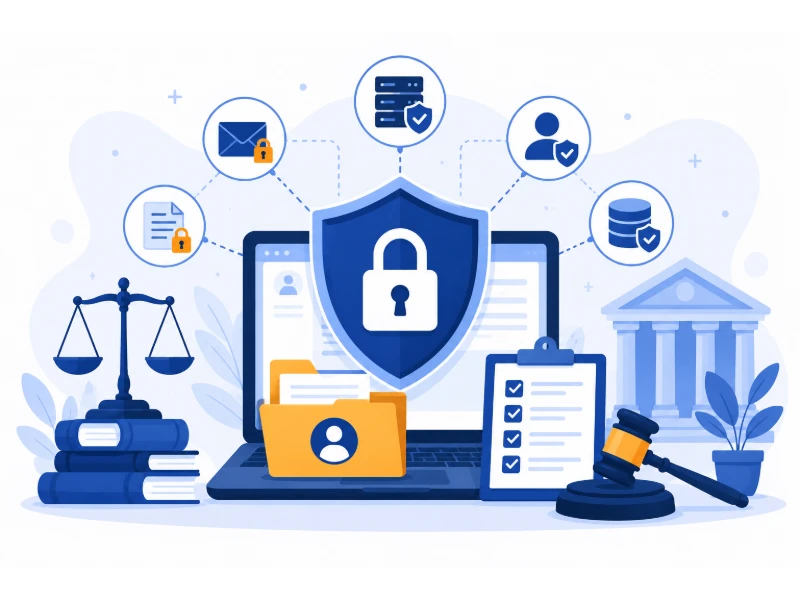
Law firms sit on some of the most valuable data in the economy: litigation strategy, M&A terms before they’re public, trade secrets, medical records, financial account details, and privileged communications that clients trust no one else will ever see. That combination of high-value information and, historically, thinner security budgets than the banks and hospitals holding similar data has made the legal industry an increasingly attractive target. Recent industry analysis from the Identity Theft Resource Center flags professional services (law firms, accounting practices, and consultancies) as the sector with the fastest-growing attack frequency of any industry tracked, driven by a simple strategic logic: compromising one firm often exposes credentials and data belonging to dozens or hundreds of that firm’s clients at once.
The numbers back this up. Roughly one in five U.S. law firms report being targeted by a cyberattack in the past year, and more than half of firms that experienced a breach lost sensitive client data as a result, according to research summarized by Embroker. The average cost of a data breach for a law firm has climbed past $5 million, though the number varies enormously by firm size. Sole practitioners and small firms typically face costs closer to the tens of thousands rather than millions, which is exactly why “we’re too small to be a target” is one of the most dangerous assumptions a practice can make. Attackers increasingly go after smaller and midsize firms precisely because their payoff per breach is lower but their defenses are weaker, making them easier, more repeatable targets.
For a law firm, a data breach is never just an IT problem. It’s a professional responsibility problem, a client relationship problem, and often a malpractice exposure problem, all at once. This guide covers the practical prevention measures every firm, from solo practice to full-service, should have in place, and it takes a step most generic cybersecurity guides skip entirely: connecting each measure directly to the ethics rules that make it a professional obligation, not just a best practice.
Why Law Firms Are a Uniquely Attractive Target
A few structural realities make legal practices different from a typical small business when it comes to cyber risk:
- Aggregated third-party data. A single firm’s systems often hold sensitive information belonging to dozens of separate clients, corporations, individuals, and sometimes other law firms, making one successful breach far more valuable to an attacker than hitting any single client directly.
- Urgency creates leverage. Litigation deadlines, closing dates, and court filings give ransomware attackers unusual leverage. A firm facing a filing deadline is more likely to pay quickly to regain access to case files.
- Historically thinner security budgets. Many small and midsize firms run lean on IT staffing relative to the sensitivity of what they hold, a gap attackers have clearly noticed.
- Heavy reliance on email. Email remains the primary tool for exchanging privileged, sensitive documents in legal practice, and it’s also the single most common entry point for phishing and business email compromise attacks.
- A large, dispersed attack surface. Between attorneys working remotely, paralegals on personal devices, and third-party vendors (court reporters, e-discovery platforms, cloud document management systems) all touching client data, the practical attack surface of even a small firm is larger than it looks.
The Ethics Angle Most Guides Miss: Cybersecurity Is a Professional Obligation, Not Just an IT Task
This is the piece that separates real legal-industry guidance from generic small-business security advice: for attorneys, data protection isn’t optional risk management. It’s built directly into professional conduct rules, and falling short can trigger consequences that have nothing to do with your cyber insurance policy.
Model Rule 1.1 (Competence) and its Comment 8. The ABA Model Rules of Professional Conduct require lawyers to provide competent representation, and Comment 8 to Rule 1.1 makes clear that competence includes understanding the benefits and risks of the technology used to practice law. As of the most recent tracking, the large majority of U.S. states have adopted this comment or an equivalent standard, meaning technology competence is now an enforceable ethical requirement in nearly every jurisdiction, not an abstract aspiration.
Model Rule 1.6(c) (Confidentiality). This rule requires lawyers to make “reasonable efforts” to prevent the unauthorized disclosure of, or access to, information relating to a client’s representation. What counts as “reasonable” isn’t fixed. ABA guidance points to factors like the sensitivity of the information, the likelihood of unauthorized access without safeguards, the cost of additional protections, and how those protections affect your ability to represent the client. In practice, this means a firm handling high-value M&A work or sensitive family law matters is held to a higher security bar than one doing routine contract review.
Model Rule 5.3 (Responsibilities Regarding Nonlawyer Assistance). This extends your confidentiality obligations to vendors: your cloud document management provider, your IT managed service provider, your e-discovery platform. If a third-party vendor mishandles client data, the firm can still bear responsibility for not vetting that vendor’s security practices adequately.
Model Rule 1.15 (Safeguarding Property) and Model Rule 1.4 (Communication) round this out. Rule 1.15 extends the duty of care to client property broadly, and Rule 1.4 requires keeping clients reasonably informed, which becomes directly relevant the moment a breach actually occurs.
ABA Formal Opinion 483 (2018) is the opinion every firm should actually read, because it spells out what happens after an incident: lawyers have an ongoing duty to monitor for breaches, must take reasonable steps to stop an ongoing breach and restore systems, must determine what client data was or may have been accessed, and in many cases must notify affected current clients even when the applicable state breach-notification statute wouldn’t otherwise require it. That duty flows from the ethics rules, not just the statute. A more recent analysis from the New York City Bar reinforces and adopts this same framework.
The practical takeaway: every prevention measure below isn’t just good practice. For an attorney, it’s part of discharging a professional duty, and failing to take reasonable steps can expose a firm to bar discipline and malpractice claims layered on top of the breach itself.
Core Data Breach Prevention Practices for Law Firms
1. Enforce Multi-Factor Authentication Everywhere
Multi-factor authentication (MFA) is, by a wide margin, the single highest-impact control available to a law firm today. It should be mandatory on email, your practice management and document management systems, remote access/VPN, and any cloud storage, with no exceptions for partners who find it inconvenient. A large share of successful law firm breaches trace back to a single compromised password with no second factor standing in the way. Pairing MFA with a password manager, since strong, unique passwords are still the first line of defense, closes off most credential-based attacks before they start.
2. Encrypt Client Data at Rest and in Transit
Every device that touches client data (laptops, desktops, mobile phones, backup drives) should have full-disk encryption enabled by default. Data moving between systems (email, file transfers, client portals) should travel over encrypted connections rather than plain, unsecured channels. Firms unfamiliar with the mechanics can review how encryption actually works to understand what “reasonable efforts” looks like in practice. An unencrypted laptop left in a car isn’t just an inconvenience; under Rule 1.1 and 1.6(c), it can be argued as a failure of reasonable care.
3. Move Away from Email for Sensitive Document Exchange
Standard email was never designed to be a secure document-transfer system, yet it remains the default tool most firms use to send contracts, settlement details, and financial records. A secure client portal or encrypted file-sharing platform, built specifically for the legal industry, dramatically reduces the exposure created by phishing, misdirected emails, and intercepted attachments. Reviewing general guidance on securing email is a reasonable starting point for firms still relying on it heavily.
4. Run Ongoing Phishing and Social Engineering Training
Phishing and business email compromise remain the leading entry point into law firm systems. Training can’t be a once-a-year slideshow. Effective programs use periodic, unannounced simulated phishing tests, immediate feedback when someone clicks, and short refresher sessions tied to real, current attacker tactics rather than generic warnings. A good baseline for staff is understanding how phishing works and how to avoid it. Attorneys and support staff both need this training; assistants and paralegals are frequently targeted specifically because they have broad access with, historically, less security awareness investment than attorneys.
5. Apply the Principle of Least Privilege Across Your Document Management System
Not every staff member needs access to every matter. Structure permissions in your document management system so access is scoped to the matters someone is actually working on, and audit those permissions on a regular schedule, not just when someone is onboarded. This is essentially a zero-trust approach applied to legal practice: verify and limit access continuously rather than granting broad trust by default. Overly broad DMS permissions are a recurring finding in law firm security assessments, and they turn a single compromised account into a firm-wide data exposure instead of a contained one.
6. Vet Third-Party Vendors Under Rule 5.3
Before signing with a cloud document management provider, e-discovery vendor, court reporting service, or IT managed service provider, ask specific questions. Where is the data physically stored? Is it encrypted at rest? What’s their breach notification commitment and timeline? Do they carry their own cyber liability coverage? Document these answers, not just for due diligence, but because Rule 5.3 makes this vetting part of your own ethical obligation, not merely a procurement nicety.
7. Secure Mobile Devices and Remote Work
Attorneys routinely review documents and respond to client emails from personal phones and home networks. A minimum mobile security baseline should include mandatory device passcodes or biometrics, remote-wipe capability for lost or stolen devices, a policy against reviewing sensitive files over unsecured public Wi-Fi, and a VPN requirement for remote access to firm systems. The underlying risks here are nearly identical to what other professional services firms, like accounting practices, face with their own traveling staff and client devices.
8. Patch and Update Systems on a Defined Schedule
Outdated software is one of the most preventable entry points into any organization, law firms included. Enable automatic updates wherever safe, and maintain a recurring manual check for anything (practice management software, firmware on network hardware, less-visible line-of-business applications) that doesn’t update automatically.
9. Back Up Data, and Actually Test the Restoration
Notably, industry surveys have found that fewer than half of law firms conduct regular online backups of their data, a striking gap given how central client files are to the practice itself. Follow the 3-2-1 rule (three copies, two media types, one off-site), and keep at least one backup immutable or air-gapped so ransomware that reaches your network can’t also encrypt or delete your recovery copy. Firms that haven’t reviewed their approach recently should look at how to protect backup data specifically from ransomware attacks, since standard backups alone are no longer enough against modern ransomware strains. Test restoring from backup on a regular schedule; a backup that’s never been tested is a hope, not a plan.
10. Build (and Rehearse) an Incident Response Plan
Every firm needs a written plan covering what happens the moment a breach is suspected: who’s notified first, how systems are isolated, when outside counsel or a forensics firm gets engaged, and how client notification decisions get made in light of ABA Formal Opinion 483’s guidance. This plan works best as part of a broader disaster recovery plan that covers not just cyberattacks but any event that could interrupt the practice. Rehearse it with a tabletop exercise at least annually; the first time your team ever discusses the plan should not be during an actual incident.
11. Carry Cyber Liability Insurance, and Understand What It Actually Covers
Legal-industry-specific cyber insurance has become close to a baseline expectation, and a growing share of corporate clients now require proof of coverage before engaging outside counsel. Review your policy carefully: many policies require specific controls, like MFA, to be in place as a condition of coverage, and a breach caused by their absence can result in a denied claim at the worst possible moment.
12. Designate Clear Ownership for Security
Someone at the firm (a partner, an office administrator, or an outsourced virtual CISO for larger practices) needs to own cybersecurity as an explicit responsibility, with authority to enforce policy even against senior partners who’d rather skip MFA. Security programs with no clear owner tend to exist only on paper.
Common Attack Vectors and the Controls That Address Them
| Attack Vector | How It Typically Happens | Primary Prevention Control |
|---|---|---|
| Phishing / business email compromise | Fraudulent email tricks staff into clicking a link, sharing credentials, or wiring funds | Ongoing phishing simulation training plus MFA on email |
| Ransomware | Malware encrypts firm systems after a compromised credential or malicious attachment | Endpoint protection, patching, immutable backups |
| Compromised credentials | Reused or weak passwords exposed in unrelated breaches | MFA everywhere plus a password manager |
| Unsecured remote access | Attorneys accessing systems over public Wi-Fi without a VPN | Mandatory VPN and mobile device policy |
| Third-party vendor breach | A cloud or e-discovery vendor is compromised, exposing firm data | Vendor security vetting under Rule 5.3 |
| Insider error/misdirected email | Sensitive documents sent to the wrong recipient | Secure client portals instead of raw email attachments |
| Lost or stolen devices | Unencrypted laptop or phone containing client files | Full-disk encryption and remote wipe capability |
What ABA Formal Opinion 483 Requires After a Breach
Prevention is the first half of this guide; the second half, what to do if prevention fails, matters just as much, because the ethics obligations don’t stop once an incident occurs. ABA Formal Opinion 483 lays out a lawyer’s post-breach duties:
- Monitor for breaches on an ongoing basis rather than assuming systems are secure by default.
- Act reasonably and promptly to stop the breach and prevent further unauthorized access once one is detected.
- Determine what occurred: which systems and data were affected, and whether client information was actually accessed or merely exposed to risk.
- Restore systems, data, and services to normal operation.
- Notify current clients whose information was, or reasonably may have been, accessed or disclosed. The opinion frames this as arising from Rules 1.4 and 1.6, independent of whatever a state’s specific breach-notification statute requires. Notably, the opinion generally does not extend a mandatory notification duty to former clients in the same way, though firms should evaluate that question with counsel given how much state law varies.
Separately, most states have their own data breach notification statutes with specific timelines and required content for notices to affected individuals. These vary considerably and sit on top of, not as a substitute for, the ethical duties above. If your firm experiences an actual breach, involve outside privacy counsel promptly rather than trying to navigate the notification requirements alone.
What a Breach Actually Costs a Law Firm
The financial exposure from a breach extends well beyond the immediate incident response bill, and firms that only budget for the obvious costs are usually underestimating their real exposure by a wide margin. A realistic accounting includes:
- Forensic investigation and remediation: hiring a specialized firm to determine what happened, contain it, and rebuild affected systems.
- Client notification costs: legal review, mailing or electronic notice to every affected client, and often credit monitoring services offered as goodwill.
- Regulatory exposure: state attorneys general and, depending on the client data involved, federal regulators may have independent authority to investigate and issue fines.
- Ransom demands: for firms hit by ransomware specifically, recent industry reporting cited by FindLaw puts average ransom demands against law firms and other professional services in the high six figures to low seven figures, with actual payouts often settling well below the initial demand after negotiation.
- Malpractice and bar complaint exposure: the layer unique to legal practice, where a breach can trigger scrutiny of whether the firm met its Rule 1.1 and 1.6(c) obligations, independent of any direct financial loss to the client.
- Client attrition and reputational damage: often the largest and least quantifiable cost, particularly for firms whose practice depends on referrals and long-term corporate relationships built on trust.
This is why prevention spending, much of which is genuinely inexpensive relative to the risk, consistently pencils out as one of the higher-return investments a firm can make, even setting the ethical obligations aside entirely.
Building a Culture of Security, Not Just a Checklist
The firms that hold up best under an actual attack tend to share one trait that has nothing to do with their technology stack: security is treated as part of how the firm practices law, not as a separate IT function bolted on afterward. That looks like partners using MFA without complaint, associates reporting suspicious emails instead of quietly deleting them, and new hires learning the firm’s data-handling expectations in their first week rather than picking them up informally months later.
Client expectations are shifting in the same direction. A growing share of legal clients, particularly corporate clients with their own compliance obligations, now say they’re willing to pay a premium for firms that can demonstrate stronger cybersecurity practices, and some now require security questionnaires or audits before retaining outside counsel at all. Strong data protection is becoming a genuine competitive differentiator, not just a defensive measure.
Frequently Asked Questions
Is my small firm really a target for cyberattacks?
Yes, arguably more so than you’d expect. Attackers increasingly target small and midsize firms specifically because they combine valuable client data with comparatively weaker defenses, making them efficient, repeatable targets rather than one-off scores.
Does cybersecurity really fall under legal ethics rules, or is that just good practice?
It’s both, and that’s the point. Model Rules 1.1, 1.6, 1.15, and 5.3, adopted in some form in nearly every U.S. jurisdiction, create enforceable professional obligations around technology competence, confidentiality, and vendor oversight. A serious security failure can trigger bar discipline and malpractice exposure independent of any breach-notification statute.
What’s the single most effective step a small firm can take right now?
Enabling multi-factor authentication across email, practice management software, and remote access delivers the largest risk reduction relative to the cost and effort involved, and it directly closes the entry point behind the majority of successful attacks.
Do we need a full-time IT security person?
Not necessarily. Many small and midsize firms handle this well through an outsourced managed IT/security provider or a fractional virtual CISO, as long as someone at the firm is clearly accountable for making sure the relationship is actually delivering the coverage it promises.
What should we do if we suspect a breach has already happened?
Engage outside counsel and a forensics firm promptly, follow the containment and assessment steps outlined in ABA Formal Opinion 483, and avoid making public statements or client notifications before you actually understand the scope of what occurred.
Are cloud-based practice management tools safe for client data?
Reputable, legal-industry-specific cloud platforms are generally more secure than most firms could build in-house, provided you vet the vendor’s encryption, access controls, and breach notification commitments as part of your Rule 5.3 obligations. The risk isn’t the cloud itself; it’s skipping that vetting step.
How often should we update our incident response plan?
Review it at least annually, and immediately after any change to your systems, vendors, or staffing. Pair the review with a tabletop exercise so the plan is tested against a realistic scenario rather than just re-read on paper.
Conclusion
Data breach prevention for a law firm isn’t a side project for whoever happens to be tech-savviest in the office. It’s an extension of the same professional judgment attorneys already apply to client representation. Multi-factor authentication, encryption, vendor vetting, employee training, and a tested incident response plan aren’t just IT recommendations; under Model Rules 1.1, 1.6, 1.15, and 5.3, they’re close to a baseline expectation of competent, ethical practice.
The firms that treat these measures as ongoing discipline, reviewed, tested, and updated as the practice and the threat landscape both evolve, are the ones that protect not just their systems, but the client trust that the entire practice of law depends on.
You May Also Like
 Cybersecurity
Is Fanatical Legit and Safe? My Honest Take on Buying Game Keys
 Data Security & Privacy
Is Gameflip Legit and Safe for Gift Cards? What Buyers Should Know
 Data Security & Privacy
Is Eldorado.gg Legit and Safe in 2026? My Investigation and What Buyers Should Know
 VPN & Proxy
Why Does Google Say Our Systems Have Detected Unusual Traffic From Your Computer Network?
 Cybersecurity
Is Groupon Legit? An Honest Review In 2026
 Cybersecurity
Is Romspure Safe? An Honest Look at the ROM Site’s Risks and Trust Scores
 Cybersecurity
Is KashKick Legit? Honest KashKick Review (Payouts, Earnings, and Pros & Cons)
 Cybersecurity
Bookvip reviews: Is Bookvip Travel Legit or Scam?
 Cybersecurity