

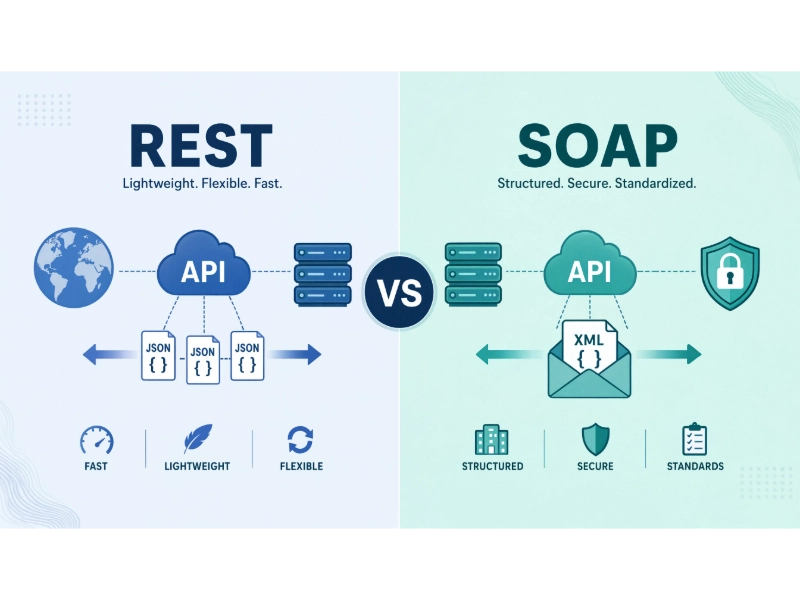
REST and SOAP are two ways to let software systems exchange data. SOAP is a protocol with strict message rules, while REST is an architectural style that uses standard web methods. SOAP usually sends XML messages with a formal structure and supports enterprise features such as built-in security and reliable messaging. REST usually uses HTTP methods and lightweight formats such as JSON, which makes it common in web, mobile, and public APIs.
Neither approach is better in every case. A banking platform that connects to older systems may have very different needs from a mobile app that loads a product catalog. The right choice depends on your security rules, the systems you must connect to, your team’s skills, and how the API will change over time. Many developers choose REST for new projects, but SOAP still runs many important systems today.
This guide explains what each approach is, how they differ in design and performance, and where each one fits best. It also covers the advantages and disadvantages of both, a practical decision framework, and answers to common questions. Where a claim comes from an official specification, the article links to that source. Where a point depends on your setup, the article says so.
What Is a SOAP API?
SOAP (Simple Object Access Protocol) is a messaging protocol for exchanging structured information between applications. It defines how a message is built, how it is sent, and how errors are reported. The World Wide Web Consortium (W3C) published the SOAP Version 1.2 Part 1 Messaging Framework as a recommendation, and that document defines the envelope structure and processing rules that SOAP messages follow.
A SOAP request usually follows a predefined structure called an XML envelope. The envelope contains a header, which can carry processing instructions such as security details, and a body, which carries the actual request or response. Because the rules are fixed, a receiving system can check whether a message is valid before it processes the content.
SOAP is also tied to a description language called WSDL (Web Services Description Language). A WSDL file describes the operations a service offers, the input and output formats, and the endpoint address. Development tools can read that file and generate client code automatically, which is one reason SOAP has been popular in large enterprise systems.
Key Features of SOAP API
- Strict protocol standards: SOAP defines how messages are formatted, so both sides of a connection follow the same rules.
- XML-based messaging: SOAP uses XML for requests and responses, which supports detailed, self-describing data.
- Standardized error handling: SOAP uses SOAP Fault messages to report what went wrong and why.
- Advanced security support: Extensions such as WS-Security can provide message encryption, authentication, and digital signatures.
- Reliable messaging: Standards such as WS-ReliableMessaging can help applications manage message delivery and retries.
- Formal service description: WSDL files describe operations and data types, which helps teams generate code and test interfaces.
What Is a REST API?
REST (Representational State Transfer) is an architectural style for designing web APIs, not a protocol with strict message rules. Roy Fielding introduced the term in his 2000 doctoral dissertation, Architectural Styles and the Design of Network-based Software Architectures. In that work, he described a set of constraints, such as client-server separation, statelessness, cacheability, and a uniform interface. A system that follows these constraints is described as RESTful.
REST APIs usually map actions to standard HTTP methods:
- GET retrieves data, such as a list of products.
- POST creates a new resource, such as a customer order.
- PUT or PATCH updates an existing resource, such as a shipping address.
- DELETE removes a resource, such as an expired session.
REST most often uses JSON because it is compact and easy for web browsers and modern programming languages to parse. However, REST does not require JSON. It can also work with XML, plain text, or other formats, as long as the client and server agree on the format.
Key Features of REST API
- Flexible architecture: REST provides design guidelines rather than a fixed message format, which gives teams room to design their own endpoints.
- Multiple data formats: REST commonly uses JSON but can also support XML and other formats.
- Stateless communication: Each request should include the information the server needs to process it, which simplifies scaling.
- HTTP-based design: REST uses existing web features, such as status codes, headers, and URLs.
- Caching support: Responses can use HTTP caching headers, which can reduce repeated work for the server and the client.
SOAP vs REST: Key Differences
The biggest difference is that SOAP defines how a message must look, while REST defines how an API should be organized around resources and HTTP methods. The table below compares the two approaches across common decision points.
| Feature | SOAP API | REST API |
|---|---|---|
| Type | Protocol | Architectural style |
| Message format | XML envelope | Usually JSON, also XML and other formats |
| Communication style | Operations defined in WSDL | Resources accessed through HTTP methods and URLs |
| Security | WS-Security and related standards, often used with transport encryption | HTTPS combined with OAuth 2.0, JSON Web Tokens (JWT), API keys, or other methods |
| Flexibility | More structured and less flexible | More flexible and easier to adapt |
| Payload size | Often larger because of XML tags and envelope overhead | Often smaller with JSON, though the result depends on the data and compression |
| Error handling | Standardized SOAP Fault messages | HTTP status codes and custom error bodies |
| Documentation | WSDL files | Often described with the OpenAPI Specification |
| Typical fit | Enterprise integrations and formal contracts | Web, mobile, and public APIs |
A few rows in this table need context. SOAP is not limited to HTTP. It can run over other transport protocols, which is one reason it has been used in some enterprise environments. REST is almost always used over HTTP or HTTPS. Payload size also depends on the data. A small XML message can be smaller than a large JSON message, so teams should measure real traffic rather than assume.
Security Differences in Practice
Security is often where the two approaches look most different, so it helps to be precise. SOAP’s WS-Security standard can protect individual parts of a message, such as one field inside an XML body. This is useful when a message passes through several intermediary systems and only certain parts should be visible to them.
REST usually relies on transport-level protection, meaning HTTPS encrypts the whole connection. Authorization is commonly handled with OAuth 2.0, defined in RFC 6749, or with JWTs and API keys. Both approaches can be secure when implemented correctly. Weak authentication, poor key management, or excessive permissions can make either one vulnerable.
Advantages and Disadvantages of SOAP API
SOAP offers strong standards and enterprise features, but it requires more setup and more XML processing. Teams should weigh these trade-offs against their requirements.
Advantages of SOAP API
1. Strong standardization. SOAP’s strict rules make it easier for organizations to agree on message formats, especially when several parties must integrate with the same service.
2. Built-in security extensions. WS-Security provides features for encryption and digital signatures at the message level, which can help when protection must follow the data across intermediaries.
3. Reliable messaging options. Extensions such as WS-ReliableMessaging support guaranteed delivery and retries, which matter for processes such as payments or order processing.
4. Formal contracts through WSDL. A WSDL file gives both sides a precise description of available operations. Tools can generate client code from it, which reduces manual errors in some projects.
5. Integration with legacy systems. Many older enterprise platforms expose SOAP services, so SOAP can be the practical choice when those systems must stay in place.
Disadvantages of SOAP API
1. More complex development. SOAP requires more configuration, and developers often need to understand the envelope, headers, and related standards.
2. Larger message size. XML tags and envelope elements can add overhead, which may increase bandwidth use for some workloads.
3. Less flexible design. A strict contract can make small changes harder to introduce, because both sides may need updates.
4. Higher learning curve. Teams often need time to learn WS-* specifications, WSDL tooling, and SOAP fault handling before they work efficiently.
5. Less common in modern front-end work. Browser-based and mobile apps usually work more naturally with JSON over HTTP, so SOAP often requires extra libraries or a translation layer.
Advantages and Disadvantages of REST API
REST is simple and flexible, but its flexibility means teams must design many rules themselves. The strengths and weaknesses are closely linked.
Advantages of REST API
1. Simple to understand. REST uses familiar HTTP concepts, such as methods, URLs, and status codes. Developers who know the web can usually start quickly.
2. Lightweight communication. JSON payloads are often compact and easy to parse, which suits mobile apps and browser clients.
3. Flexible integration. REST works with web browsers, mobile apps, frontend frameworks, and many backend languages without special protocol support.
4. Scalable design. Because each request should carry the information needed to process it, servers can be added or replaced more easily behind a load balancer.
5. Broad tooling support. Most programming languages include HTTP clients, and many tools can test, document, and monitor REST endpoints.
Disadvantages of REST API
1. Less standardized. REST gives design principles rather than a single rulebook, so two teams may build very different APIs for similar tasks.
2. More design responsibility. Authentication, versioning, pagination, and error formats usually need to be designed and documented by the team.
3. Complex workflows need extra design. Operations that involve several related changes may require patterns such as sagas or compensating actions, because REST does not include a built-in transaction model.
4. Large APIs need planning. Without clear naming, versioning, and documentation, a growing REST API can become hard to maintain.
5. Weak contracts without documentation. REST APIs often rely on documentation to define expected inputs and outputs. The OpenAPI Specification helps describe these contracts in a machine-readable way.
SOAP vs REST: Common Use Cases
The best choice depends on existing systems, security requirements, and the type of client that will call the API. Each approach has typical use cases, although real projects often mix them.
When to Use SOAP API
SOAP is a sound choice when an application must follow strict contracts, support formal security extensions, or connect to existing enterprise services. Common examples include:
- Financial services: Banks and payment processors sometimes maintain SOAP interfaces for transactions that require formal message structure and audit trails.
- Healthcare integrations: Some health information systems use SOAP-based standards, particularly where older platforms are already in place.
- Government and large enterprises: Public agencies and large companies may keep SOAP services because of long-term contracts and established infrastructure.
- Legacy system integration: Older platforms that only expose SOAP endpoints often need SOAP clients, at least until a migration plan is complete.
Organizations in these sectors should confirm their own regulatory and technical requirements. The fact that an industry often uses SOAP does not mean every project in that industry must use it.
When to Use REST API
REST fits best when developers need a lightweight, flexible interface for web or mobile clients. Common examples include:
- Web applications: Frontend code can call REST endpoints to load data and submit forms.
- Mobile applications: REST works well with mobile networks because it can return compact JSON responses.
- Public APIs: Many developer platforms use REST because external developers can test it with a browser or common tools.
- Microservices: Independent services often communicate over HTTP using REST or similar patterns.
- E-commerce platforms: REST endpoints often handle product catalogs, customer accounts, carts, and order status.
Teams building these systems can also consider newer options such as GraphQL, which lets clients request specific fields, or gRPC, which is often used for high-performance internal communication. Each option has its own trade-offs.
How to Choose Between REST and SOAP
Start by listing your requirements, then match them to the strengths of each approach. A short checklist can make the decision clearer.
Choose SOAP when your project needs:
- Strict message contracts that all parties must follow.
- Message-level security, such as encrypting or signing specific parts of a message.
- Reliable messaging features for workflows where lost or duplicated messages create serious problems.
- Compatibility with an existing SOAP service that is too costly to replace right now.
- A formal WSDL-based process for generating client code.
Choose REST when your project needs:
- A simple API for web, mobile, or public developer use.
- Lightweight JSON responses that are easy to parse on many devices.
- Flexible design that can change as the product grows.
- Integration with common web tools, caches, and browser clients.
- Faster development for a small or medium-sized team.
Some organizations use both. A company might keep a SOAP service for a legacy billing system while building REST endpoints for a new mobile app. In that case, an integration layer can translate between the two.
Common Mistakes When Choosing an API Style
The most common mistake is choosing based on popularity rather than requirements. A new API does not need SOAP just because a large enterprise uses it, and a legacy system does not need to be replaced just because REST is more popular.
A second mistake is assuming that REST is automatically secure. REST APIs that accept weak tokens, skip input validation, or expose too much data can be attacked as easily as any other service. Teams should use HTTPS, authenticate every sensitive call, and limit access to what each client needs.
A third mistake is ignoring rate limits. Public REST APIs often need protection from excessive traffic, which is why teams should plan throttling early. The guide on API Rate Limiting explains how limits help protect services and keep performance stable for other users.
A fourth mistake is skipping documentation. Whether you choose SOAP or REST, clients need clear examples, error descriptions, and version notes. A WSDL file or an OpenAPI document can help, but only if someone keeps it current.
How to Evaluate an API Before You Commit
A practical test reveals more than a feature checklist. Build a small prototype that performs one real workflow, such as creating an order or retrieving a customer record. Measure response size, latency, error handling, and how long it takes a developer to complete the task. Then test security by checking authentication, authorization, and input validation.
For REST, review whether the endpoints follow consistent naming and versioning rules. For SOAP, confirm that the WSDL matches the implemented service and that generated client code works with your development environment. In both cases, record the results so the team can compare options with evidence instead of memory.
Frequently Asked Questions
Is REST better than SOAP?
Not always. REST is often preferred for modern web and mobile applications because it is simple and flexible. SOAP can be the better choice for enterprise systems that require strict contracts, message-level security, or reliable messaging.
Is SOAP more secure than REST?
Neither is automatically more secure. SOAP offers WS-Security, which can protect parts of a message. REST typically relies on HTTPS, OAuth 2.0, JWTs, and API keys. Security depends on how each system is configured and maintained.
Can REST use XML?
Yes. REST can use XML, JSON, or other formats. JSON is more common because it is compact and widely supported by browsers and programming languages.
Is SOAP still used today?
Yes. SOAP remains in use in some banking, healthcare, government, and enterprise environments, especially where older systems and formal contracts are in place.
Should I use REST or SOAP for a new API?
For most new public-facing applications, REST is usually the simpler starting point. SOAP may be more appropriate when you must integrate with an existing SOAP system or when your requirements call for WS-* features.
Does REST support transactions?
REST does not provide a built-in transaction model across multiple resources. Teams can design workflows with patterns such as compensating actions, idempotent requests, or a single endpoint that handles a related group of changes.
Conclusion
REST and SOAP solve similar problems, but they were designed for different needs. REST offers a flexible, lightweight approach that fits web apps, mobile platforms, and public APIs. SOAP offers a strict, standardized approach that remains valuable for enterprise systems with formal contracts, message-level security, and established integrations.
The better choice depends on your security requirements, the systems you must connect, your team’s experience, and how the API will change. Teams that start with a clear list of requirements, build a small prototype, and measure the results will usually make a more reliable decision than teams that choose based on trends alone.
You May Also Like
 Web Development
What Is API Rate Limiting? (A Practical, Simple Guide for Safer, Faster APIs)
 Cybersecurity
What Is Zero Trust Network Access (ZTNA)? How It Works, How It Differs From a VPN, and When to Use It
 Cybersecurity
What Is Netskope? Cloud Security, SASE, and Zero Trust Explained
 Web Development
How Long Does It Take to Code an App?
 Cybersecurity
Is Fanatical Legit and Safe? My Honest Take on Buying Game Keys
 Data Security & Privacy
Is Gameflip Legit and Safe for Gift Cards? What Buyers Should Know
 Data Security & Privacy
Is Eldorado.gg Legit and Safe in 2026? My Investigation and What Buyers Should Know
 Web Development
Supabase vs Firebase: Which Backend Platform is Right for Your Project?
 Cloud Computing