

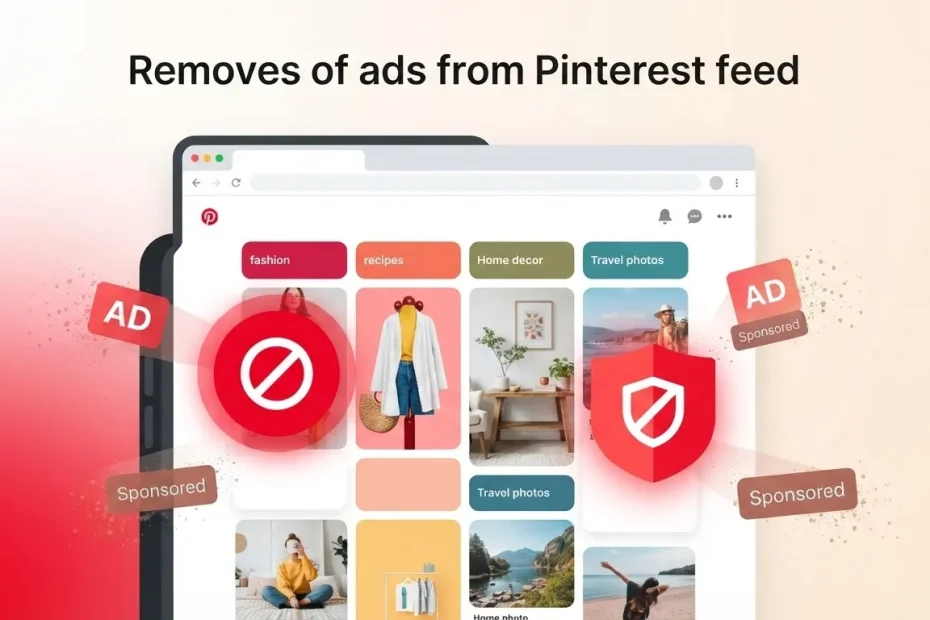
Pinterest is a great place to discover recipes, products, home ideas, fashion, travel inspiration, and more. The downside is that your feed can also contain promoted pins and other ads, which some people find distracting.
If you’re looking for a simple way to block ads on Pinterest, a reputable ad blocker is usually the easiest place to start on a computer. On mobile, the best option depends on whether you use Pinterest in a web browser or through the Pinterest app.
There are also other ways to reduce what you see, including Pinterest’s own advertising settings and DNS-based filtering. However, these methods don’t work in exactly the same way. Some can hide many ads, while others mainly reduce personalized advertising or block certain advertising requests. No method should be treated as a guarantee that every sponsored item on Pinterest will disappear.
The easiest way to block Pinterest ads
For most desktop users, the simplest approach is to install one reputable browser ad blocker and then open Pinterest normally.
Popular options include:
- AdBlock: Easy for beginners and widely available.
- uBlock Origin: Offers more advanced filtering and customization.
- AdGuard: Available as browser extensions and standalone apps.
You usually don’t need to run several ad blockers together. Using more than one can sometimes create conflicts and make it harder to figure out why Pinterest isn’t working properly.
Using Browser Extensions to Block Pinterest Ads
Browser extensions can filter advertising and tracking requests while you browse Pinterest. They are generally the most convenient solution when you use Pinterest on a desktop or laptop.
AdBlock
AdBlock is a widely used browser extension that can filter ads on many websites, including Pinterest.
How to install AdBlock
For Chrome:
- Open the AdBlock Chrome Web Store page.
- Click Add to Chrome.
- Confirm by selecting Add extension.
For Firefox:
- Visit the AdBlock Firefox Add-ons page.
- Click Add to Firefox.
- Follow the installation prompts.
For Safari:
- Open the AdBlock Safari page.
- Click Get.
- Complete the installation and enable the extension in Safari.
Using AdBlock on Pinterest
After installing AdBlock, open Pinterest and browse normally. The extension can filter many ads without requiring you to change Pinterest itself.
You can click the AdBlock icon in your browser toolbar to check its settings or disable filtering for a particular site.
uBlock Origin
uBlock Origin is a free, open-source content blocker with extensive filtering controls.
Its browser support and distribution can change over time, so check the current extension listing for the browser you’re using before installing it.
How to install uBlock Origin
For Chrome:
You can check the uBlock Origin Chrome Web Store page. Because extension support can change between browser versions, make sure the current listing is compatible with your Chrome installation.
For Firefox:
- Open the uBlock Origin Firefox Add-ons page.
- Select Add to Firefox.
- Complete the installation.
For Safari:
uBlock Origin isn’t distributed for Safari in the same way as Firefox. A Safari-compatible option such as AdGuard may be more suitable.
Using uBlock Origin on Pinterest
Once installed, uBlock Origin can filter many advertising and tracking requests while you browse Pinterest.
Click the uBlock Origin icon to see its filtering activity and adjust settings when necessary.
If Pinterest stops loading a particular feature, temporarily disable the blocker for Pinterest. This can help determine whether a filter is causing the problem.
AdGuard
AdGuard provides browser extensions and standalone applications, giving you more flexibility if you want filtering beyond one browser.
How to install AdGuard
For Chrome:
- Visit the AdGuard Chrome Web Store page.
- Click Add to Chrome.
- Confirm the installation.
For Firefox:
- Open the AdGuard Firefox Add-ons page.
- Click Add to Firefox.
- Follow the setup instructions.
For Safari:
- Visit the AdGuard for Safari page.
- Click Get.
- Install and enable the extension.
Using AdGuard on Pinterest
After setup, AdGuard can filter many ads and tracking requests while you browse Pinterest. You can also adjust its filtering settings or create exceptions when a website feature doesn’t work correctly.
Which ad blocker is best for Pinterest?
There isn’t one option that is best for everyone. The choice usually comes down to how much control you want.
| Ad blocker | Best for | What to expect |
|---|---|---|
| AdBlock | Beginners | Simple setup and familiar interface |
| uBlock Origin | Users who want advanced filtering | More control over filters and requests |
| AdGuard | Browser and broader device filtering | Available as extensions and standalone apps |
For a straightforward setup, start with one reputable option rather than installing all three.
Can Pinterest’s own settings remove ads?
No. Pinterest’s settings don’t provide a simple switch that removes all advertising.
You can, however, change privacy and personalization settings that affect how ads are selected for you. This can make advertising less personalized, but it isn’t the same as blocking ads.
How to change Pinterest ad preferences
- Log in to Pinterest.
- Open your profile menu.
- Select Settings.
- Go to Privacy and data.
- Review the available advertising and personalization options.
- Turn off any options you don’t want to use.
One option may refer to personalized ads based on your activity on Pinterest and other websites. The wording and location of settings can change as Pinterest updates its interface.
This method is useful when your main concern is personalized advertising, but don’t expect it to make your Pinterest feed completely ad-free.
How to block Pinterest ads on mobile
Mobile ad blocking is a little different because there is an important distinction between Pinterest in a browser and the Pinterest app.
A Safari content blocker, for example, can filter web pages opened in Safari. That doesn’t automatically mean it can remove ads inside the native Pinterest app.
Blocking Pinterest ads on iPhone and iPad
If you browse Pinterest through Safari, you can use a supported content blocker.
Using 1Blocker
- Download 1Blocker from the App Store.
- Open 1Blocker and complete the setup.
- Enable the content-blocking features you want.
- Make sure the blocker is enabled for Safari.
- Open Pinterest in Safari and test it.
Using AdGuard for iOS
- Install AdGuard for iOS from the App Store.
- Complete the setup.
- Open your device’s Safari or extension settings.
- Enable the AdGuard content blocker.
- Visit Pinterest in Safari.
The exact menu names can vary between iOS versions, so use the options shown on your device.
Blocking Pinterest ads on Android
Android gives you several browser-based options.
Using Brave Browser
- Download Brave from Google Play.
- Open Brave.
- Visit Pinterest.
- Leave Brave’s built-in Shields enabled unless you need to change them.
Brave can block many ads and trackers without requiring a separate browser extension.
Using Firefox
- Install Firefox from Google Play.
- Open Firefox.
- Check the browser’s current add-on support.
- Install a compatible content blocker when available.
- Visit Pinterest and test the result.
Browser extension support can change, so check the current Firefox Android add-on options rather than relying on an old installation guide.
Using AdGuard
You can also download AdGuard from its official website.
Follow the setup instructions for your device. Depending on the configuration, AdGuard can provide filtering beyond a single browser.
Can DNS block Pinterest ads?
Sometimes, but DNS filtering isn’t a guaranteed Pinterest ad blocker.
DNS-based filtering works by blocking requests to domains that appear on a filter list. This can reduce some advertising and tracking traffic across devices, but it has limitations.
For example, an advertisement can sometimes be delivered through the same infrastructure used for normal website content. In that situation, DNS filtering may not be able to separate the ad from the content you want to keep.
For that reason, DNS filtering is best treated as an additional layer, not a promise that every Pinterest ad will disappear.
Setting up an ad-blocking DNS service
A service designed for ad and tracker filtering, such as AdGuard DNS, is more relevant to this use case than a general-purpose security DNS service.
The exact setup depends on whether you configure DNS on one device or your router.
Changing DNS on Windows
- Open Control Panel > Network and Internet > Network and Sharing Center.
- Select Change adapter settings.
- Right-click your active connection and choose Properties.
- Select Internet Protocol Version 4 (TCP/IPv4).
- Click Properties.
- Select Use the following DNS server addresses.
- Enter the DNS addresses supplied by your chosen provider.
- Save the changes.
Changing DNS on Mac
On newer versions of macOS, DNS settings are generally found under:
System Settings > Network > your connection > Details > DNS
On older macOS versions, the path may be:
System Preferences > Network > Advanced > DNS
Add the DNS addresses provided by your chosen service and save your changes.
Changing DNS on a router
- Sign in to your router’s administration page.
- Locate the DNS settings.
- Enter the DNS server addresses provided by your chosen service.
- Save the configuration.
- Restart the router or reconnect devices if necessary.
Changing DNS at the router level can affect devices throughout your home network. Make sure you understand the scope of the change before applying it.
What if Pinterest ads still appear?
Don’t assume the ad blocker has failed immediately. Pinterest can change how sponsored content is delivered, and an ad blocker may not recognize every advertising element.
Try these troubleshooting steps:
- Update the blocker. Filtering rules may need to be updated.
- Refresh Pinterest. Previously loaded content may remain visible until the page is reloaded.
- Check your device. A browser blocker may not apply to the Pinterest app.
- Review the extension settings. Make sure filtering is enabled for Pinterest.
- Test another browser. This can reveal whether the issue is browser-specific.
- Disable other blockers temporarily. Multiple privacy or filtering tools can sometimes conflict.
- Temporarily disable the blocker for Pinterest. If the site immediately starts working normally, the filter may be blocking something Pinterest needs.
- Check the blocker logs. Advanced tools may show which requests were blocked.
Also remember that a sponsored pin can sometimes look like a normal pin. If the item is built deeply into Pinterest’s feed, blocking it may require a filter update rather than a simple setting change.
Can you use a hosts file to block Pinterest ads?
Technically, you can use a system hosts file to block selected domains, but this isn’t the first method I’d recommend for Pinterest.
Hosts files work best when you know exactly which domains need to be blocked. Pinterest advertising doesn’t necessarily rely on a small, fixed list of domains, so manually adding a few common ad domains may have little effect.
Windows hosts file
- Open Notepad as an administrator.
- Open:
C:\Windows\System32\drivers\etc\hosts
- Add only entries you understand.
- Save the file.
- Restart the affected application or your computer if necessary.
macOS and Linux
Open Terminal and edit:
/etc/hosts
A text editor such as nano can be used.
For users who already understand hosts-file management, maintained lists are available from projects such as StevenBlack/hosts on GitHub.
Be careful here. An incorrect hosts entry can prevent normal websites or services from resolving correctly. For Pinterest, a browser ad blocker is generally easier to configure and troubleshoot.
Can an ad blocker remove every Pinterest ad?
No method can reliably guarantee that every Pinterest ad will disappear.
There are several reasons for this:
- Pinterest can change how it delivers sponsored content.
- Filters need to be updated when websites change.
- Some ads can be closely integrated with normal content.
- DNS filtering can’t always distinguish ads from first-party content.
- Browser extensions don’t necessarily control advertisements inside native apps.
That’s why it’s better to think in terms of reducing or filtering Pinterest ads rather than expecting a permanent 100% block.
Does blocking Pinterest ads improve performance?
It can, but the result depends on the page and the blocking method.
When an ad blocker prevents certain advertising and tracking requests from loading, your browser may have less work to do. That can sometimes make pages feel cleaner or faster.
However, don’t treat ad blocking as a guaranteed performance upgrade. Your connection, device, browser, Pinterest’s own scripts, and the amount of content on the page can all affect how fast Pinterest feels.
Does an ad blocker protect your privacy on Pinterest?
It can help with some forms of advertising and tracking, but it isn’t a complete privacy solution.
A content blocker may prevent some tracking scripts and third-party advertising requests from loading. That doesn’t mean your activity is completely private.
For broader privacy protection, consider the browser and privacy settings you use, along with the permissions you give websites and apps.
A VPN, for example, can serve a different purpose from an ad blocker. It should not be described as a complete privacy solution by itself.
Is using an ad blocker on Pinterest safe?
Using a reputable ad blocker is generally straightforward, but the source you download it from matters.
Install browser extensions from official browser stores or download applications from the vendor’s official website. Avoid random download pages that package extensions with unrelated software.
It’s also worth remembering that not every extension with “ad blocker” in its name is equally trustworthy. Check the publisher, permissions, reviews, and source before installing anything.
Frequently Asked Questions
How do I block ads on Pinterest?
The easiest method on a computer is to install a reputable browser ad blocker such as AdBlock, uBlock Origin, or AdGuard. On mobile, use a supported content-blocking browser or app, especially when browsing Pinterest through a web browser.
Can I block Pinterest ads without installing an extension?
Yes. You can adjust Pinterest’s privacy and advertising settings or use DNS-based filtering. These options may reduce advertising or personalization, but they don’t guarantee that all sponsored content will disappear.
Can I block Pinterest ads on Chrome?
Yes. A compatible ad-blocking extension can filter many ads while you browse Pinterest in Chrome. Browser extension availability can change, so use the current store listing for the blocker you choose.
Can I block Pinterest ads on Firefox?
Yes. Firefox supports several content-blocking extensions, including options such as AdBlock and uBlock Origin.
Can I block Pinterest ads on Safari?
Yes, when browsing Pinterest through Safari. Safari supports content blockers such as AdBlock, AdGuard, and 1Blocker.
Can I block ads inside the Pinterest app?
It depends on the device and filtering solution. Browser-based blockers generally apply to browser traffic rather than automatically filtering every advertisement shown inside a native app.
Will DNS blocking remove all Pinterest ads?
No. DNS filtering can block some advertising and tracking requests, but it cannot necessarily distinguish every sponsored item from normal Pinterest content.
Will Pinterest detect my ad blocker?
It can be possible for websites to detect blocking behavior. Pinterest can also change its implementation, which may affect how well a blocker works.
Will blocking ads break Pinterest?
It can. A filter may occasionally block a resource required by a page feature. Temporarily disabling the blocker for Pinterest can help identify whether it is responsible.
Are free ad blockers available?
Yes. AdBlock and uBlock Origin are examples of free options, while some products also offer paid features or standalone apps.
Do ad blockers protect me from every privacy or security threat?
No. An ad blocker can reduce certain advertising and tracking activity, but it doesn’t replace safe browsing habits, account security, or other security tools.
Do ad blockers use a lot of system resources?
It depends on the blocker, browser, and filter lists you use. Some lightweight blockers have relatively low overhead, while more comprehensive filtering tools can use more resources.
What is the best way to block Pinterest ads?
For most people, start with one reputable browser ad blocker if you use Pinterest on a desktop or laptop. AdBlock, uBlock Origin, and AdGuard are all familiar options, although availability can vary by browser and platform.
On an iPhone or iPad, a Safari content blocker can be useful when you browse Pinterest through Safari. On Android, an ad-blocking browser such as Brave is another straightforward option.
Pinterest’s own settings are better suited to reducing personalized advertising than removing ads entirely. DNS filtering can provide broader network-level filtering, but its effectiveness against Pinterest’s sponsored content can vary.
Hosts-file editing is an advanced option and generally isn’t worth the extra complexity for most Pinterest users.
Conclusion
If Pinterest ads are making your feed harder to browse, you have several ways to reduce them. A reputable browser ad blocker is usually the easiest starting point on a computer, while Safari content blockers and ad-blocking browsers can help on mobile when you’re using Pinterest through a supported browser.
Pinterest’s own privacy settings can give you more control over personalized advertising, but they won’t make the service completely ad-free. DNS filtering can block some advertising and tracking requests across a network, although it can’t guarantee that every sponsored pin will be removed.
The key is to choose the method that matches the way you use Pinterest. Start with the simplest option, keep your blocker updated, and remember that Pinterest can change how sponsored content is delivered over time.
You May Also Like
 VPN & Proxy
Why Do CAPTCHAs Appear When You Use a VPN?
 VPN & Proxy
Why Does Google Say Our Systems Have Detected Unusual Traffic From Your Computer Network?
 VPN & Proxy
10 Best VPNs for California in 2026: Privacy, Speed, and Security
 VPN & Proxy
Mobile Proxies vs. Residential Proxies: Differences, Costs, and Use Cases
 VPN & Proxy
Datacenter vs. Residential Proxies: Differences, Costs, and Use Cases
 Web Scraping
Reasons Why You Should Avoid Using Free Proxies For Web Scraping
 Web Scraping
How to Use Proxies for Web Scraping Without Getting Blocked
 VPN & Proxy
Residential Proxies in 2026: Our 90-Day Benchmark of IPRoyal, Proxy-Seller, and RoundProxies
 VPN & Proxy