


API security for a data collection platform comes down to controlling who can send data, limiting what they can send, protecting what you store, and knowing every endpoint you run. No single tool covers all four.
Data collection platforms carry more risk than many other APIs because they accept data from many sources at once. Mobile apps, websites, server integrations, devices, and partners all send requests, often with different levels of trust. The data is frequently personal or behavioral, and the same endpoints often feed dashboards, exports, and customer integrations. An attacker who finds one weak route might flood the system, insert false records, or read records that belong to someone else.
This guide covers the controls that matter most for these platforms, roughly in the order most teams should tackle them. It draws on the OWASP API Security Top 10 (2023), which is the second edition of OWASP’s awareness document for API risks, and it refers to privacy rules where specific obligations apply. It isn’t legal advice, and it doesn’t replace a threat model for your own system.
How data collection platforms differ from other APIs
Most APIs have two surfaces that matter: the places where clients write data and the places where they read it back. Data collection platforms usually have a large write surface, because the purpose is to accept events from as many producers as possible. That surface is typically exposed to the public internet and called from code that ships to end users’ devices.
Two features make this harder. First, client-side credentials can’t be kept secret. Any key embedded in a mobile app or a web page can be extracted by anyone who looks for it. Second, traffic is often bursty. A product launch, a viral moment, or a misconfigured SDK can multiply request volume within minutes.
The read surface is where serious breaches tend to happen. Dashboards, query APIs, and export endpoints return the collected data, so a flaw there can expose records from many customers at once. A reasonable working assumption is that the read paths deserve at least as much attention as ingestion, even though ingestion gets more traffic and more visibility.
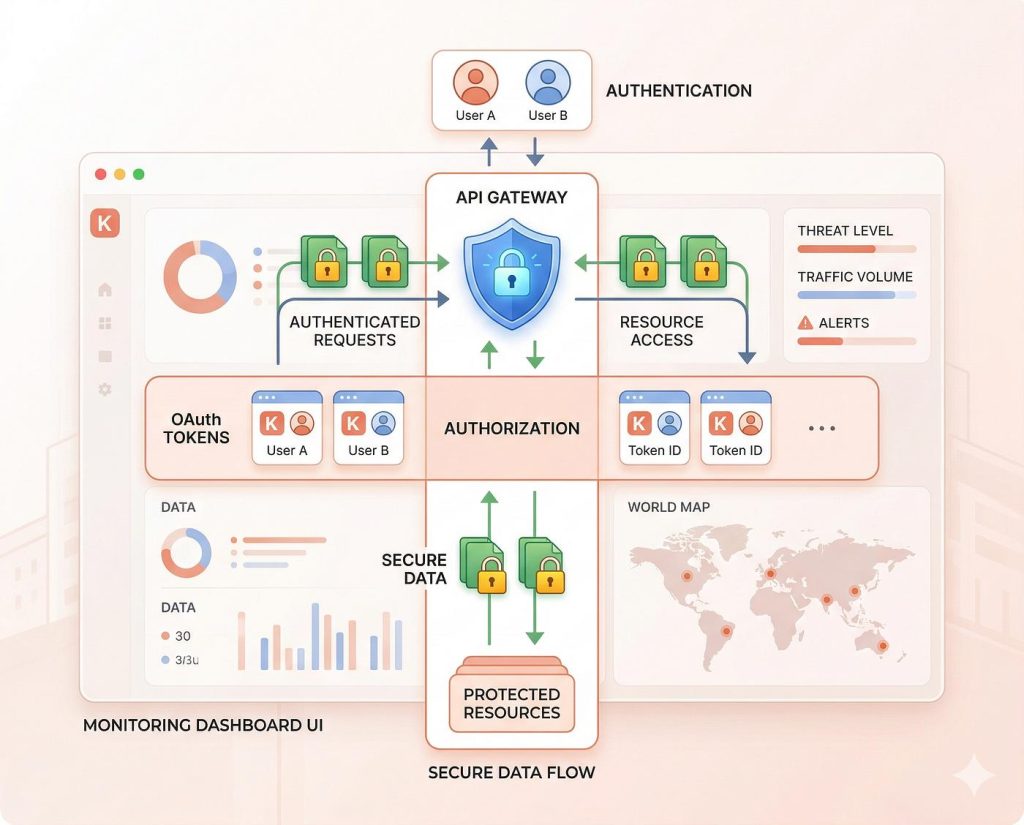
Start with a complete inventory of your endpoints
You can’t protect an endpoint you don’t know exists. Improper inventory management is one of the ten risk categories in the OWASP API Security Top 10 2023, and it shows up often in practice. Old API versions keep accepting requests, staging hosts are reachable from the internet, and undocumented routes get added during a quick fix.
Build your inventory from real traffic and code, not only from documentation. API gateway logs, load balancer records, and a scan of your route definitions usually reveal endpoints that official docs leave out.
For each endpoint, record its purpose, its callers, whether it’s public, which versions expose it, and what data it touches. The table below shows how common endpoint types tend to fail.
| Endpoint type | Typical exposure | Main risks | Priority controls |
|---|---|---|---|
| Ingestion (write) | Public; called from apps, sites, and SDKs | Spam, flooding, forged records, key misuse | Scoped keys, schema validation, rate limits |
| Query and export (read) | Dashboards, customers, partner integrations | Cross-tenant data exposure, bulk export | Object-level authorization, role checks, audit logs |
| Admin and configuration | Internal staff or customer administrators | Privilege escalation, configuration tampering | Function-level authorization, strong login, separate hosts |
| Webhooks and URL fetches | Server makes outbound requests | Server-side request forgery, data sent to the wrong destination | Domain allowlists, private address blocking, signed payloads |
| Older API versions | Often forgotten | Bypassed newer controls | Sunset dates, traffic monitoring, shutdown plans |
Authenticate every caller, and separate credential types
Authentication answers one question: who or what is making this request? For data collection platforms, the answer usually depends on the caller, and treating every caller the same is a common mistake.
Most platforms need at least three credential types:
- Ingestion keys for browsers and mobile apps. These are public by nature, so they should be able to submit events to one project and do nothing else.
- Server-side secret keys for backend integrations. These can carry more permission, but they belong in a secrets manager and should be rotated on a schedule.
- User tokens for people signing in to dashboards. These should follow standard session and token practices, with short lifetimes and working logout and revocation.
The design principle behind this split is that any credential sent to a client will eventually leak. If an ingestion key leaks, the damage should be limited to someone sending fake events to one project. It shouldn’t allow reading customer data or changing settings.
Broken authentication is its own OWASP category because weak implementations let attackers take over tokens or impersonate users. The fix isn’t only a stronger password policy. It means using established token standards, validating tokens on every request, and making sure revocation actually works.
An authenticated request isn’t automatically a safe one. A valid key can still send malformed or malicious payloads, which the next sections cover.
Check authorization on every object
Authentication tells you who’s calling. Authorization decides what that caller can touch. Two OWASP categories cover most authorization problems in APIs.
The first is broken object level authorization, which OWASP ranks first in its 2023 list. Data collection APIs are full of object identifiers: project IDs, source IDs, event IDs, and export job IDs. A route like /projects/{projectId}/events is only safe if the server confirms that the caller owns the project in that path. Confirming that the user is logged in isn’t enough.
Watch for these specific gaps:
- Batch endpoints that accept a list of IDs but check only the first one.
- Tenant identifiers taken from the request body or a header instead of from the verified credential.
- Lookup endpoints that accept sequential IDs, which make it easy to enumerate records.
Here’s a hypothetical example. A query endpoint accepts a project_id parameter. If the server checks that the caller is logged in but not that they belong to the project, changing the value from one customer’s ID to another’s returns the other customer’s events. The fix is a server-side ownership check on every query, enforced in one shared function rather than repeated (or forgotten) in each handler.
The second category is broken function level authorization, which covers administrative and privileged actions. An export endpoint or key-management endpoint should check the caller’s role on the server. Hiding a button in the interface doesn’t protect the endpoint, because anyone can send the request directly.
Validate every payload against a strict schema
Input validation is where data collection platforms can gain the most, because strict schemas protect both security and data quality.
The OWASP 2023 list includes broken object property level authorization, which combines two older concerns: excessive data exposure and mass assignment. The problem runs in two directions.
On input, a client should not be able to set fields it has no reason to set. If your event model includes fields such as tenant_id, ingested_at, or is_verified, a crafted request may write them unless you explicitly allowlist the fields clients can send. Silently accepting unknown fields is a common way this happens.
On output, internal record models often include values that shouldn’t leave the server, such as internal IDs, storage paths, or metadata from other customers. Return only what each caller needs.
Useful validation rules for event ingestion include:
- A maximum request body size.
- A maximum number of events per batch.
- A maximum nesting depth for JSON objects.
- Type and format checks for every field, including allowed values for category fields.
- Timestamp bounds, so events dated far in the future or many years in the past get rejected or flagged.
- Content-type checks, so the parser accepts only the formats you expect.
When a request fails validation, return a clear 400 response that describes the problem in general terms. Don’t return stack traces, database errors, or internal field names beyond what the client needs to fix the request.
Rate limit and set quotas to protect availability and cost
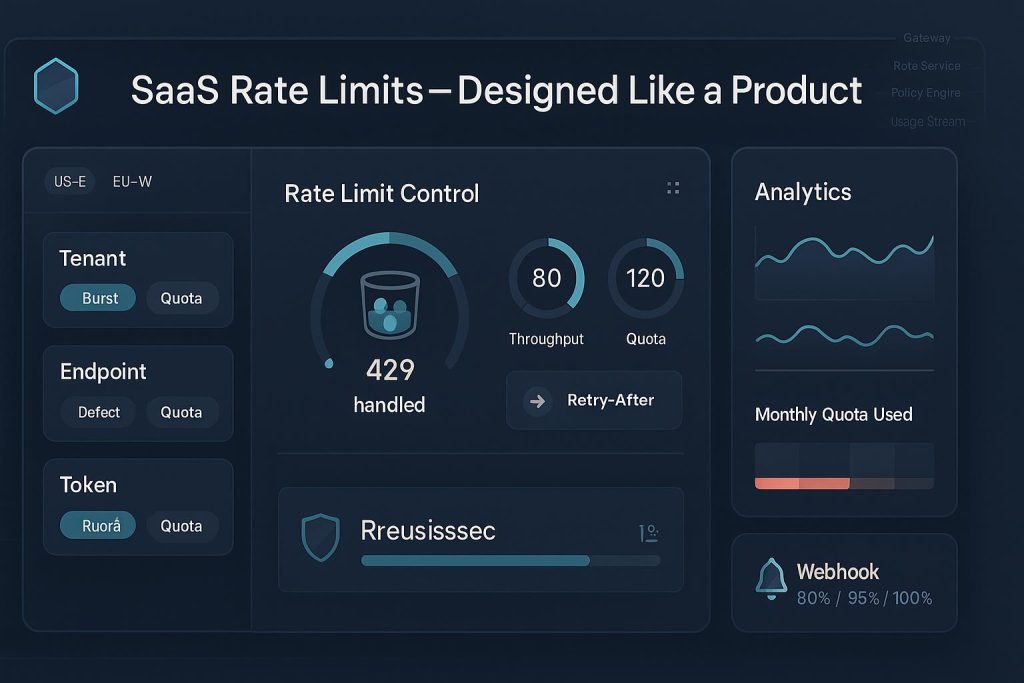
Unrestricted resource consumption is another OWASP category. For data collection platforms, it matters for two reasons. Floods can take the service down, and high ingestion volume costs money when you pay for storage, processing, or third-party calls per event.
Rate limits and quotas do different jobs. Rate limits control how quickly a caller can send requests. Quotas cap total usage over a longer period, usually for billing. Keep them separate in your design so a burst limit doesn’t quietly become a billing rule.
Apply limits at several levels:
- Per key or per token, as the primary control.
- Per project or tenant, so one customer can’t consume shared capacity.
- Per IP address, as a secondary control against simple floods. Be careful here, because many users can share one IP address through carrier networks or corporate networks.
- Per payload, through size and batch limits.
When a caller exceeds a limit, the HTTP 429 “Too Many Requests” status code is the standard response. According to RFC 6585, the response should explain the condition, and it may include a Retry-After header that tells the client how long to wait. The same RFC notes that servers aren’t required to use 429. Under heavy attack, responding to every request can consume the resources you’re trying to protect, so dropping connections or relying on upstream protection may be more appropriate.
That distinction matters. A 429 response helps well-behaved clients slow down, but it doesn’t stop a determined flood. At that scale, protection usually sits in front of your application, through a content delivery network, a web application firewall, or a queue that absorbs spikes.
A rough calculation can help you set starting values. The numbers below are hypothetical and chosen only to show the arithmetic:
Suppose your platform receives 1,000,000 events per day. Spread evenly, that’s about 11.6 events per second (1,000,000 ÷ 86,400). If peak traffic runs at three times the average, the peak is around 35 events per second. A per-key limit of 50 events per second leaves headroom above that peak. A sudden burst of 1,000 events per second from one key would trigger throttling and an alert. Real limits should come from your measured traffic, with room for growth and for launches that spike usage.
Collect less, and keep it for less time
The most effective way to reduce breach damage is to hold less data. Privacy principles point the same way, so the security and compliance goals support each other.
The EU’s General Data Protection Regulation (GDPR) sets out principles that apply directly to collection systems. Personal data must be adequate, relevant, and limited to what’s necessary for its purposes, which is the data minimisation principle in Article 5(1)(c). Data must be collected for specified, explicit, and legitimate purposes, which is purpose limitation under Article 5(1)(b). And data that identifies people should be kept no longer than necessary, under Article 5(1)(e).
In practice, those principles translate into engineering decisions:
- Drop fields at ingestion when no defined purpose needs them. It’s easier to never store a value than to protect it indefinitely.
- Avoid capturing identifiers like full IP addresses or device identifiers unless you need them. When you do need them, consider truncating or pseudonymizing where your purpose allows.
- Define a retention period for each dataset and enforce it with scheduled deletion jobs rather than manual cleanup.
- Build a way to honor deletion requests across primary storage, backups, and downstream systems, and test that it works.
Pseudonymization isn’t the same as anonymization. Under GDPR, pseudonymized data can still count as personal data, because it can be linked back to a person with additional information. Treat hashed or tokenized identifiers with the same care as the originals unless legal review concludes otherwise.
Privacy requirements vary by jurisdiction. US state privacy laws, for example, have their own rules on collection, retention, and consumer rights. This section describes engineering practices that align with those principles. It doesn’t tell you what the law requires for your product, and that answer should come from privacy counsel.
Protect data in transit and at rest
Encryption is a baseline, not a complete strategy.
Require TLS on every endpoint, and reject plain HTTP instead of redirecting it for ingestion. Redirects can leak data or confuse older SDKs. Apply the same standard to traffic between internal services where your architecture allows.
Keep sensitive values out of URLs. Query strings often appear in server logs, proxy logs, analytics tools, and browser history. Send identifiers that must stay private in request bodies or headers instead.
For data at rest, use managed encryption with keys stored in a key management service, and limit which roles can decrypt production data. Keep production data separate from test and development environments, because test copies often have weaker controls.
Encryption has a limit worth stating clearly. If your API decrypts data and returns it to a caller who shouldn’t see it, encryption at rest doesn’t prevent that. Authorization still has to be right.
Guard against server-side request forgery and unsafe third-party data
Some data collection features make your server fetch resources from URLs. Examples include webhook deliveries, importing files from a link, and enriching events with a lookup. Each one creates a risk that OWASP calls server-side request forgery (SSRF). An attacker who can supply a URL may point your server at internal services, cloud metadata endpoints, or other addresses that aren’t reachable from the internet.
Controls that reduce this risk include:
- Allowlisting destination domains wherever the feature allows it.
- Resolving hostnames and blocking private, loopback, and link-local address ranges before connecting. Checking the hostname alone isn’t enough, because a public name can resolve to an internal address.
- Restricting or disabling redirects, since an allowed URL can redirect to a blocked one.
- Setting strict timeouts and size limits on fetched responses.
- Avoiding returning raw response bodies to whoever supplied the URL.
The reverse direction matters too. OWASP’s “unsafe consumption of APIs” category covers the risk of trusting data from third-party APIs more than user input. Enrichment services, partner feeds, and data providers can return malformed or hostile content. Validate their responses with the same schema discipline you apply to incoming events, handle errors and timeouts explicitly, and set size limits. A compromised partner shouldn’t be able to push content through your platform unchecked.
Remove security misconfiguration
OWASP lists security misconfiguration as its own category. It covers settings and defaults rather than application logic, and it’s a frequent finding in real assessments.
Common examples on data platforms include:
- Verbose error responses that expose stack traces or database details.
- Debug endpoints or admin consoles left enabled in production.
- Default credentials on internal tools or databases.
- Overly broad cross-origin resource sharing (CORS) settings, especially ones that let any origin send credentialed requests.
- Missing or inconsistent security headers on API responses.
- Storage buckets or database snapshots with public access.
- Out-of-date dependencies with known vulnerabilities.
Build a baseline configuration for each environment and check it automatically. Infrastructure-as-code templates, configuration scanners, and dependency checks in your continuous integration pipeline catch many of these before deployment. Periodic scanning of production catches drift that code review misses.
Monitor and log without creating a new privacy problem
You need logs to detect abuse and investigate incidents, but logs can become a leak of their own. Log stores are often less protected than the primary database, and they quietly collect data nobody meant to keep.
Log the events that help you detect and investigate problems:
- Authentication failures, grouped by key or source.
- Rate-limit hits and quota exhaustion.
- Schema rejections, recorded as counts and error categories rather than full payloads.
- Export and bulk-read actions, with the identity of the person or system that requested them.
- Key creation, rotation, and revocation.
Avoid logging full request bodies, authorization headers, session tokens, and personal data unless a specific, documented need requires it. Scrub known fields before logs leave the application, and apply retention limits to logs just as you do to primary data.
Alerts should focus on changes that suggest abuse or misuse. Useful examples include a sudden change in volume for a single key, a spike in 4xx errors from one source, or large exports requested outside normal working patterns. Set thresholds from your own traffic baseline rather than generic numbers.
A practical order for tackling these controls
Teams rarely have time to do everything at once, so sequencing matters. The order below addresses the most serious exposure first, though your own threat model may change it.
- Inventory your endpoints. Find every public route, API version, and environment that accepts data. You can’t prioritize what you haven’t listed.
- Separate credential types. Move client code to write-only ingestion keys, move server integrations to protected secrets, and rotate any key with more permission than it needs.
- Fix object-level authorization on read and export paths. Cross-customer exposure is often the most damaging failure, so check every endpoint that returns stored records.
- Enforce strict schemas and field allowlists. Reject unexpected fields and control which fields clients can set.
- Add rate limits, payload caps, and quotas. Start with per-key and per-project limits, then tune them against measured traffic.
- Review outbound requests. Audit webhooks, URL fetches, and third-party calls for SSRF and unsafe consumption.
- Clean up logs and retention. Remove personal data from logs, set retention periods, and build deletion workflows.
- Test and review. Use automated scanning, manual testing of authorization logic, and an external assessment before major launches.
Authorization comes early because read-path failures can affect the most people at once. Schemas and rate limits come after because they reduce exposure but depend on an accurate inventory.
Common mistakes to avoid
- Treating an API key as proof of permission. A key identifies the caller. It doesn’t decide what the caller may do.
- Checking authentication but not ownership. A logged-in user may still be viewing another customer’s records.
- Relying on the interface to hide features. Anyone can send a request directly to an endpoint the interface doesn’t show.
- Limiting by IP address alone. Shared networks make this unreliable in both directions.
- Leaving test endpoints in production. Staging routes often have weaker checks, and some use real data.
- Collecting fields “just in case.” Every stored field becomes something you must protect, disclose, and delete.
- Trusting SDK behavior. Clients can be modified, outdated, or misconfigured, so the server must enforce every rule.
When these recommendations don’t fit
This guidance is built for public-facing collection APIs that handle personal or sensitive data. Other situations call for different trade-offs.
An internal telemetry pipeline that handles non-personal data inside a closed network has a different threat model. Schema enforcement and per-key quotas may still help, but the privacy controls become less central.
Managed platforms shift some responsibilities to the vendor. Before you assume a control is in place, read the provider’s shared responsibility documentation and confirm which controls remain yours.
Strict schemas can break older SDK versions already deployed on users’ devices. Versioning, compatibility windows, and staged rollouts reduce that risk but add maintenance work.
Hashing and tokenization both reduce exposure, but they work differently. Hashing is one-way and may not support later lookups. Tokenization usually requires a secure mapping store. The right choice depends on what the data must support.
Finally, the OWASP API Security Top 10 is an awareness document, not a checklist. The 2023 edition wasn’t built from statistical data the way the main OWASP Top 10 was. At least one security vendor’s analysis suggests reading it as a secure design guide rather than a complete list of tests. Use it to prompt thinking, then test your own system.
Where you need qualified review
Some decisions shouldn’t rest on an article alone. Have privacy counsel review collection purposes, retention periods, consent flows, and cross-border transfers, especially if you handle health, financial, children’s, or precise location data. Have a qualified security engineer or independent firm test your authorization logic, since automated tools handle that poorly. Your engineers can implement most of these controls, but independent review catches flaws that teams tend to miss in their own design.
Frequently asked questions
Is an API key enough to secure a data collection endpoint?
No. An API key identifies the caller, but it doesn’t limit what that caller can do. A secure endpoint also needs scoped permissions, object-level ownership checks, strict input validation, and rate limits. Treat the key as one control among several.
Is it safe to put an ingestion key in a mobile app or website?
It depends on what the key can do. Assume anyone can extract a key from client code. If the key can only send events to a single project, the main exposure is spam and quota use, which rate limits and rotation can contain. If the key can read data, change settings, or reach other projects, it isn’t safe to ship.
Should I rate limit by IP address?
It depends on your traffic. IP-based limits can slow simple floods, but many legitimate users can share one address through carrier networks, offices, or schools. Use per-key and per-project limits as your primary controls, and treat IP limits as a secondary layer.
Should I reject unknown fields or ignore them?
Usually, reject them on ingestion endpoints. Silently accepting unexpected fields can hide SDK bugs and can let clients write to internal fields. If older SDKs send extra data you don’t need, use a versioned schema with a compatibility window rather than turning validation off.
Does the GDPR apply to my platform?
It depends on where your data subjects are and what you do with their data. GDPR’s reach extends beyond organizations based in the EU in some cases. Because the answer depends on specific facts, confirm the scope with privacy counsel.
Does following the OWASP API Security Top 10 make my API secure?
No. The list identifies common risk categories, which makes it a useful starting point. It doesn’t cover every vulnerability in your system, so you still need testing, configuration review, and a clear map of your own data flows.
Conclusion
Securing a data collection platform means controlling who sends data, enforcing ownership on every read, rejecting unexpected input, limiting consumption, and collecting only what you need. Authorization on read and export paths deserves early attention, because cross-customer exposure is often the most damaging failure. Start with an accurate endpoint inventory, then work through credentials, authorization, validation, and limits in that order. Any platform handling personal data, sensitive categories, or cross-border transfers should also get privacy counsel review and independent security testing before launch.
You May Also Like
 Data Security & Privacy
API Gateway Explained: Architecture, Patterns, and How to Choose
 Web Development
10 Best Mobile App Hosting Providers
 Web Development
What Is API Rate Limiting? (A Practical, Simple Guide for Safer, Faster APIs)
 Web Development
REST API vs SOAP API: Differences, Pros & Cons, and Use Cases
 Cybersecurity
What Is Zero Trust Network Access (ZTNA)? How It Works, How It Differs From a VPN, and When to Use It
 Cybersecurity
What Is Netskope? Cloud Security, SASE, and Zero Trust Explained
 Web Development
How Long Does It Take to Code an App?
 Cybersecurity
Is Fanatical Legit and Safe? My Honest Take on Buying Game Keys
 Data Security & Privacy
