

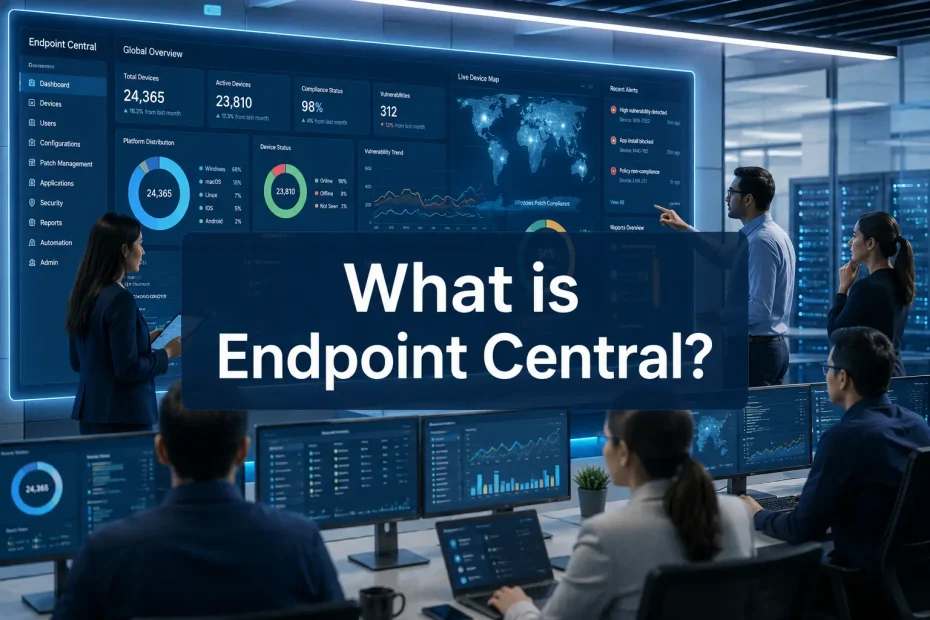
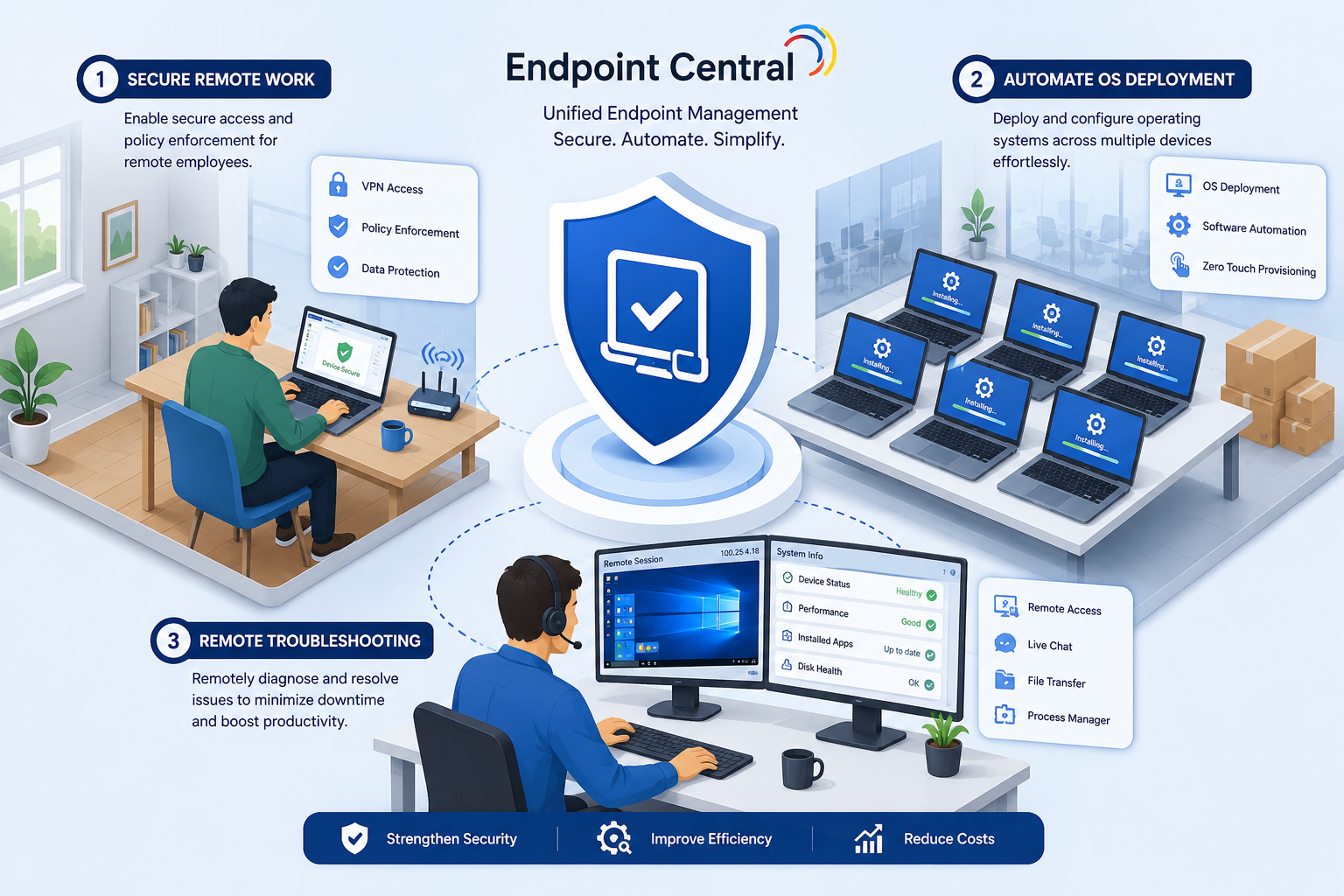
ManageEngine Endpoint Central is a Unified Endpoint Management (UEM) and security software that allows IT administrators to manage and secure servers, desktops, laptops, smartphones, and tablets from a single, centralized console. It streamlines IT operations by automating tasks like patch management, software deployment, and remote troubleshooting across multiple operating systems. Basically, it’s a comprehensive tool designed to give enterprise IT teams complete control over their entire device ecosystem.
Key Takeaways
- Endpoint Central is a Unified Endpoint Management (UEM) solution from ManageEngine.
- It centralizes the management of various endpoint devices, including desktops, laptops, servers, and mobile devices.
- The software supports multiple operating systems like Windows, macOS, Linux, iOS, Android, and Chrome OS.
- Core functions include automated patch management, software deployment, asset management, and remote desktop management.
- It enhances endpoint security through vulnerability management, application control, and device compliance.
- Recent 2026 updates have added advanced security features like Endpoint Detection and Response (EDR) and Secure Private Access.
- A 2025 Forrester study showed that Endpoint Central can deliver a 442% return on investment (ROI) over three years.
- The platform helps manage the entire endpoint lifecycle, from device provisioning and configuration to retirement.
- It is designed for a wide audience, from small and medium-sized businesses (SMBs) to large enterprise organizations and Managed Service Providers (MSPs).
With the average number of connected devices per person continuing to climb, the complexity of managing and securing every endpoint has become a significant challenge for IT departments. Each device, whether it’s a company-owned laptop, a personal smartphone accessing corporate email, or a server in the data center, represents a potential entry point for security threats and a point of failure that can disrupt productivity. This distributed and diverse technology landscape makes traditional, siloed endpoint management tools inefficient and inadequate for the demands of the modern digital workspace and remote workforce management.
This is where a unified approach becomes not just beneficial, but essential. An effective Unified Endpoint Management (UEM) solution aims to solve this problem by providing a single pane of glass for all endpoint administration tasks. What is Endpoint Central? It’s ManageEngine’s answer to this challenge. As a comprehensive UEM software, ManageEngine Endpoint Central combines robust endpoint management with powerful endpoint security features. It offers IT administrators the tools they need for complete endpoint lifecycle management, from initial device provisioning and OS deployment to ongoing maintenance, security patching, and eventual decommissioning, all from one platform. This integration simplifies IT operations, enhances enterprise security, and ensures that all endpoint devices, regardless of their type or location, remain compliant and secure.
What Exactly is ManageEngine Endpoint Central?
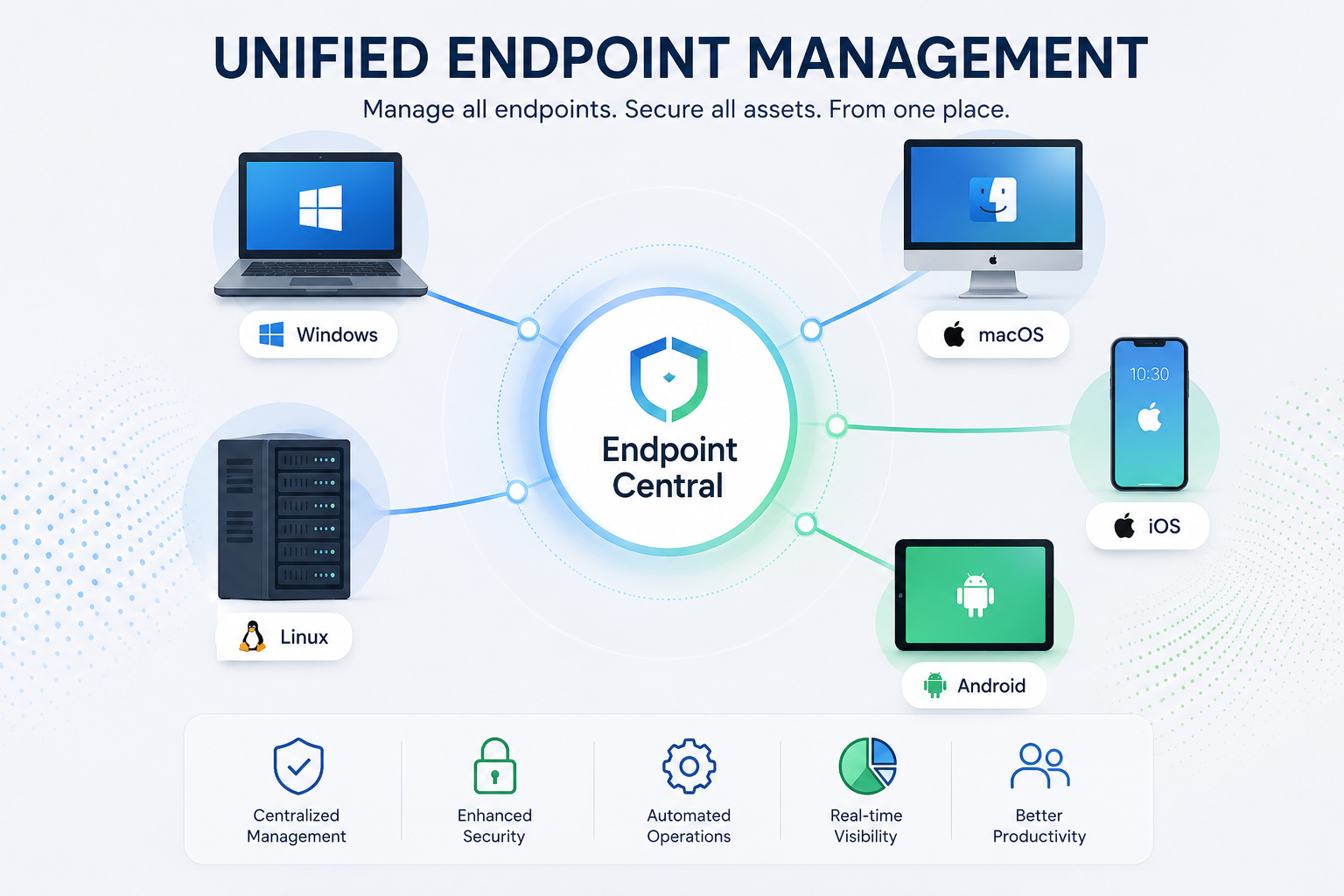
At its core, ManageEngine Endpoint Central is a comprehensive software solution designed for unified endpoint management and security. In other words, it consolidates the tools needed to oversee and control the vast array of endpoint devices used within an organization. This includes everything from traditional desktops and laptops to servers, smartphones, tablets, and even point-of-sale systems. The platform provides a centralized console for IT administration, enabling teams to manage devices running on various operating systems, including Windows, macOS, Linux, iOS, Android, and Chrome OS.
The primary goal of Endpoint Central is to streamline and automate the entire endpoint lifecycle. This begins with zero-touch deployment and device provisioning, allowing IT teams to set up new remote devices for employees with minimal manual intervention. Once deployed, the software facilitates ongoing endpoint configuration management, ensuring that all devices adhere to corporate policies and security standards. This unified approach breaks down the silos that often exist between desktop management, mobile device management (MDM), and server management, creating a more efficient and cohesive IT infrastructure management strategy. By using a single, lightweight agent for both management and security functions, Endpoint Central simplifies endpoint control and reduces the software footprint on each device.
Core Features and Capabilities of Endpoint Central Software
Endpoint Central software is equipped with a wide range of features that address the key challenges of IT endpoint management. These capabilities are designed to automate routine tasks, enhance endpoint protection, and provide deep visibility into the entire device ecosystem. The platform’s modular design allows organizations to implement the functionalities they need most, from basic device management to advanced cybersecurity.
Here are some of the core features that define ManageEngine Endpoint Central:
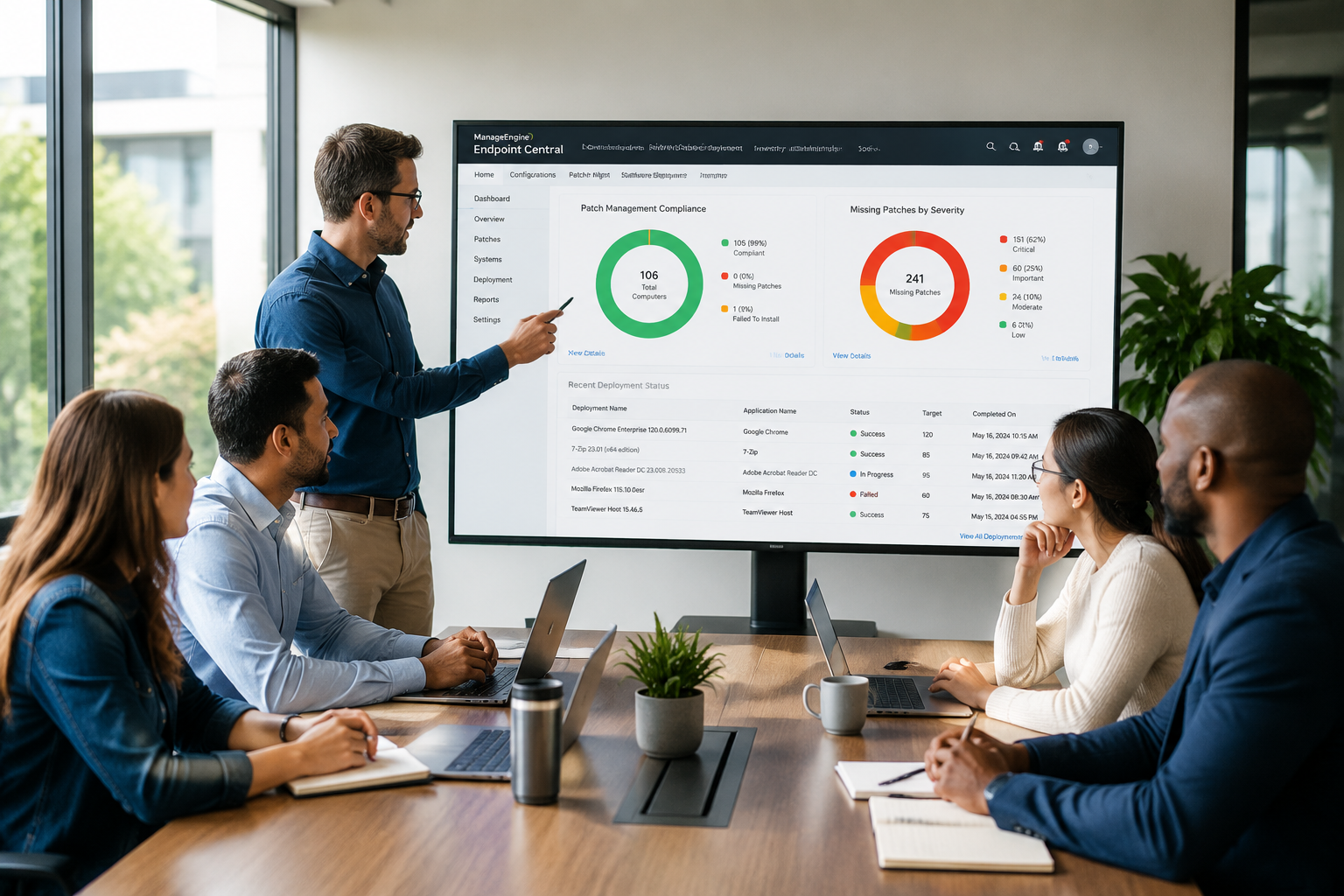
- Automated Patch Management: One of the most critical aspects of endpoint security is keeping software and operating systems up to date. Endpoint Central automates the entire patch management process, from scanning for missing patches to deploying them across Windows, macOS, Linux, and over 1,000 third-party applications. This helps organizations remediate software vulnerabilities quickly and reduce their attack surface.
- Software Deployment and Application Management: The platform simplifies the distribution of software to endpoints. IT administrators can use over 10,000 pre-built templates to deploy applications silently and without user disruption. It also includes a self-service portal, allowing users to install approved applications themselves, which reduces help desk tickets.
- IT Asset Management: Gaining a complete inventory of all hardware and software assets is fundamental to effective IT operations. Endpoint Central provides detailed hardware and software inventory reports, tracks software license compliance, and meters software usage. This helps with IT asset management, enabling better budget planning and preventing compliance issues.
- Remote Troubleshooting: For help desk teams and desktop support technicians, the ability to provide remote assistance is crucial, especially with a distributed workforce. The software includes powerful remote monitoring and management tools that allow for remote control, file transfers, and chat, facilitating quick and efficient remote troubleshooting.
- Mobile Device Management (MDM): Endpoint Central extends its management capabilities to mobile devices. Its MDM features allow administrators to enroll devices, enforce security policies, distribute apps, and remotely lock or wipe devices if they are lost or stolen. This is essential for securing corporate data on both corporate-owned and personal (BYOD) devices.
- Operating System (OS) Deployment: The software automates and standardizes the process of deploying operating systems. IT teams can create a master OS image and deploy it to new computers, which is a key part of device provisioning and significantly reduces the time required for setup.
The Business Benefits of Unified Endpoint Management
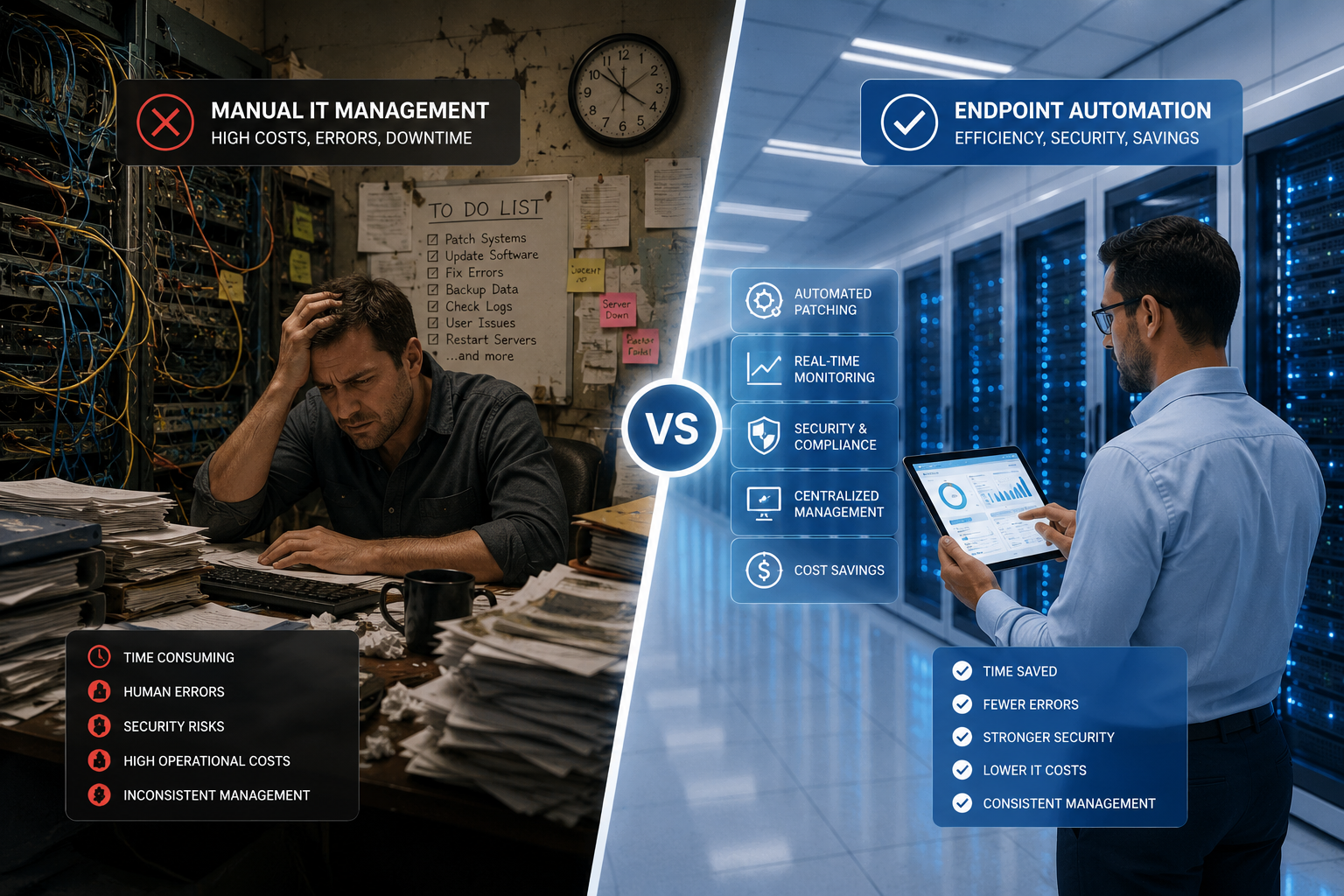
Implementing a solution like ManageEngine Endpoint Central goes beyond simple device management; it delivers tangible business benefits that impact an organization’s bottom line, security posture, and overall operational efficiency. By centralizing endpoint administration, businesses can move from a reactive, fire-fighting approach to a proactive and strategic IT management model. The financial impact can be substantial. A 2025 Total Economic Impact (TEI) study conducted by Forrester Consulting found that a composite organization using Endpoint Central achieved a 442% return on investment (ROI) over three years, with a full payback period of less than six months.
The study highlighted total benefits of $4.5 million over three years, driven by several key advantages:
| Benefit Category | Description |
|---|---|
| Increased IT Administrator Productivity | By automating routine tasks like patching, software deployment, and endpoint configuration, IT teams can save thousands of hours annually. This frees them up to focus on strategic initiatives rather than manual, repetitive work. |
| Improved Endpoint Security | The platform’s integrated vulnerability management and automated security patching significantly reduce the risk of cyberattacks. Proactive threat detection and remediation prevent costly data breaches and system downtime. |
| Reduced IT Costs | Consolidating multiple point solutions for desktop management, MDM, and security into a single UEM platform lowers software licensing and maintenance costs. Furthermore, detailed asset management helps optimize software spending. |
| Enhanced Employee Experience | Faster device provisioning, a self-service portal for applications, and quicker resolution of IT issues lead to a better digital employee experience (DEX). In 2025, ManageEngine even launched a dedicated DEX module to further improve end-user productivity and reduce downtime. |
Ultimately, the goal of enterprise endpoint management is to create a secure, stable, and efficient environment that empowers employees to do their best work. A UEM solution like Endpoint Central provides the necessary endpoint control and IT automation to achieve this, making it a valuable investment for any modern enterprise.
Who is Endpoint Central For? Key Use Cases
ManageEngine Endpoint Central is a versatile device management software designed to serve a broad audience, from small and medium-sized businesses (SMBs) to large, globally distributed enterprise organizations. Its scalability and comprehensive feature set make it suitable for any organization looking to centralize its endpoint administration and bolster its cybersecurity defenses. The primary users are typically IT administrators, system administrators, and cybersecurity professionals who are responsible for the day-to-day management and security of the company’s IT infrastructure.
Here are some of the key use cases and audiences for Endpoint Central:
- Enterprise IT Teams: In large enterprises with thousands of endpoints, Endpoint Central provides the scalability needed for enterprise IT management. It helps enforce uniform policies across the organization, manage a diverse set of devices and operating systems, and ensure compliance with industry regulations. Strict privileged access controls further limit who can make changes across the fleet.
- Managed Service Providers (MSPs): MSPs use Endpoint Central to manage the IT infrastructures of multiple clients from a single console. The platform’s multi-tenant architecture allows them to securely and efficiently provide remote endpoint management services, including patching, monitoring, and support, to their customer base.
- Organizations with Remote Workforces: With the rise of remote work, securing and managing devices outside the traditional office perimeter has become a top priority. Endpoint Central enables remote workforce management by allowing IT teams to deploy policies, distribute software, and provide remote troubleshooting to employees located anywhere in the world.
- Educational Institutions: Schools and universities rely on Endpoint Central for OS deployment in computer labs, deploying educational software to student devices, and managing a mix of desktops, laptops, and tablets across campus.
- Healthcare and Finance: In highly regulated industries like healthcare and finance, endpoint compliance is critical. The software helps enforce strict security policies, manage device configurations to meet standards like HIPAA and PCI DSS, and provide detailed audit logs to prove compliance.
- Small and Medium-Sized Businesses (SMBs): For SMBs with limited IT staff, the automation features of Endpoint Central are a significant benefit, and they reinforce broader efforts around cybersecurity for small businesses. The platform simplifies complex tasks and provides an all-in-one solution for management and security, eliminating the need for multiple disparate tools. This is especially valuable for teams building out endpoint protection for smaller firms with tight budgets.
Recent Innovations: DEX, EDR, and Autonomous Security
The world of cybersecurity and IT management is constantly evolving, and ManageEngine has continued to innovate to meet new challenges. Celebrating its 20th anniversary in 2025, Endpoint Central has a long history of adaptation. Recent updates have focused on enhancing the end-user experience, bolstering threat detection capabilities, and moving towards a more autonomous endpoint security model.
One of the key additions in 2025 was the introduction of Digital Employee Experience (DEX) capabilities. Available as an add-on or a standalone product, the DEX module provides proactive analytics and remediation tools to improve end-user experience by minimizing downtime and resolving issues before they impact productivity.
More recently, in March 2026, ManageEngine announced a significant advancement in the platform’s security offerings by integrating Endpoint Detection and Response (EDR) and Secure Private Access. This update transforms Endpoint Central into a more formidable endpoint protection tool. The EDR functionality uses AI-powered threat detection to identify and respond to sophisticated attacks, while the Secure Private Access feature enables Zero Trust access to corporate applications by verifying device trust before granting entry. This move was recognized by industry analysts, with Endpoint Central being named a Challenger in the 2026 Gartner Magic Quadrant for Endpoint Management Tools.
Furthermore, in late 2025, the cloud version of the platform gained integrated malware protection, adding Next-Generation Antivirus (NGAV) and ransomware defense capabilities. These innovations demonstrate a clear focus on building a comprehensive, security-centric management platform that can autonomously detect, analyze, and remediate threats across the entire endpoint environment, complementing a broader network security strategy.
Conclusion
In 2026, managing a diverse and distributed fleet of endpoint devices is more complex than ever. The modern digital workspace demands a solution that is both powerful and flexible, capable of handling everything from initial device deployment to advanced threat remediation. What is Endpoint Central? It is ManageEngine’s robust and mature answer to this demand, a comprehensive Unified Endpoint Management (UEM) platform that combines deep endpoint management capabilities with an increasingly powerful suite of endpoint security tools.
For IT administrators, cybersecurity professionals, and business leaders, Endpoint Central offers a centralized, automated, and secure way to manage the entire endpoint lifecycle. By streamlining IT operations, reducing costs, and strengthening an organization’s security posture, it provides a clear path to more efficient and effective IT infrastructure management. As evidenced by its continuous innovation in areas like EDR and DEX, Endpoint Central is not just a tool for today’s challenges but a platform positioned to meet the future of enterprise IT.
If your organization is struggling to manage its growing number of endpoints or looking to consolidate its IT management and security tools, exploring a UEM solution like ManageEngine Endpoint Central is a logical next step. Evaluating its features against your specific needs could reveal significant opportunities to improve productivity, reduce risk, and achieve a substantial return on investment.
Frequently Asked Questions (FAQ)
What is ManageEngine Endpoint Central used for?
Endpoint Central is used for unified endpoint management (UEM) and security. It allows IT teams to manage and secure desktops, laptops, servers, and mobile devices from a single console, automating tasks like patching, software deployment, and asset management.
Is Endpoint Central a UEM solution?
Yes, Endpoint Central is a comprehensive Unified Endpoint Management (UEM) solution. It combines traditional desktop management with mobile device management (MDM) and modern security features into a single, integrated platform.
What operating systems does Endpoint Central support?
Endpoint Central supports a wide range of operating systems, including Windows, macOS, Linux, iOS, Android, and Chrome OS, enabling cross-platform device management.
Does Endpoint Central include antivirus?
Yes, the cloud version of Endpoint Central now includes integrated malware protection, featuring Next-Generation Antivirus (NGAV) and ransomware defense capabilities as of a late 2025 update.
What is the difference between Desktop Central and Endpoint Central?
Desktop Central was the original name for the product. ManageEngine rebranded it to Endpoint Central to better reflect its expanded capabilities as a full-fledged Unified Endpoint Management (UEM) solution that manages more than just desktops.
Can Endpoint Central manage mobile devices?
Yes, Endpoint Central includes robust Mobile Device Management (MDM) and Enterprise Mobility Management (EMM) features for managing and securing both iOS and Android smartphones and tablets.
How does Endpoint Central improve security?
It improves security through automated patch management, vulnerability assessment, application control, device compliance enforcement, and, with recent updates, features like Endpoint Detection and Response (EDR) and Next-Generation Antivirus (NGAV).
Is Endpoint Central suitable for small businesses?
Yes, Endpoint Central is scalable and offers different editions, making it suitable for small and medium-sized businesses (SMBs) as well as large enterprises. Its automation features are particularly beneficial for smaller IT teams.
You May Also Like
 Software
9 Best Free Laser Engraver Software Tools in 2026
 Software
When Fixing Bugs Is No Longer Enough: How to Rescue a Failing Software Project
 SaaS
SaaSNotion vs Coda vs ClickUp for Teams: A Field Report From 18 Months
 SaaS
SaaSTrello vs monday.com vs ClickUp: Which Project Management Tool Fits Your Team in 2026?
 SaaS
SaaS8 Best Asana Alternatives in 2026: Free Tools, Top Competitors, and How to Choose
 Software
What is Asana Software? How Businesses Use It for Project Management and Team Collaboration
 Software
10 Best Audio Redaction Software in 2026 (Tested Picks by Use Case)
 SaaS
SaaS10 Best AI Audio Enhancers for Podcasts in 2026 (Reviewed & Compared)
 Software