

Most companies did not choose to have an AI governance problem. It arrived the way most operational debt arrives: one pilot project at a time, across marketing, HR, underwriting, and customer support, each team picking its own tools and writing its own rules, until legal and compliance looked up one day and realized nobody could say with confidence how many models the company was actually running.
That is the situation a growing number of enterprises are in, and the data backs it up. According to IAPP’s AI Governance Profession Report 2025, 77% of surveyed organizations say they are actively building or refining an AI governance program, a figure that climbs to nearly 90% among companies already using AI in production. Ambition, in other words, is not the problem. Execution is. PwC’s 2025 US Responsible AI Survey found that only 33% of business leaders describe their program as fully “embedded” in day-to-day operations, with another 28% calling themselves merely “strategic.” The rest are still writing policy documents while their AI systems are already live.
That gap is exactly what AI contextual governance is built to close. Rather than issuing one master policy and applying it everywhere, contextual governance calibrates rules, review requirements, and technical controls to the specific situation each AI system operates in — its data sensitivity, its business function, its user base, and the regulations that actually apply to it. A marketing chatbot and a loan-underwriting model are both “AI,” but treating them identically either overburdens the chatbot with controls it doesn’t need or leaves the lending model dangerously under-governed. This piece walks through what contextual governance looks like in practice, the pillars that hold it up, a step-by-step path to implementing it, and the mistakes that most commonly derail it.
Key Takeaways
- Context beats uniformity. AI contextual governance sizes controls to the use case, the data involved, and the applicable regulation, instead of applying one rulebook everywhere.
- The gap is real and measurable. 77% of organizations are building AI governance programs, but only about a third describe those programs as fully embedded in daily operations.
- Ungoverned AI has a price tag. IBM’s 2025 Cost of a Data Breach Report found that 63% of breached organizations had no AI governance policy at all, and shadow AI usage added an average of $670,000 to breach costs.
- Five pillars hold the framework up: accountability, transparency, fairness, security, and continuous monitoring — each one calibrated to risk level rather than applied at a flat setting.
- Standards already exist. ISO/IEC 42001, the NIST AI Risk Management Framework, and the EU AI Act all give organizations a structure to build on rather than starting from a blank page.
- Human oversight is not optional. A human-in-the-loop checkpoint remains the backstop for high-stakes AI decisions, no matter how mature the automated controls become.
- Governance that isn’t monitored decays. Stanford HAI’s 2026 AI Index recorded 362 documented AI incidents in 2025, up from 233 the year before — a reminder that a policy on paper is not the same as a control that’s actually enforced.
What AI Contextual Governance Actually Means
Strip away the terminology and contextual governance is a fairly old idea applied to a new problem: match the level of scrutiny to the level of risk. Banks have done this for decades with lending decisions. Hospitals do it with clinical protocols. AI governance is catching up to the same logic, because the alternative — one policy for every model — breaks down fast at scale.
Consider two systems sitting in the same company. The first drafts first-pass copy for social media posts. The second scores loan applicants for creditworthiness. Governing both under an identical checklist wastes effort on the first (nobody needs a fairness audit for ad copy) and dangerously under-serves the second, which touches the Equal Credit Opportunity Act and needs documented bias testing, an explainability layer, and a human reviewer before any adverse decision goes out. Contextual governance is the discipline of recognizing that difference up front and routing each system to the right tier of control, rather than discovering the mismatch during an audit or, worse, a regulatory inquiry.
This is also where risk-tiering frameworks earn their keep. The EU AI Act, which entered into force on August 1, 2024, sorts AI systems into four risk categories — unacceptable, high, limited, and minimal — and scales documentation, testing, and human-oversight requirements to match. Organizations that build their internal governance around a similar risk-tiered structure aren’t just organizing their own house better; they’re pre-positioning themselves for a regulation that already applies extraterritorially to any company serving EU users, with most of its substantive provisions taking effect in August 2026.

The Five Pillars That Hold a Governance Framework Together
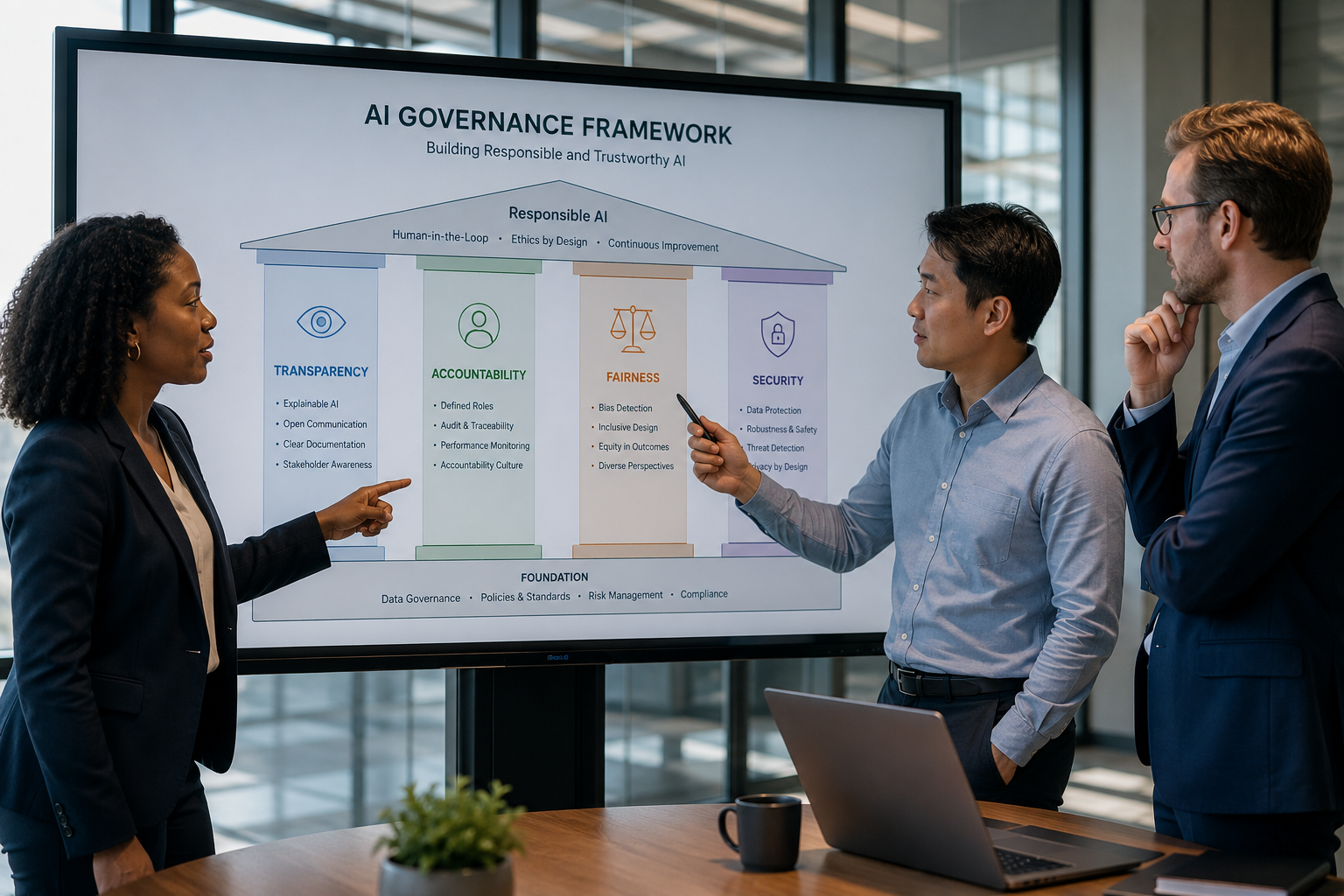
A governance program that exists only as a slide deck doesn’t survive contact with a real incident. The organizations that hold up under pressure tend to have built on the same five load-bearing pillars, each one scaled to context rather than fixed at one setting.
Accountability and ownership. Somebody has to be answerable for a given model’s behavior, and that name needs to be written down before there’s a problem, not discovered afterward in a scramble. This means naming a model owner, defining an escalation path for incidents, and — for higher-risk systems — requiring sign-off from an AI review board before deployment. It also means controlling who can retrain, fine-tune, or reconfigure a production model in the first place, which is really a question of privileged access controls: the fewer people who can quietly change what a model does, the fewer surprises show up in production.
Transparency and explainability. Regulators, auditors, and increasingly customers want to know why a model reached a particular output, not just that it did. For low-stakes systems, a model card and a data-lineage note might be enough. For anything touching credit, employment, insurance, or healthcare, that bar rises to a documented explainability method — SHAP values, counterfactual explanations, or a comparable technique — that a non-technical reviewer can actually follow.
Fairness and bias mitigation. Models trained on historical data inherit the patterns baked into that history, including the discriminatory ones. Contextual governance means testing for disparate impact before launch and at intervals afterward, with the testing rigor scaled to how consequential the decision is. A recommendation engine gets a lighter touch than a hiring-screening tool.
Security and privacy. This pillar has gotten measurably more expensive to ignore. IBM’s 2025 Cost of a Data Breach Report, based on Ponemon Institute research across 600 breached organizations, found that 97% of AI-related breaches involved missing or inadequate access controls, and 63% of the breached organizations had no AI governance policy in place at all. Practically, this pillar covers data privacy and security by design, closing off the software vulnerabilities that let someone tamper with a model or its training data, and applying Zero Trust principles so that access to sensitive training data is never assumed, only verified.
Continuous monitoring. A model that was fair and accurate at launch does not stay that way automatically. Data drifts, user behavior shifts, and edge cases accumulate. Stanford HAI’s 2026 AI Index documented 362 real-world AI incidents in 2025 against 233 the year before — a 55% jump that tracks almost exactly with the pace of adoption, not against it. Continuous monitoring is what catches drift before it becomes an incident, and the same telemetry that flags a misbehaving model usually feeds into whatever process the organization already uses for AI-driven incident management.
A pattern worth watching for: teams that pour their governance budget into pre-launch validation and treat monitoring as an afterthought. A model that passed every fairness test on day one can still drift into biased or inaccurate territory within months if nobody is watching afterward. The pre-launch checklist is necessary. It is not sufficient.
What This Looks Like in Practice: A Worked Example
It helps to see the tiering in action rather than just in the abstract. Picture a mid-size regional bank running three AI systems at once: an internal chatbot that answers employee HR questions, a fraud-detection model that flags suspicious transactions for human review, and a credit-scoring model that feeds directly into loan approval decisions.
Under a flat, one-size-fits-all policy, all three might get the same quarterly review cycle and the same documentation template — which means the HR chatbot eats up review time it doesn’t need, while the credit-scoring model, arguably the one with the most legal and reputational exposure, gets no more scrutiny than a tool answering vacation-day questions.
Under contextual governance, the tiering looks different. The HR chatbot sits in a low-risk tier: light logging, an annual review, no bias testing required because it isn’t making decisions about people, only answering questions. The fraud-detection model sits in a medium tier: quarterly performance review, drift monitoring, and a human analyst confirming every flagged transaction before action is taken. The credit-scoring model sits in the highest tier: documented fairness testing before every model update, mandatory explainability output attached to every adverse decision, a named model owner who reports to the risk committee, and a human underwriter with the authority to override the model’s recommendation. Same organization, three very different governance postures, each one matched to what’s actually at stake.
Implementing Contextual Governance: A Five-Step Path
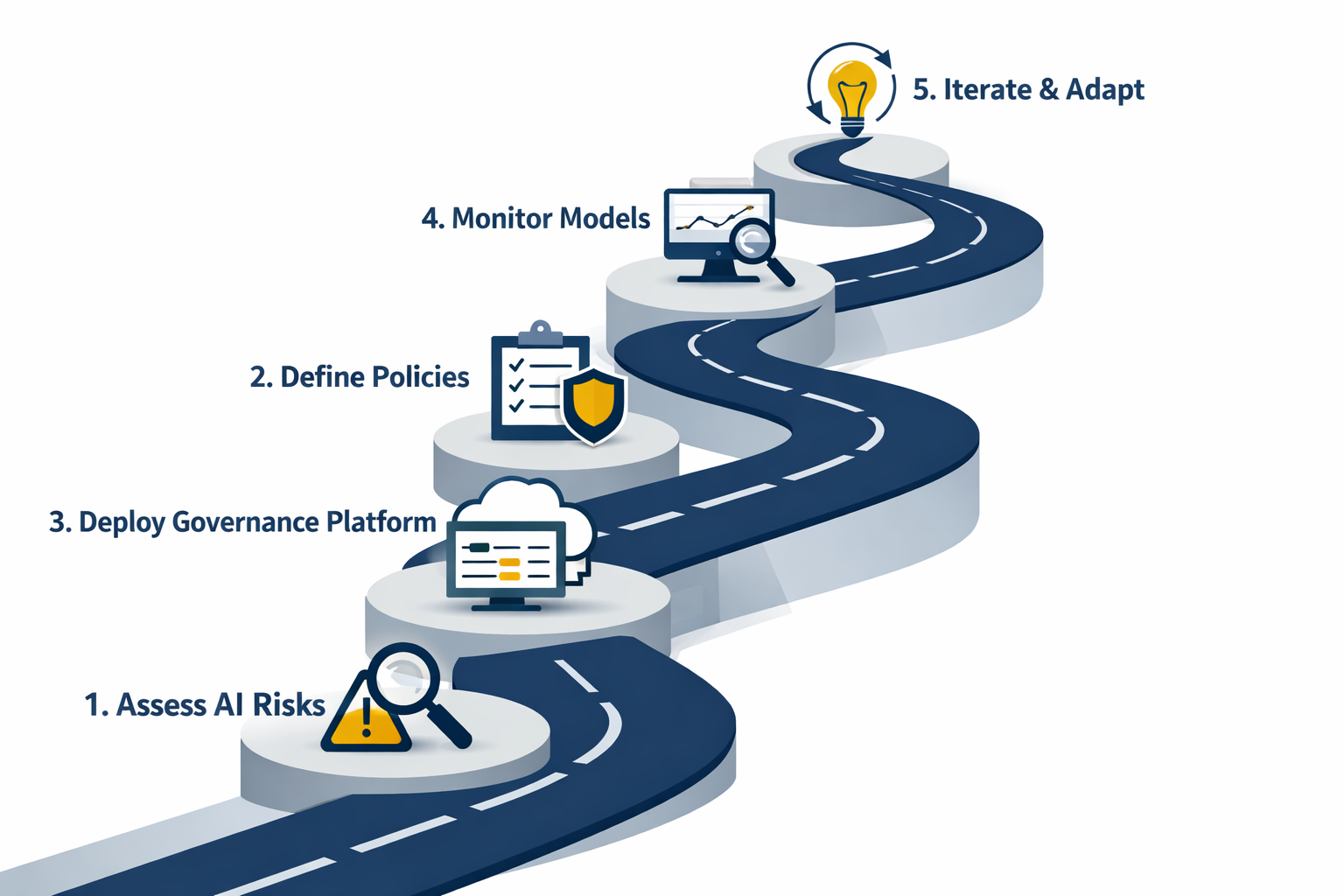
Standing up this kind of tiered framework is a program, not a single project, but it breaks down into five concrete stages.
- Build a cross-functional governance team. Legal, compliance, data science, and the business units that actually use the models all need a seat at the table. A framework designed by data science alone tends to underweight legal exposure; one designed by legal alone tends to be unworkable for the people who have to follow it day to day.
- Inventory every model and assess its risk. You cannot govern what you haven’t counted. This step means cataloging every AI system in production or development — the same discipline behind a formal asset management policy — and scoring each one against factors like data sensitivity, the population it affects, and which regulations touch it.
- Write risk-tiered policies, not one master policy. Use the inventory from step two to sort systems into tiers, then attach a proportionate set of controls to each tier — closer in spirit to how a risk-tiered policy structure works in traditional IT risk management than to a single blanket AI policy. A medical-diagnosis model earns mandatory human review and full explainability documentation; a copy-generation tool earns a lighter check.
- Put tooling behind the policy. Spreadsheets do not scale past a handful of models. A dedicated AI governance platform — whether built in-house or bought — should track the model inventory, automate policy enforcement by tier, log audit trails, and flag drift. Aligning that tooling with ISO/IEC 42001, the first international AI management system standard, or the NIST AI Risk Management Framework‘s Govern-Map-Measure-Manage structure gives the program a recognized backbone instead of a homegrown one nobody outside the company understands.
- Train people, not just systems. A written acceptable use policy does nothing if employees don’t know it exists or don’t understand why the medium-risk model gets more scrutiny than the low-risk one. Recurring, role-specific training — different for engineers than for the underwriters actually using model output — is what makes tiering stick instead of quietly eroding six months after the policy is published.
Traditional vs. Contextual AI Governance
| Feature | Traditional (Static) Governance | Contextual (Adaptive) Governance |
|---|---|---|
| Policy application | One rulebook applied uniformly to every model | Controls scaled to each system’s risk tier |
| Risk assessment | Done once, usually at launch | Ongoing, re-scored as the model or its data changes |
| Scalability | Breaks down past a handful of models | Built to handle hundreds of systems without a linear increase in review effort |
| Effect on speed | Slows every project down equally, including low-risk ones | Frees low-risk projects to move fast while concentrating scrutiny where it’s warranted |
| Regulatory fit | Struggles to map cleanly onto risk-based laws like the EU AI Act | Mirrors the tiered structure regulators already use |
Where This Effort Usually Breaks Down
None of the above is controversial in principle. Most compliance leaders would nod along with every pillar and every step. The friction shows up in execution, and it tends to cluster around five recurring failure points.
The technology moves faster than the policy. A framework written around last year’s chatbot architecture can look outdated by the time a new model class ships. The fix isn’t chasing every new tool with a new rule; it’s anchoring policy to durable principles — explainability, fairness, human oversight — that hold regardless of which specific model generation is in production, then revisiting the specifics on a fixed review cadence rather than an ad hoc one.
Technical and compliance teams don’t speak the same language. Data scientists understand model architecture; compliance teams understand regulatory exposure. Neither group alone can write a policy the other can actually execute. Cross-functional training, run in both directions, closes more of this gap than another policy document ever will.
Tooling is scattered across the AI lifecycle. Different teams building and deploying AI with different toolchains creates blind spots almost by default. Deloitte’s Global Boardroom Program, which surveyed 695 board members and C-suite executives across 56 countries in early 2025, found governance oversight still concentrated unevenly at the top, with visibility gaps compounding wherever tooling isn’t unified. A single governance platform that can see across tools — including basic data loss prevention coverage for the data feeding these models — closes more of that gap than adding another point solution.
Governance gets framed as a cost center, not a value driver. It’s genuinely hard to put a clean number on risk avoided. The more persuasive framing, backed by IBM’s finding that ungoverned shadow AI adds $670,000 to the average breach, is that governance is cheaper than the alternative — and that a documented, risk-tiered process actually accelerates approval of low-risk projects instead of slowing everything down uniformly.
Regulatory complexity outruns any single team’s bandwidth. Between the EU AI Act, sector rules like HIPAA and the Equal Credit Opportunity Act, state-level AI laws in the US, and voluntary frameworks like the NIST Cybersecurity Framework, no compliance team can track all of it by memory. Mapping internal controls once to a recognized external standard — ISO 42001 or the NIST AI RMF — and then cross-referencing new regulations against that existing map is far more sustainable than starting from scratch every time a new law passes.

Knowing Whether It’s Actually Working
A governance program’s real test isn’t the policy document — it’s whether anyone can answer basic questions about it under pressure. Can the team name every high-risk model in production without checking three spreadsheets first? Is there a record of who reviewed the last update to the credit-scoring model, and when? Has monitoring caught drift in the last quarter, or has nobody looked?
A handful of concrete signals tend to separate programs that are working from ones that only look like they are: a current, single-source model inventory rather than one scattered across team wikis; a median time from incident detection to human review measured in hours rather than weeks; and an audit trail complete enough that an external regulator or auditor could reconstruct a decision without help from the engineer who built the model. None of these require exotic tooling. They require the discipline to keep the inventory current and the monitoring turned on — which, per the IBM and Stanford data cited above, is exactly where most organizations are still falling short.
The Bottom Line
The gap between the 77% of organizations building AI governance and the roughly one-third who’ve actually embedded it isn’t a data quality problem or a tooling problem, primarily. It’s a design problem. Flat, one-size-fits-all policies either overburden low-risk projects until people quietly route around them, or under-govern the handful of systems that carry real legal and reputational exposure, and often both at once inside the same organization.
Contextual governance fixes the design, not just the enforcement. It puts the heaviest scrutiny where the risk actually concentrates — credit decisions, hiring, healthcare, anything touching a regulated outcome — while letting lower-stakes projects move at a reasonable pace. Getting there means an honest inventory of what’s already running, tiered policies instead of one master document, tooling that can actually see across the AI lifecycle, and a habit of checking whether monitoring is catching drift before a regulator or a journalist does. None of it is exotic. Most of it is just discipline, applied consistently, to a problem that most companies backed into rather than planned for.
Frequently Asked Questions (FAQ)
What is the main difference between data governance and AI governance?
Data governance is about handling sensitive information correctly — availability, integrity, and security of the data itself. AI governance is broader: it covers the entire model lifecycle, from training data through deployment decisions to what happens when the model is wrong. Data governance is a necessary input to AI governance, not a substitute for it.
Why does “contextual” governance matter more now than it did a few years ago?
Because most enterprises have stopped running one or two AI pilots and started running hundreds of models across different departments and countries at once. A recruiting algorithm and a supply-chain forecasting tool carry entirely different risk profiles; a single static policy applied to both either over-controls the low-risk one or under-controls the high-risk one. Tiering by context is what makes managing that volume tractable.
What is an AI governance framework, concretely?
It’s the documented set of rules, roles, processes, and tools an organization uses to make sure its AI systems are built and used responsibly. In practice that usually means a model inventory, risk-tiered policies, named accountable owners, monitoring processes, and a mapping to an external standard like ISO/IEC 42001 or the NIST AI RMF so the internal framework isn’t reinventing definitions regulators already use.
How does governing generative AI differ from governing a traditional predictive model?
Generative AI introduces failure modes that classic predictive models mostly don’t have — hallucinated facts presented confidently, intellectual property exposure from training data or outputs, and brand-safety risk from unscripted text or image generation. Governance for generative systems typically adds content moderation, source attribution checks, and human review of outputs before anything customer-facing ships, on top of the fairness and monitoring controls a predictive model would already need.
What does a “human-in-the-loop” requirement actually look like day to day?
It means a real person reviews or can override the AI’s output before it takes effect, at least for higher-risk decisions. For a credit model, that’s an underwriter who can decline the model’s recommendation and document why. For a content-moderation model, it’s a reviewer who checks borderline flags before content is removed. The point isn’t to slow every decision down — low-risk outputs can flow through automatically — it’s to guarantee a person is accountable wherever the stakes justify it.
Is there an actual international standard for AI governance, or is it still all internal policy?
There is. ISO/IEC 42001, published in December 2023, is the first certifiable international standard for an AI management system, built on the same Plan-Do-Check-Act structure as ISO 9001 and ISO 27001. It doesn’t replace laws like the EU AI Act, but it gives organizations a recognized, auditable structure to build their internal governance on rather than inventing one from scratch.
What happens if a company just skips this and hopes for the best?
Based on the data above, the honest answer is: it gets expensive. IBM’s 2025 breach research found 63% of breached organizations had no AI governance policy at all, and unmanaged shadow AI added $670,000 to the average breach cost. Stanford HAI’s 2026 AI Index recorded a 55% year-over-year jump in documented AI incidents. Skipping governance doesn’t avoid the cost — it just moves the bill to whenever the first serious incident happens, usually with less control over the timing.
You May Also Like
 SaaS
SaaSWhat Is No-Code Automation? How It Works, Benefits, and Risks
 Web Scraping
TinyFish.ai Review: Is It the Best AI Agent for Web Scraping
 AI Technology
ChatGPT API Alternatives: 13 AI APIs and Platforms for Developers
 Web Development
Building Apps with Lovable and Supabase: A Step-by-Step Guide
 AI Tools
10 Best PDF Extraction APIs for Text, Tables, OCR, and Structured Data
 Web Scraping
What Is AI Web Scraping? A Complete Guide to AI-Powered Data Extraction
 Web Scraping
Scrapy in Python: A Practical Guide to Web Scraping
 AI Tools
15 Best Free AI APIs for Developers: Free Tiers, Credits, and Limits Explained
 AI Technology